Pro XG7 Spectral Purity
展示
Spectral purity plays a critical role in demanding RF and microwave measurements. When a signal source contributes excessive phase noise, amplitude modulation (AM) noise, or broadband noise, the source itself can obscure device-under-test (DUT) behavior and reduce available measurement margin. This demonstration examines these source-noise contributions through a direct comparison of two generations of Keysight Pro XG7 analog signal generators.
The demo compares the new Keysight Pro XG7 with the previous-generation Pro XG7 using a two-channel configuration on the Keysight E5058A SSA-X Signal Source Analyzer. Both signal generators operate under the same basic RF conditions, with a 10 GHz carrier frequency and +10 dBm output power, providing a consistent setup for comparing their spectral purity. The measurement focuses on three areas: phase noise, AM noise, and broadband noise at far-out frequency offsets.
The demonstration begins with a phase-noise comparison. Phase noise close to the carrier and through the pedestal region can affect measurements in which source noise competes with low-level DUT behavior. The side-by-side measurement illustrates the difference between the two signal generators and demonstrates how reducing source phase noise can provide additional measurement margin. This is particularly relevant when characterizing the residual noise of amplifiers and other components, where the test source must be sufficiently clean to avoid limiting the measurement.
The phase-noise measurement also provides visibility into broadband noise performance at far-out offsets. Beyond 30 MHz offset, the new Pro XG7 demonstrates a broadband noise floor of approximately -170 dBc/Hz in the measurement shown. Low broadband noise is important for applications in which integrated wideband source noise can affect the result, including high-speed analog-to-digital converter (ADC) and digital-to-analog converter (DAC) characterization, high-speed SERDES clocking, and wideband error vector magnitude (EVM) measurements. By reducing the source contribution, engineers can more clearly evaluate the noise, jitter, and signal quality associated with the DUT and the surrounding system.
The demo then moves to AM noise. Unwanted amplitude fluctuations from the source can mask low-level behavior in amplifiers, mixers, and other RF components. Using the same two-channel measurement approach, the AM-noise traces provide a direct comparison between the new and previous-generation Pro XG7 platforms. The demonstration shows up to a 20 dB difference between the measured traces, illustrating how lower source AM noise can reduce another potential contribution to measurement uncertainty in applications sensitive to both amplitude and phase fluctuations.
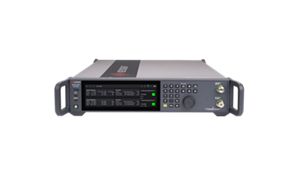
In addition to the spectral-purity measurements, the demonstration briefly examines the updated Pro XG7 platform and measurement setup. The new instrument includes a touch graphical user interface (GUI) for accessing key signal-generation settings from the front panel and uses a smaller instrument form factor. The comparison also illustrates the continuity between generations, including SCPI compatibility mode and familiar rear-panel connections intended to support integration into existing test environments.
Together, the phase-noise, broadband-noise, and AM-noise measurements show why spectral purity must be considered as more than a single specification. Different noise mechanisms can influence different regions of a measurement and different applications. Evaluating them under consistent operating conditions provides a clearer view of how much the signal source itself contributes to the result.
This demonstration shows how the new Pro XG7 advances spectral purity across these noise dimensions while carrying the Pro XG7 platform forward. For engineers working on demanding RF, microwave, satellite, high-speed digital, and advanced wireless measurements, reducing source-contributed noise can help preserve measurement margin and provide greater visibility into the behavior of the device under test.

尋找感興趣的產品?