
N4391C Optical Modulation Analyzer
資料表
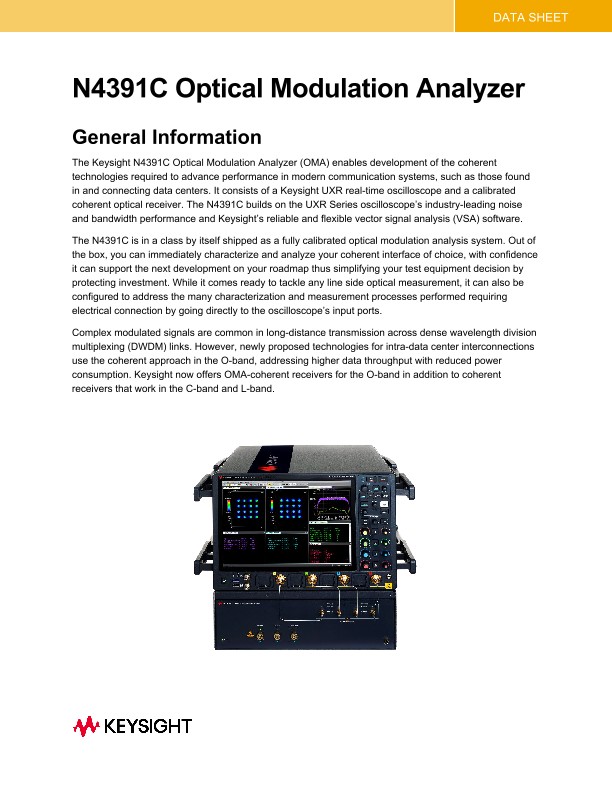
The Keysight N4391C Optical Modulation Analyzer (OMA) enables development of the coherent technologies required to advance performance in modern communication systems, such as those found in and connecting data centers. It consists of a Keysight UXR real-time oscilloscope, a calibrated coherent optical receiver and Keysight’s reliable and flexible Vector Signal Analysis (VSA) software.
The N4391C is shipped as a fully calibrated optical modulation analysis system. Out of the box, you can immediately characterize and analyze your coherent interface of choice, with confidence it can support the next development on your roadmap thus protecting your investment. While it comes ready to tackle any line side optical measurement, it can also be configured to perform electrical characterization and measurement processes by going directly to the oscilloscope’s input ports.
Complex modulated signals are common in long-distance transmission across Dense Wavelength Division Multiplexing (DWDM) links. Also, newly proposed technologies for intra-data center interconnections use the coherent approach in the O-band, addressing higher data throughput with reduced power consumption. Keysight now provides OMA-coherent receivers for the O-band in addition to coherent receivers that work in the C-band and L-band.
The N4391C comes in two configurations based on the RF connector type of the UXR oscilloscope: 1.85 mm and 1.0 mm. It offers C/L-band and O-band variants with factory calibration up to 70 GHz in combination with the 1.85 mm UXR oscilloscope and a C/L-Band variant with factory calibration up to 110 GHz in combination with the 1.0 mm UXR oscilloscope. The OMA system is field upgradable from the purchased frequency up to maximum frequency.
With the new N4391C OMA, optical and electrical bandwidth licensing for the oscilloscope and the OMA itself is independent and independently upgradable. This scheme recognizes that the oscilloscope works in two use models: as part of the OMA system where optical bandwidth is necessary and in standalone oscilloscope operation (OMA optical front-end disconnected) where electrical bandwidth is key. Because the modes are independent, you can enable what your teams need when they need it.