
How Far Can a Radio Signal Travel?
アプリケーションノート
Discussion
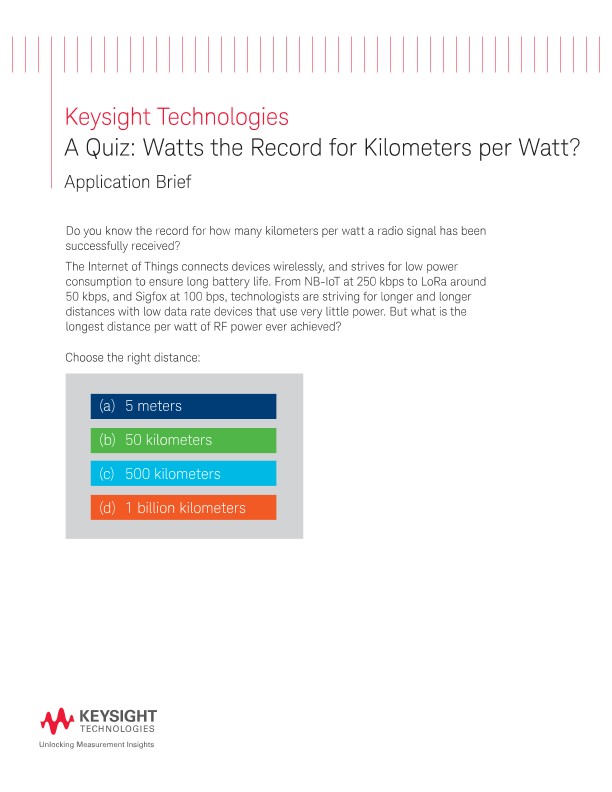
One billion kilometers per watt is a major accomplishment, and was performed by the NASA Voyager Spacecraft, now beyond Pluto and outside the solar system. The signal from its 20-W transmitter can be received by NASA’s large (70-meter) radio antennas on Earth. While terrestrial radio links may not approach this record, your new RF device should still strive for the lowest possible power consumption to accomplish the wireless performance you need.
Standards-based wireless networks are loosely grouped into several categories, including:
- Personal area networks (PAN) with about 10 meters range, such as Bluetooth® and ZigBee® networks
- Wi-Fi (IEEE 802.11 b/g/n/ac) with about 100 meters range
- Low Power Wide Area networks (LPWANs) with ranges in tens of kilometers.
Of course, there are many factors involved: transmitter power, radio frequency, antenna design, signal path, bandwidth, modulation type, receiver sensitivity, signal processing, and the RF environment (path, noise and interference).