
Using Oscilloscopes in Optical Communications Research
アプリケーションノート
Introduction
Using coherent techniques in optical communications
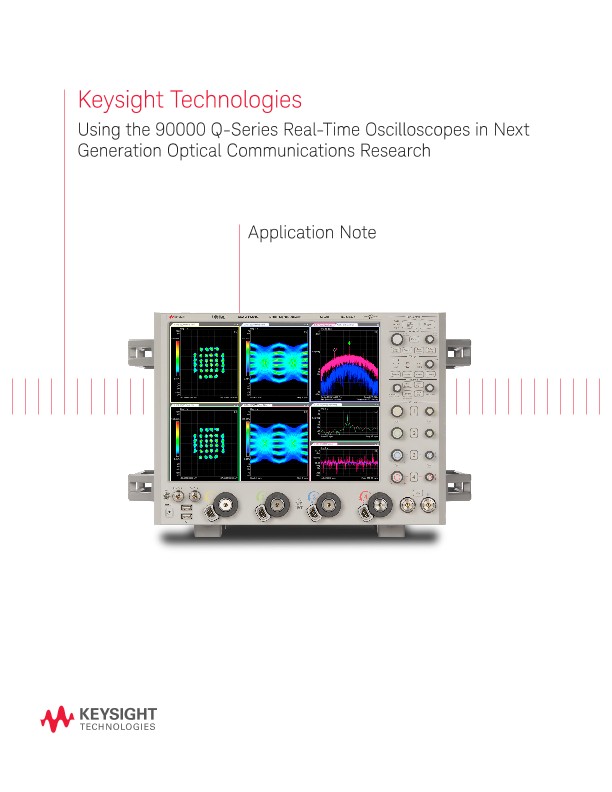
Complex phase modulation is an important method being used to increase the capacity of optical communications links. For many years radio engineers have benefited from this approach and it is now being leveraged into the optical world. Rather than simply turning the light source on and off, phase modulation of the optical carrier is used to transmit digital information. This uses available bandwidth efficiently but comes at the expense of more sophisticated transmitters and receivers compared to NRZ. Test equipment that is designed to display simple NRZ modulated signals do not supply the information needed to validate the performance of transmitters used in a coherent system. Optical transmitter test, historically performed with ‘equivalent time’ sampling oscilloscopes, typically the 86100 digital communications analyzer, requires more than simple eye-diagrams. Instead, constellation diagrams are often used to provide a visual display of communications performance. Waveform acquisition is achieved using a coherent optical receiver followed by a real-time oscilloscope, such as the N4931A optical modulation analyzer system configured with a 90000X or 90000Q.