
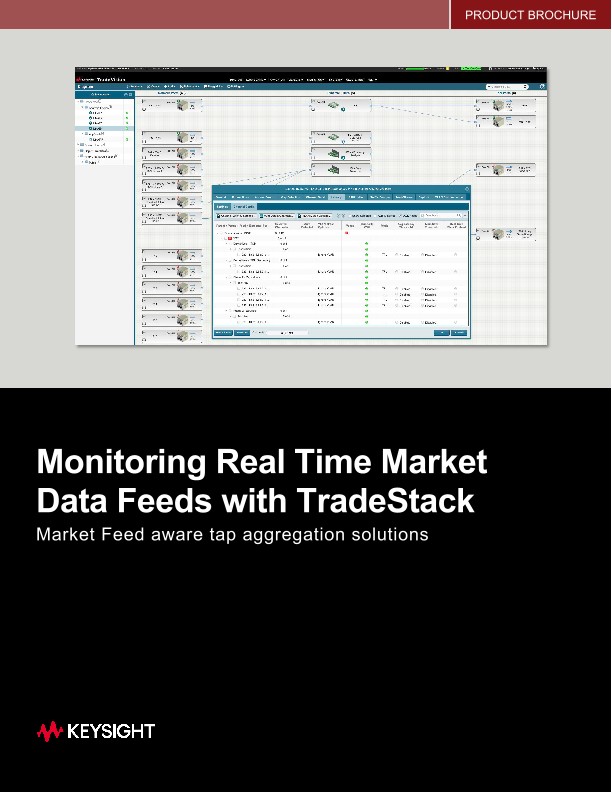
Monitoring Real Time Market Data Feeds with TradeStack
Brochures
Rapidly detecting degradation in the quality of market data feeds is a considerable challenge for any market participant who uses or transports real-time market data. Market data transport technology is primarily based around the use of multicast, which does not have any error correcting mechanisms at the network layer. This means that any packets containing key trade data that have been lost cannot be detected until they are passed through a feed handler system at the end user site.
This creates several challenges:
- Many feed handlers use feed arbitration (between A and B feeds) to autocorrect message drops, so application teams may neither be aware of problems nor quickly pass-on details to their network operations teams.
- Application teams may be aware of the problem, but the tools they use may not be available to the network operations teams who are responsible for diagnosing and resolving the issue.
- Detecting a problem at the feed handler does not tell you where the problem occurred. Was it a problem with the Exchange or Market Data Vendor’s ticker plant? Was it a problem in their internal network? Was there a problem in the third- party network carrier or extranet provider used to transfer the market data? Was there a problem with one or more of the upstream production switches? Or, was the problem in the end user’s internal network?
All these questions lead to slow decision-making, lengthy problem identification and remediation times that can be measured in days and not minutes. Much of the technology used to monitor this infrastructure today is either not up to the task or involves expensive data capture, storage, and analytics technologies that have remained the same for twenty years. These technologies are expensive and consume valuable power and real estate within expensive colocations and data centers.