
M8091CKPA Pre-Compliance Receiver Test Application for IEEE 802-3ck
データシート
Introduction
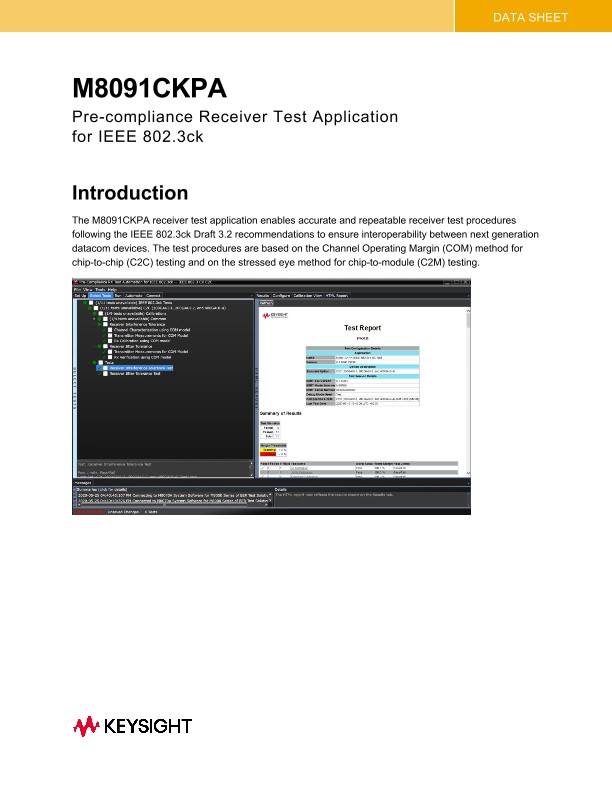
The M8091CKPA receiver test application enables accurate and repeatable receiver test procedures following the IEEE 802.3ck Draft 3.2 recommendations to ensure interoperability between next generation datacom devices. The test procedures are based on the Channel Operating Margin (COM) method for chip-to-chip (C2C) testing and on the stressed eye method for chip-to-module (C2M) testing.
Key Features
• 100GAUI-1, 200GUI-2, 400GAUI-4 C2C and C2M interfaces testing following recommendations from IEEE 802.3ck (Draft 3.2)
Annex 120F Chip-to-Chip (C2C)
o 120F.3.2.4 Receiver Interference Tolerance Test
o 120F.3.2.5 Receiver Jitter Tolerance Test
Annex 120G Chip-to-Module (C2M) Host & Module Input
o 120G.3.3.5 Host Stressed Input Test
o 120G.3.4.3 Module Stressed Input Test
o 120G.3.3.2 & 120.G.3.4.2 Differential Input Voltage Tolerance Test
• C2M test coverage includes near-end and far-end host input test and module input test with high and low-loss channel
• Guided setup, automated stress signal calibration and pre-conformance measurement • HTML test report
• Data Analytics Enabled
• Choose between node-locked, transportable, network, USB-dongle license types either perpetual or subscription with 6/12/24/36-month duration
Description
The M8091CKPA v2.5 electrical receiver test application is designed to assist and simplify the stress signal calibration used for testing the inputs of IEEE 802.3ck Draft 3.2 chip-to-chip (C2C) and chip-tomodule (C2M) electrical interfaces using a Keysight M8040A 64Gbaud Higher Performance BERT and a Keysight Digital Communication Analyzer (DCA) Oscilloscope. It reduces user interaction to a minimum and performs all required calibration routines and compliance testing automatically by remote controlling all required instruments. At the same time, it offers flexibility to test different scenarios within or beyond the standard recommendations.
The test application utilizes the same framework for the graphical user interface like most of Keysight transmitter test applications reducing training time by providing a common look and feel. When a user is required to perform setup changes, the user is guided by diagrams as well as text to minimize errors. Results of the individual calibration steps and tests are presented in tabular form as well as graphical form, where appropriate. Calibrations and test results can be stored in projects and recalled at a later point in time. The application can generate an HTML based test report.
Calibrations and Tests Covered by M8091CKPA
100GAUI-1, 200GAUI-2, 400GAUI-4 C2C (chip-to-chip)
The chip-to-chip C2C test procedures defined on IEEE 802.3ck draft 3.2 Annex 120F rely on the Channel Operating Margin (COM) method1. COM has been first introduced to measure the performance margin of a channel and then extended to digital systems. Interoperability of digital receiver can be expressed in terms of COM requirements. COM is calculated out of channel 4-ports S-parameters (for victim and aggressor lanes) as well as the noise and equalization functionality of the considered transmitter and receiver. The resulting COM metric is the ratio of the signal amplitude (after equalization) to the noise and crosstalk peak-to-peak amplitude measure during a time interval depending on the target BER.