O que você está procurando?
SL1221A Anti-Islanding Conformance Test Automation Software for IEEE 1547.1-2020
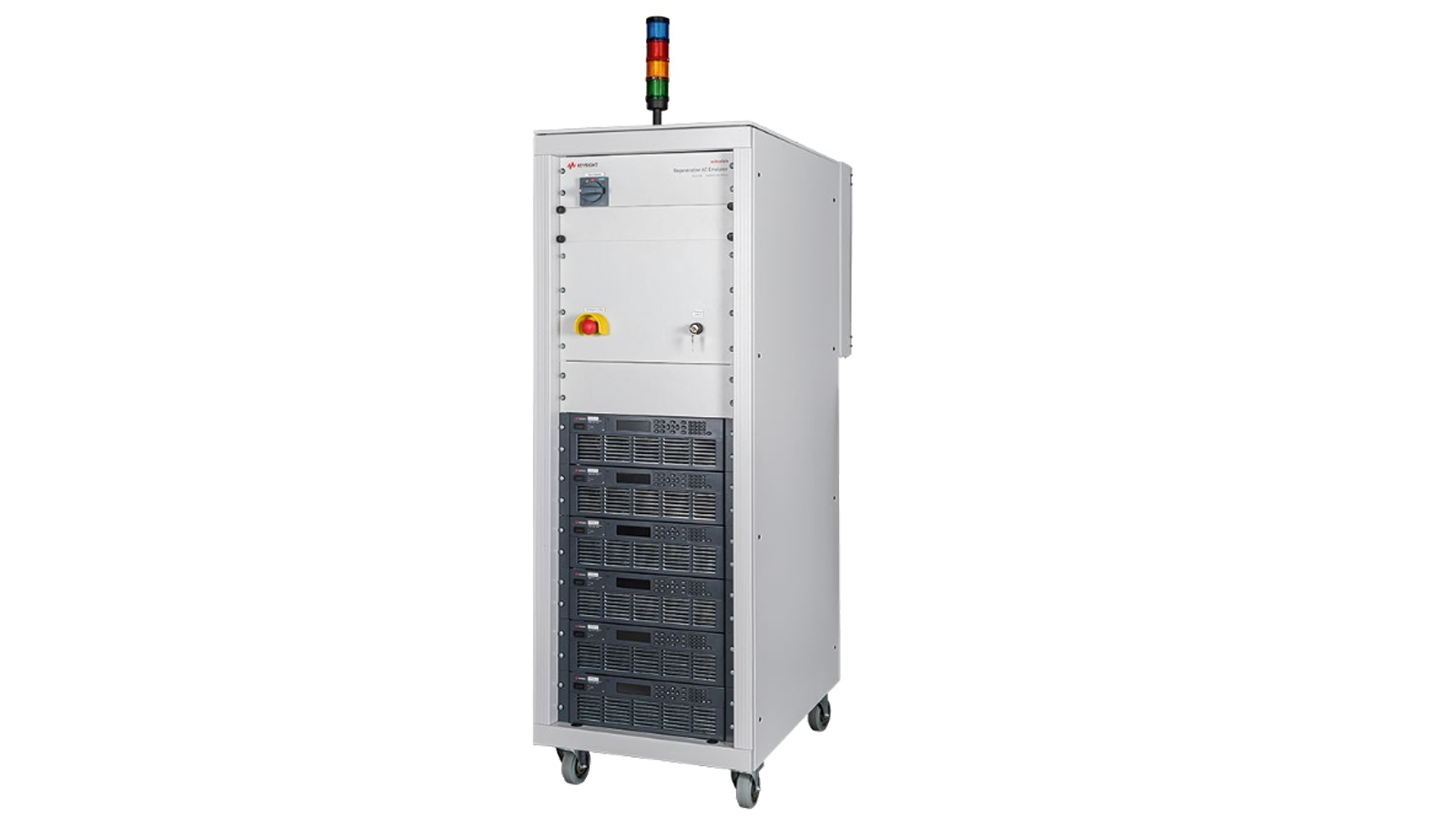
Validate DERs with PHIL grid sim for fast, repeatable grid compliance testing
A partir de
Highlights
PHIL-Based Automated Anti-Islanding Test Solution
As distributed energy resources (DERs) proliferate, ensuring grid stability and safety becomes increasingly critical. Validating the inverter's anti-islanding features and algorithms is vital to ensuring safe operation and compliance with grid codes.
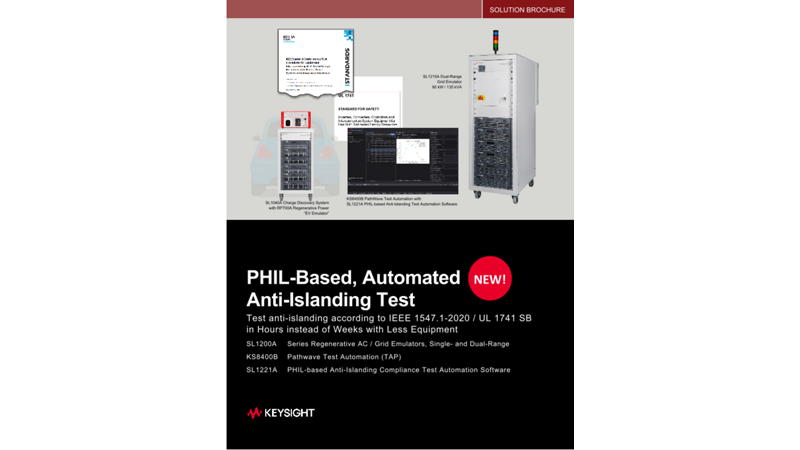
Anti-islanding testing has traditionally been a time-consuming, equipment-intensive process, including manual tuning of a load bank containing resistors, inductors, and capacitors (RLC). The Keysight SL1221A automates anti-islanding testing using real-time simulation and power hardware integration. This approach reduces manual effort, improves repeatability, and accelerates time to certification.
- Automated anti-islanding testing aligned with IEEE 1547.1-2020 / UL 1741 SB standards
- Patent-pending resonant RLC autotuning eliminates manual tuning and reduces test time
- PHIL-based real-time simulation ensures reliable and fast testing
- Compact, integrated test setup reduces lab space and energy consumption
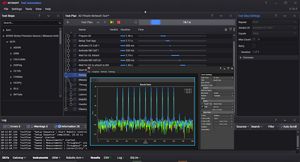
- Seamless software integration with KS8400B PathWave Test Automation for streamlined workflows and reporting
Anti-Islanding Test – Why it is Important and What is Needed?
As DERs, such as solar inverters, Battery Energy Storage Systems (BESS), and V2G-enabled EVs, become more common, ensuring they disconnect safely from the grid during outages is critical. This is where anti-islanding testing plays a vital role.
Why it is important
- Safety First: Unintentional islands can leave parts of the grid energized during outages, posing serious risks to utility workers and the public. Anti-islanding ensures DERs shut down promptly, preventing electric shock hazards and equipment damage.
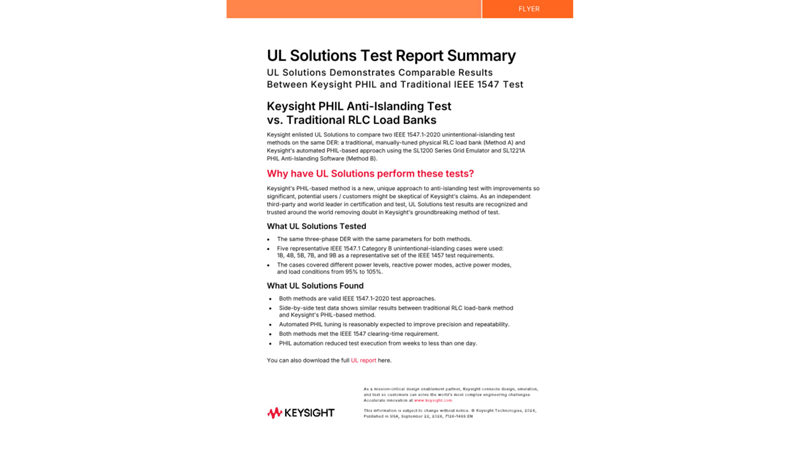
- Grid Code Compliance: Standards like IEEE 1547.1-2020 and UL 1741 SB mandate anti-islanding capabilities for grid-connected DERs. Passing these tests is essential for product certification and market access.
What is needed
- Realistic Grid Simulation: A controllable grid emulator that can simulate disconnecting events and grid conditions.
- Resonant RLC Load Emulation: To replicate the conditions under which islanding might occur, traditionally requiring complex and bulky hardware.
- Automated Test Software: To execute, monitor, and document test sequences in compliance with standards.
- Power Hardware-in-the-Loop (PHIL): Enables real-time interaction between simulated grid conditions and physical DER hardware for accurate, repeatable testing.


Extend the Capabilities of Your SL1221A Anti-Islanding Conformance Test Automation Software for IEEE 1547.1-2020
Featured Resources










Related Products


Want help or have questions?