
Waveguide Design Workflows for Near-Eye Display Systems
技術概要
Augmented Reality (AR) smart glasses rely on advanced optical waveguides to deliver high-quality virtual images while maintaining a compact, lightweight, and comfortable form factor. Designing these systems presents unique engineering challenges, requiring careful consideration of image quality, field of view, brightness, eye box performance, optical efficiency, and manufacturability. Unlike conventional Virtual Reality (VR) systems, which typically use traditional imaging optics such as pancake or Fresnel lenses, waveguide-based AR displays introduce additional complexities associated with light propagation, coupling, and pupil expansion.
This technical overview explores how optical simulation supports the design and evaluation of waveguide-based near-eye display systems. It examines the challenges engineers face when balancing competing performance requirements, including optical losses during in-coupling and out-coupling, image non-uniformity, chromatic artifacts, stray light, ghost images, and brightness limitations that can affect outdoor visibility.
The overview highlights how simulation enables engineers to investigate waveguide behavior before committing to physical prototypes. By modeling light propagation, diffraction effects, image quality, and optical efficiency, designers can identify potential performance limitations and evaluate alternative configurations earlier in development.
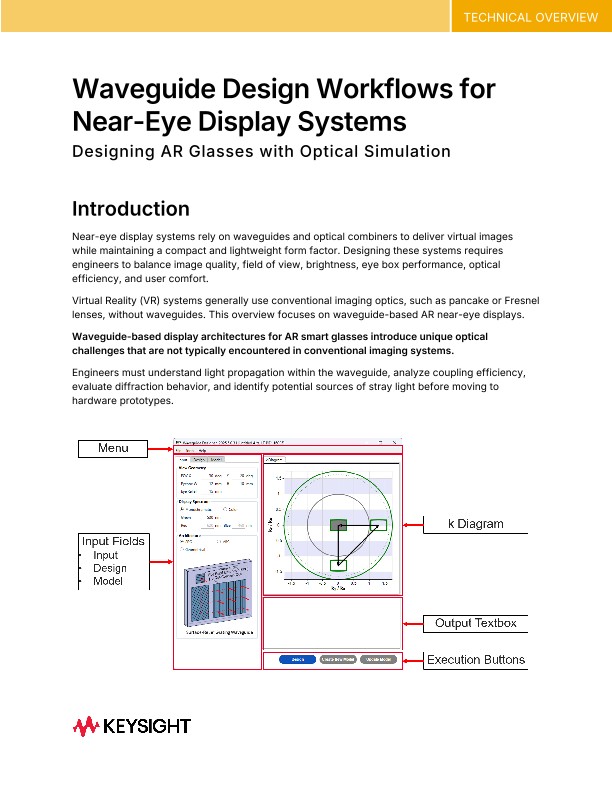
Particular attention is given to advanced analysis techniques such as k-space analysis, which provides insight into allowable light propagation paths, clipping boundaries, coupling behavior, and potential sources of stray light. These capabilities are especially valuable when evaluating geometric and diffractive waveguide architectures, where complex optical interactions can significantly influence overall display performance.
Beyond individual waveguide components, the technical overview emphasizes the importance of connected, system-level design workflows. By bringing together display design, waveguide analysis, optical simulation, stray light evaluation, and overall performance assessment, engineering teams can better understand how design decisions affect the complete near-eye display system.
Explore how simulation-driven workflows help engineers evaluate design tradeoffs, improve confidence in optical performance, reduce development risk, and accelerate the development of advanced AR smart glasses and waveguide-based near-eye display technologies.