
Understanding the Digital-to-Analog Converter
Visão Geral Técnica
PathWave System Design (SystemVue)
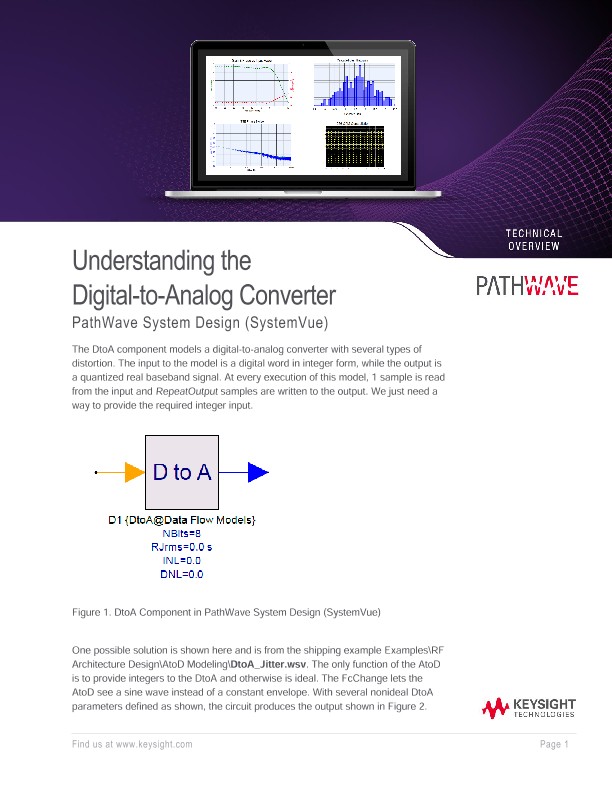
The DtoA component models a digital-to-analog converter with several types of distortion. The input to the model is a digital word in integer form, while the output is a quantized real baseband signal. At every execution of this model, 1 sample is read from the input and RepeatOutput samples are written to the output. We just need a way to provide the required integer input.
One possible solution is shown here and is from the shipping example Examples\RF Architecture Design\AtoD Modeling\DtoA_Jitter.wsv. The only function of the AtoD is to provide integers to the DtoA and otherwise is ideal. The FcChange lets the AtoD see a sine wave instead of a constant envelope. With several nonideal DtoA parameters defined as shown, the circuit produces the output shown in Figure 2.
Using a Direct Digital Synthesizer (DDS)
The Radar Library’s DDS model can drive an DtoA with its integer outputs. As shown in the example Examples\Radar\Signal\DDS_Model.wsv, a Radar_DDS part drives two DtoA’s, one for I and one for Q, to produce both a sine wave and an LFM chirped pulse in two different test benches in that workspace, see Figure 3.
You may want to apply the DtoA output to a circuit inside an RF Link. In that case, one way to handle this is to use an FcChange at both the input and output of the RF Link so that any Sinks capturing the output will show the sine wave representation rather than the envelope representation (which is a constant amplitude waveform).
The FcChange at the input successfully converts the DtoA output to an RF signal to apply to the RF Link. At the RF Link output, which is Envelope centered at 10 GHz in this case, another FcChange lets us look at the signal as a sine wave. To see an envelope signal as a time domain waveform, use an FcChange with OutputFc = 0 Hz.
Now you can put a DtoA into your simulations to create realistic analog signals with impairments like jitter, quantization, noise and spurs. Be sure to consult the examples cited in this solution brief for details on using this versatile and powerful part.