
Resource Guide
What Is Intermodulation Distortion – An Engineers Guide



Introduction
You set up a new 5G base station, expecting flawless performance. But instead of clean signals, nearby users report interference and dropped connections.
After hours of checks, the culprit isn’t faulty hardware or external noise, it’s intermodulation distortion (IMD). Nonlinearities inside amplifiers and connectors have generated extra frequencies that overlap with the signals you need most.
This is the hidden challenge of IMD in RF and audio systems. It doesn’t just reduce signal clarity, it can compromise compliance with industry standards, create costly troubleshooting cycles, and delay product launches. For engineers responsible for system linearity and signal integrity, understanding IMD is essential to building reliable designs.
By learning how to measure and minimize IMD, you can safeguard system performance, reduce the risk of unexpected failures, and strengthen product reputation across industries from telecom and aerospace to automotive and audio.
This guide will take you through the fundamentals of IMD, proven measurement techniques, troubleshooting strategies, and advanced mitigation practices. Along the way, you will see how IMD knowledge applies in real-world applications and how the right test instruments can provide both technical accuracy and long-term value.
Background and Context
Intermodulation distortion happens when two or more signals pass through a nonlinear device and generate additional, unwanted frequencies. These new frequencies, called intermodulation products, often fall close to or within the band of interest, which makes them especially troublesome to remove.
The most critical types are second- and third-order products. Second-order products appear at the sum and difference of the input tones, while third-order products fall much closer to the original signals, creating serious interference in communication channels.
Sources of IMD
Nonlinear components are the primary contributors to IMD. Devices such as mixers, power amplifiers, and variable gain amplifiers introduce nonlinearities when they are pushed outside their ideal operating range. Even small nonlinear effects can produce distortion that grows with signal power and directly impacts system linearity.
It is useful to distinguish between active and passive IMD. Active IMD originates in devices that process or amplify signals. Passive intermodulation (PIM), on the other hand, arises from connectors, cables, and antennas. Factors like poor contacts, surface corrosion, or material defects can cause PIM, and in high-power systems its effects can be as disruptive as active distortion.
Why IMD Matters
The impact of IMD stretches across industries:
- In telecommunications and wireless systems, it reduces channel capacity and masks weak signals.
- In aerospace and automotive radar, IMD affects detection accuracy and safety.
- In high-end audio applications, it reduces fidelity, producing a harsh or muddy sound that degrades listener experience.
Common Misconceptions
A frequent misunderstanding is to confuse harmonic distortion with intermodulation distortion. Harmonics are integer multiples of a single frequency, while IMD results from the interaction of two or more tones. Because IMD products can land very close to the desired signals, they are often harder to filter than harmonics.
Prerequisites
To get the most from this guide, you should be familiar with spectral analysis, signal theory, and test equipment operation. If you need a refresher, review this resource on understanding spectrum analyzers for RF engineers.
Step-by-Step Instructions for Measuring IMD
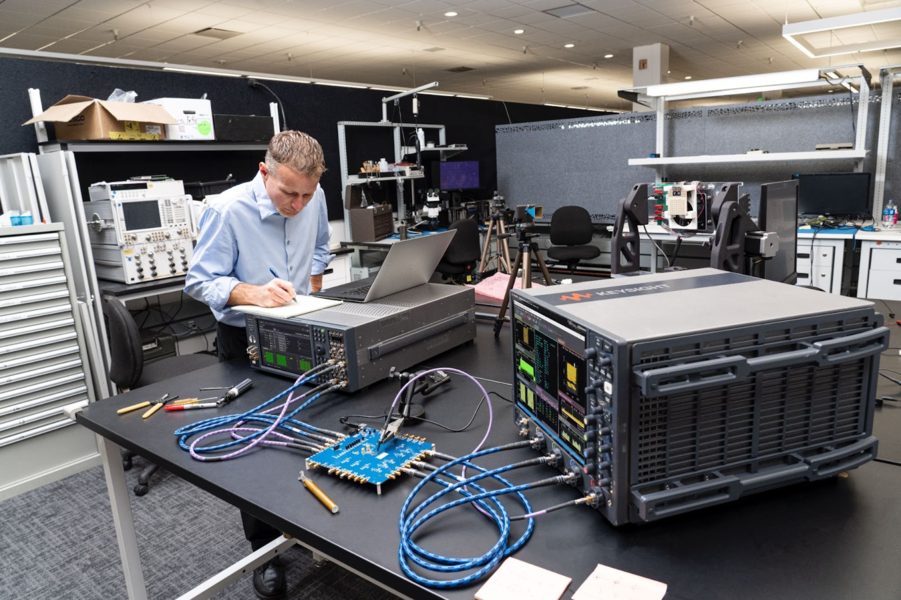
The most widely used method for evaluating intermodulation distortion is the two-tone test. In this approach, two signals at closely spaced frequencies are injected into the device under test. The output is then observed on a spectrum analyzer, which displays both the original signals and any additional distortion products generated by nonlinearities in the DUT.
This method is preferred because it replicates real-world scenarios where systems often handle multiple signals simultaneously. By carefully setting up and executing a two-tone test, you can identify distortion levels, calculate intercept points, and predict device performance in operational conditions.
Step Overview
| Step | Description | Difficulty | Tools Needed | Time Estimate |
|---|---|---|---|---|
| Preparing the Test Setup | Configure signal generators, calibrate, and stabilize tones | Intermediate | Dual-tone capable signal generator, cables, attenuators | 30–45 minutes |
| Performing the Two-Tone Measurement | Inject signals into DUT and configure analyzer settings | Intermediate | Spectrum analyzer, DUT, proper cabling | 30 minutes |
| Analyzing and Calculating IMD Products | Identify IMD sidebands, measure power levels, compute IP3 | Advanced | Spectrum analyzer software, calculation tools | 45–60 minutes |
| Reporting and Documentation | Record results, uncertainty, and prepare reports | Easy | Data capture tools, reporting templates | 20–30 minutes |
Step 1: Preparing the Test Setup
Accurate IMD measurement starts with signal generation. You need a signal generator capable of producing two stable tones with adjustable spacing and power levels. Configure both tones so they are equal in amplitude and set within the DUT’s expected operating range.
Calibration is critical. Poor calibration can introduce spurious signals that look like distortion but are artifacts of the setup. Use precision attenuators, check cable integrity, and ensure connectors are clean to avoid passive intermodulation (PIM).
Expected outcome: Two stable, calibrated tones free of artifacts and ready for injection into the DUT.
Step 2: Performing the Two-Tone Measurement
Connect the output of the signal generator to the DUT input, ensuring proper impedance matching to avoid reflections. The DUT output is then connected to a spectrum analyzer.
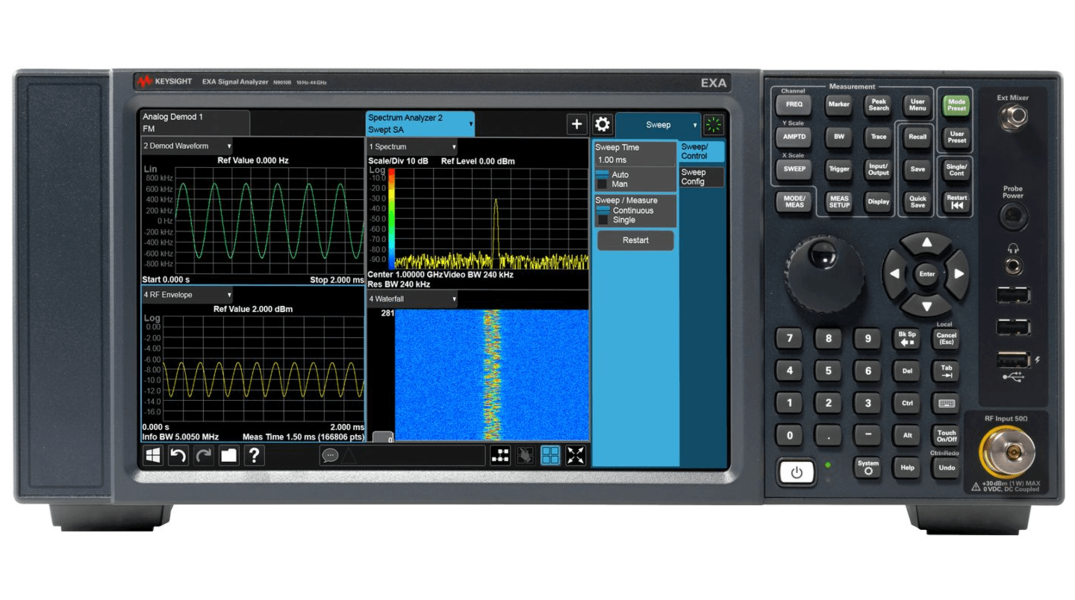
Configure the analyzer with a resolution bandwidth narrow enough to distinguish IMD sidebands but wide enough to capture the two fundamentals. Set appropriate input attenuation to prevent analyzer overload. Typical frequency spacing is in the range of a few kilohertz to several megahertz, depending on the application.
Watch for common pitfalls such as:
- Signal clipping, which produces artificial distortion.
- Environmental noise, which can mask true IMD products.
- Unequal tone levels, which lead to skewed measurements.
Expected outcome: A spectral display showing the two fundamental tones plus visible IMD products on either side.
Step 3: Analyzing and Calculating IMD Products
Once the spectrum is captured, identify the second- and third-order IMD products. Second-order products appear at frequencies such as f1+f2 and f1–f2. Third-order products appear closer to the fundamentals, such as 2f1–f2 and 2f2–f1.
Measure the power of these products relative to the fundamentals, typically expressed in dBc (decibels relative to the carrier). A lower IMD level (e.g., –70 dBc) indicates better linearity than a higher one (e.g., –40 dBc).
You can also calculate the third-order intercept point (IP3), a figure of merit for predicting how a device behaves under higher input levels. Extrapolate the fundamental and third-order product levels to where they would theoretically intersect, that point is the IP3. Higher IP3 values generally mean better linear performance.
Tips:
- Use averaging to reduce measurement noise.
- Compare results against specifications or regulatory limits.
- Consider both relative (dBc) and absolute power levels for full context.
Expected outcome: Quantified IMD levels with computed IP3, providing insight into device linearity and system robustness.
Step 4: Reporting and Documentation
Clear reporting ensures your IMD measurements hold value beyond the lab. Document:
- Test setup conditions, including generator and analyzer settings
- Calibration status and date
- Environmental conditions if relevant
- Measurement uncertainty estimates
Include tables of results, annotated spectral screenshots, and calculated IP3 values. Follow internal or industry reporting standards such as SMPTE IMD or IEC 62037 when applicable.
Expected outcome: A complete, traceable record of IMD measurements that supports audits, compliance checks, and future troubleshooting.
Troubleshooting IMD Measurement Issues
Even with a careful setup, IMD measurements can present challenges. Recognizing common issues and applying corrective steps quickly is essential to ensure valid, repeatable results.
Common Issues
- Unstable signals: Test tones drift in frequency or amplitude, creating inconsistent results.
- Unexpected spurs: Spurious signals appear on the spectrum that may not be true IMD products.
- Noisy baselines: Elevated noise floors obscure weak distortion components.
- Equipment faults: Aging or improperly calibrated instruments add artifacts that resemble IMD.
Stepwise Corrective Actions
- Check cabling and connections: Damaged cables or poor-quality connectors are frequent causes of passive intermodulation. Replace or reseat them to see if the issue resolves.
- Re-check calibration: Confirm that both the signal generator and spectrum analyzer are properly calibrated. A small drift in calibration can introduce misleading distortion products.
- Verify power levels: Overdriving the DUT or analyzer can create artificial clipping that mimics IMD. Reduce levels and retest.
- Isolate environmental interference: Shield sensitive connections, relocate equipment if external noise sources are present, and use averaging or narrower resolution bandwidths where appropriate.
- Cross-check with a different instrument: If anomalies persist, compare results using another analyzer or generator to rule out equipment-specific faults.
When to Escalate
If your results remain ambiguous or inconsistent despite following corrective steps, it may be time to escalate. This could involve:
- Consulting senior RF engineers for a peer review of the setup.
- Contacting the instrument vendor for diagnostic support.
- Requesting a formal recalibration or repair service if equipment behavior appears abnormal.
Troubleshooting IMD requires both technical rigor and process discipline. By addressing the most common root causes first — cables, calibration, and power levels — you can often resolve issues without major delays. However, when problems persist, leveraging expert resources ensures your data remains accurate and reliable, supporting compliance with standards and confidence in system performance.
Advanced Tips and Variations
Once you are comfortable with standard two-tone testing, there are advanced techniques that help improve accuracy, expand measurement scope, and adapt IMD testing to specialized applications.
Increasing Sensitivity and Reducing Noise Floor
The ability to detect very low-level distortion products often depends on minimizing the measurement system’s noise floor. Practical steps include:
- Shielding sensitive components to reduce environmental interference.
- Using averaging or narrower resolution bandwidths on the spectrum analyzer to enhance weak signal visibility.
- Applying low-noise preamplifiers to boost IMD products above the analyzer’s inherent noise level.
These methods allow you to capture distortion products that would otherwise remain hidden.
Alternative Methodologies
While two-tone testing is the standard, there are cases where other approaches provide additional insight:
- Multi-tone testing introduces several tones at once, simulating the complex spectral conditions found in wireless communication systems. It provides a more realistic view of system behavior under load.
- Pulsed IMD testing applies short bursts of tones, useful in radar and satellite applications where devices operate with pulsed signals. This method highlights transient distortion behavior that continuous wave tests may miss.
Customizing for Specialized Devices
Some devices, such as mixers, RF front ends, or highly integrated modules, require adjustments to the test method. Input frequency spacing, power levels, or filtering may need to be tuned to avoid masking IMD products or overloading sensitive stages. In these cases, careful customization ensures results reflect actual performance.
Real-World Applications of IMD Knowledge
Understanding and managing intermodulation distortion directly impacts system performance in critical industries. Engineers apply IMD testing and mitigation techniques in areas such as:
- 5G telecom base stations: Reducing IMD ensures channel clarity and prevents interference between tightly packed frequency bands.
- Automotive radar and communication systems: Lower IMD improves detection accuracy and prevents false targets in driver-assist features.
- High-end audio amplification: Controlling IMD preserves fidelity, delivering clean, transparent sound that meets customer expectations.
- Satellite and aerospace communications: IMD management protects signal integrity where spectrum availability is limited and reliability is mission-critical.
Lessons from the Field
Real-world projects often expose hidden IMD challenges:
- Environmental noise masking low-level distortion.
- Connectors or cables generating passive intermodulation that mimics active device issues.
- System complexity makes it difficult to trace distortion sources.
Effective mitigation requires a combination of careful testing, iterative adjustments, and the right measurement tools. By applying structured IMD testing workflows, teams can diagnose problems faster, improve overall system linearity, and safeguard product reliability.
Additional Resources
Expanding your knowledge of intermodulation distortion goes beyond the lab bench. A variety of tools, references, and communities are available to help engineers refine measurement skills and ensure reliable results.
- Recommended tools and software: Spectrum analyzers with advanced distortion analysis functions, signal generators with two-tone capability, and software packages for automated IP3 calculations can significantly improve test accuracy and repeatability. Keysight also provides calibration services to keep your instruments in peak condition.
- Suggested reading and standards:
- AES17-2020: Defines procedures for intermodulation testing in audio systems.
- IEC 62037-1: A widely adopted standard addressing passive intermodulation (PIM) in RF and telecom equipment.
- IEEE Standard for Intermodulation Distortion Testing: Provides guidance for IMD testing across applications.
- Webinars and expert sessions: Keysight’s advanced IMD webinars offer in-depth guidance on test methodologies, sensitivity improvements, and real-world applications.
- Technical communities and forums: Engaging with peers through IEEE working groups, RF engineering forums, or industry webinars can provide valuable troubleshooting advice and exposure to emerging practices.
By combining the right instruments, trusted standards, and expert communities, you can develop a comprehensive approach to IMD measurement and apply it effectively in your own projects
Quick Reference
IMD Measurement Cheat Sheet
| Step | Key Action | Quick Tip |
|---|---|---|
| Setup | Configure dual-tone signal generator, calibrate, check cables | Use clean connectors to avoid passive intermodulation (PIM). |
| Measurement | Inject tones into DUT, view on spectrum analyzer | Keep tone levels equal and avoid analyzer overload. |
| Analysis | Identify second- and third-order products, calculate IP3 | Record results in dBc for easy comparison. |
| Documentation | Save screenshots, note calibration and uncertainty | Use clear tables and graphs for reports. |
Glossary
- IMD (Intermodulation Distortion): Unwanted signals created when multiple tones pass through a nonlinear device.
- IP3 (Third-Order Intercept Point): Figure of merit predicting distortion performance under load.
- PIM (Passive Intermodulation): Distortion from connectors, cables, or passive components.
- dBc: Power of distortion products relative to carrier.
Conclusion
Intermodulation distortion is a critical factor in the performance of RF, wireless, audio, and communication systems. By understanding how IMD arises, applying proven measurement techniques, and interpreting results with care, you can maintain system reliability and meet demanding industry standards.
The best way to benefit from IMD knowledge is to put it into practice immediately. Begin by auditing your systems for potential IMD risks, refine your testing protocols to capture distortion accurately, and continue tracking new developments in both technology and measurement standards.
If you are ready to strengthen your lab while staying within budget, Keysight’s premium used oscilloscopes, spectrum analyzers, network analyzers, signal generators, and multimeters provide the precision and reliability you need. Every instrument is certified, pre-calibrated, and supported by KeysightCare.
Whenever You’re Ready, Here Are
5 Ways We Can Help You
Call tech support US: +1 800 829-4444
Press #, then 2. Hours: 7am – 5pm MT, Mon– Fri
Contact our sales support team
Create an account to get price alerts and access to exclusive waitlists
Talk to your account manager about your specific needs.
Frequently Asked Questions
Use high-quality connectors and cables, keep contact surfaces clean, and avoid excessive torque or corrosion. Regular inspection and replacement of aging components also help reduce PIM.
Two-tone testing is the industry standard but represents a simplified case. Multi-tone testing better replicates real-world spectral conditions in broadband systems.
At least once a year, or more frequently if instruments are exposed to harsh environments, heavy use, or if results show signs of drift.
Yes. Many modern spectrum analyzers and software tools offer automation features, enabling repeatable, high-throughput IMD testing in manufacturing environments.
Temperature fluctuations, electromagnetic interference, vibration, and even poor grounding can introduce errors or mask weak distortion products.
Use averaging, narrow resolution bandwidths, and reference measurements to distinguish true IMD products from noise and unrelated spurs.
Add two-tone testing early in the validation phase and use consistent procedures across design, QA, and production for reliable comparisons.
IMD products can fall directly into the receiver’s passband, raising the noise floor and reducing the ability to detect weak signals.
Balance performance with budget. Precision instruments reduce troubleshooting time and compliance risk, which often outweighs lower upfront costs of less accurate tools.
Simulation tools provide valuable insights, but physical testing remains essential to capture real-world nonlinearities and environmental effects.