
Ray Tracing Design Kit
Technical Overviews
Abstract
The demand for autonomous vehicles (AVs) and advanced driver assistance systems (ADAS) is causing rapid growth in automotive radar solutions. New frequency ranges and new types of radar signals are changing the capabilities of this safety technology and challenging developers to handle increasingly complicated radar processing. Testing designs with many different complex scenarios is necessary to validate radar algorithm performance. Companies are turning to simulation to manage risk in mission[1]critical applications and to help validate their designs earlier in the design cycle, reducing complex and costly real-world testing.
Solution Details
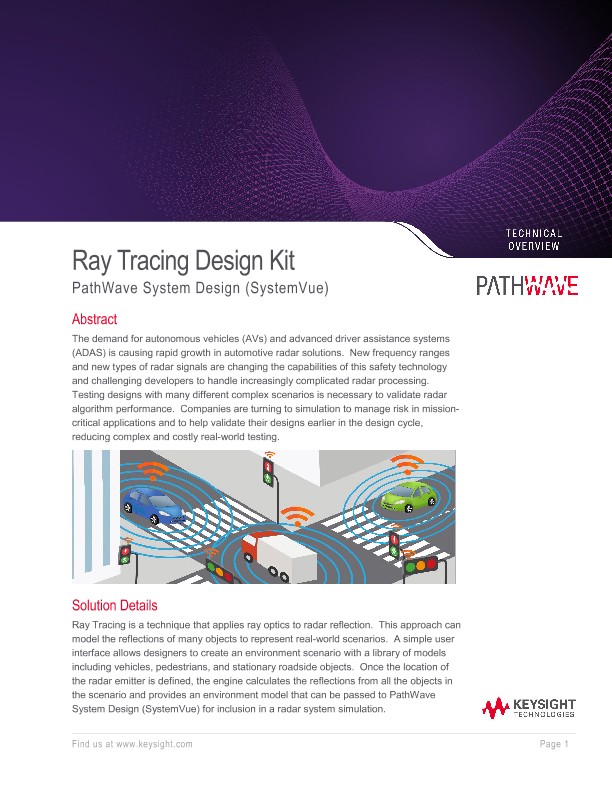
Ray Tracing is a technique that applies ray optics to radar reflection. This approach can model the reflections of many objects to represent real-world scenarios. A simple user interface allows designers to create an environment scenario with a library of models including vehicles, pedestrians, and stationary roadside objects. Once the location of the radar emitter is defined, the engine calculates the reflections from all the objects in the scenario and provides an environment model that can be passed to PathWave System Design (SystemVue) for inclusion in a radar system simulation.
Automotive Scenario Modeling
The Ray Tracing Design Kit offers automotive radar system developers a high-fidelity scenario modeling capability to enhance their current system design flow. The user interface is launched from within PathWave System Design (SystemVue). The tool offers several configurations to trade off accuracy for speed, including overall scenario time, ray density, field of view (FOV) and model fidelity.
Key Technical Features of the Ray Tracing Design Kit
• Shooting and bouncing ray (SBR) based Multiple Ray Tracing (MRT) technique
• Calculates time-varying channel response from a single radar source
• Material properties are used for edge scattering and surface roughness calculations for increased accuracy of complex scenarios
• Library of models for both vehicles, pedestrians, and stationary objects, expandable by import of standard CAD format models by users
• The output of the Ray Tracing Design Kit works in conjunction with the PathWave System Design Automotive Radar Library W1908EP/ET
Automotive Radar Systems in PathWave System Design (SystemVue)
The Ray Tracing Design Kit and Automotive Radar Library are used with the PathWave System Design (SystemVue) simulation platform to integrate RF, baseband, antenna, and environment modelsinto a complete automotive radar system design.
Radar system developers can use digital signal processing (DSP) blocks for automotive radar directly from the library or can add their own DSP through MATLAB code that runs natively in PathWave System Design. Advanced RF models, including behavioral circuit models and antenna models, can also be placed along with the DSP blocks for true system analysis.
To accelerate the product development cycle from simulation to prototype, signals and data from PathWave System Design can be easily uploaded to Keysight instrumentation for use in various testing scenarios. Similarly, test data from real-world measurements can be brought into PathWave System Design for detailed analysis and signal processing for automotive radar systems.
Benefits to Designers Throughout the Automotive Ecosystem
• Chip designers can prove design performance in complex reference scenarios
• Equipment vendors can evaluate chipset offerings from multiple companies
• Baseband designers can test algorithm performance in real-world configurations
• Car manufacturers and OEMs can perform ‘deep dive’ analysis of specific scenarios used in sensor fusion/ virtual test drive simulations