


Title
Charge and discharge cycles, battery performance and life testing
Tech Guide
EV Battery Testing Equipment Guide: Every Layer of the Lab, Mapped

Introduction
The lab plan says cycler, chamber, done. Then the failure review spends an hour on a contactor transient nobody's logger caught, BMS resets that only happen under load, and the budget line that has nothing left for the bench that could have answered both. If you are searching for EV battery testing equipment, you have probably noticed that many results focus on cyclers while skipping the rest of the lab.
This guide gives you the map. It covers every layer of an EV battery test lab, explains which battery test equipment is available certified used from Keysight and which categories are not, and goes deeper on the layer many catalogs skip: the electrical measurement bench. The market momentum makes that planning more important. The IEA's Global EV Outlook reports that EV battery deployment reached 1.2 TWh in 2025, up about 30% in one year and 7 times the 2020 level. As EV battery technology scales, every added gigawatt-hour of energy storage needs validation benches behind it.
Summary
- EV battery test equipment spans six layers across cell, module, and pack testing: cyclers, formation systems, environmental chambers, DAQ, the electrical measurement bench, and BMS/bus test capability.
- The measurement bench exists because of a blind spot: BMS-class logging may sample at 100 ms for voltage and about 10 ms for current, while an uncontrolled DC-link inrush can be over in 50 to 100 µs.
- The recommended oscilloscope for that layer is the Keysight InfiniiVision HD3 (HD304MSO): native 14-bit ADC, about 50 µVRMS noise floor, 3.2 GSa/s sample rate, 200 MHz to 1 GHz bandwidth options, 4 analog plus 16 digital channels, and HD300AUTA decode for CAN/CAN FD/CAN XL/LIN/SENT.
- Beyond the scope, the bench may include the N6781A 2-quadrant SMU for battery drain analysis, the N6705C DC power analyzer, EL34243A-class electronic loads, and DC supplies, all available certified used.
- Certified used direct from Keysight can save 40 to 90% vs new, with up to 5 years of warranty options and calibration documentation available.
Building the measurement layer? Browse the certified used oscilloscopes and the automotive test landing page, and request a quote.
What Is a Mixed Signal Oscilloscope?
An EV battery test lab runs on six layers, but many catalogs focus on just one:
- Charge/discharge cyclers: regenerative, bidirectional power supply systems that run capacity, high-power, and cycle-life profiles
- Formation systems: the initial-charge and aging step, normally upstream at cell plants
- Environmental and cell-isolating chambers: temperature and abuse-condition control
- DAQ and switching: multi-channel voltage and current logging plus cell temperature measurements
- The electrical measurement bench: oscilloscope, SMU, DC power analyzer, electronic loads, supplies
- BMS and bus test capability: decode, simulation, and validation around the battery management system
| Layer | Job | Example equipment class | Available certified used from Keysight |
|---|---|---|---|
| Cycling | Charge and discharge cycles, battery performance and life testing | Regenerative cycler / battery test systems | |
| Formation | Initial charge, SEI formation, grading | Formation and aging system | |
| Environment | Environmental conditions, abuse containment | Temperature chamber / test chamber | |
| Data logging | Long-duration V/I/T records | DAQ + switch | |
| Measurement bench | Transients, ripple, decode, precision source/measure | Oscilloscope, SMU, power analyzer, loads, supplies | Y |
| BMS/bus test | Protocol decode, BMS validation | MSO decode + SMU/simulators | Y |
Layer
Job
Example equipment class
Available certified used from Keysight
Cycling
Title
Regenerative cycler / battery test systems
Regenerative cycler / battery test systems
Title
Formation
Title
Initial charge, SEI formation, grading
Initial charge, SEI formation, grading
Title
Formation and aging system
Formation and aging system
Title
Environment
Title
Environmental conditions, abuse containment
Environmental conditions, abuse containment
Title
Temperature chamber / test chamber
Temperature chamber / test chamber
Title
Data logging
Title
Long-duration V/I/T records
Long-duration V/I/T records
Title
DAQ + switch
DAQ + switch
Title
Measurement bench
Title
Transients, ripple, decode, precision source/measure
Transients, ripple, decode, precision source/measure
Title
Oscilloscope, SMU, power analyzer, loads, supplies
Oscilloscope, SMU, power analyzer, loads, supplies
Title
Y
Y
BMS/bus test
Title
Protocol decode, BMS validation
Protocol decode, BMS validation
Title
MSO decode + SMU/simulators
MSO decode + SMU/simulators
Title
Y
Y
The blank cells are intentional: cyclers, formation systems, and chambers are the capex backbone of the lab, but they are not certified used categories available from Keysight Used Equipment Store. What the store does cover, direct from Keysight and certified used, is the measurement bench and the BMS/bus layer. These are also the two layers many search results do not explain in depth. For the lab-scale lifecycle systems, Keysight Technologies' main site covers electric vehicle battery testing at cell level, module, and pack with lab-scale test solutions; for the wider bench, our 6 instruments every automotive testing lab needs guide is the companion read.
What Do Cyclers, Formation Systems, and Chambers Do?
Cyclers, formation systems, and chambers are the lab's backbone, so here is the neutral 1-minute version. A cycler charges and discharges cells, modules, and packs through programmed profiles, from constant current and constant voltage steps to full drive cycles, while logging voltage and current per channel. Regenerative versions return discharge energy to the grid instead of dissipating it as heat, which can become an efficiency factor at lab scale. Around the cycling core, cell testing may extend to capacity, internal resistance testing (DCIR), self-discharge screening, and electrochemical impedance spectroscopy (EIS), each with its own bench requirements and throughput considerations. Formation systems run the carefully controlled initial charge that forms a new cell's SEI layer, usually inside cell factories. Environmental chambers control the temperatures and conditions that standards require, with cell-isolating versions built for higher-risk abuse tests.
The cycler layer is guided by established public procedures. The USABC battery test procedures manuals maintained at Idaho National Laboratory (current revision INL/EXT-15-34184) define widely used reference performance tests for EV battery labs, from capacity and power characterization to cycle-life profiles.
The procurement reality is that this backbone consumes much of the capital budget and sets the lead-time clock for the buildout, often measured in quarters. That is why the measurement bench, the layer that helps find root causes, often gets squeezed, and why the rest of this guide focuses on pricing that layer certified used. For the large lifecycle systems themselves, the Keysight EV battery testing page covers the lifecycle system classes.
Are You Testing a Vehicle or Building a Lab?
If you are developing or validating cells, modules, packs, or the electronics around them, you are building a lab, and this guide is for you. It covers the measurement bench and the BMS and bus layer that the Official Keysight Used Equipment Store supplies certified used. If you only want to check the battery health of a car, that is a service-tool job that runs through the vehicle's on-board diagnostics (OBD2) route. Our how to test a battery with a multimeter guide covers the hand-tool basics for smaller batteries.
What Do Oscilloscopes Add to an EV Battery Test Setup?
The key gap is time resolution: the logger records milliseconds, while many failures happen in microseconds. Cyclers and DAQ layers are built for long-duration records. The events that delay programs are often short, fast, and small.
The blind spot is measurable. Benchmarking work at RWTH Aachen's ISEA institute (Berger et al., eTransportation, 2024) treats 100 ms sampling as acceptable for battery management system (BMS) cell-voltage channels and about 10 ms as the industrial standard for current. That means battery voltage and current records can be averaged views of faster events. Altran Magnetics' precharge design guide puts an uncontrolled DC-link inrush at 50 to 100 µs at very high current, the class of event that can weld contactors. The event can fit between 2 logger samples with room to spare.
An oscilloscope layer can catch events the cycler's logger may miss:
- Contactor switching and pre-charge transients on the DC link
- BMS brownouts and resets that only appear under load
- Converter switching ripple riding the pack and auxiliary rails
- CAN bus and CAN FD communication faults timed against related electrical events
- Inrush profiles, relay bounce, and weld-precursor behavior
- Intermittent harness faults that scheduled tests may miss
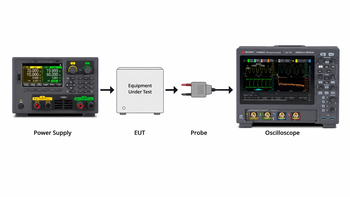
The recommended instrument for this layer is the Keysight InfiniiVision HD3 (HD304MSO): a native 14-bit ADC with 16,384 levels, about 50 µVRMS noise floor at the most sensitive settings, 3.2 GSa/s sample rate, 200 MHz standard bandwidth with license upgrades to 350 MHz, 500 MHz, or 1 GHz, 20 Mpts standard memory with 50/100 Mpts options, 4 analog plus 16 digital channels, and a 1.3 million waveforms-per-second update rate. The HD300AUTA package decodes CAN, CAN FD, CAN XL, LIN, and SENT beside the analog rails, so the bus response and electrical event can land in one capture. Fault Hunter can run unattended for up to 48 hours to log anomalies that are hard to catch manually. Adjacent power-stage work (inverter bring-up, double-pulse testing) lives on the same instrument class; the automotive oscilloscopes glossary frames the wider role.
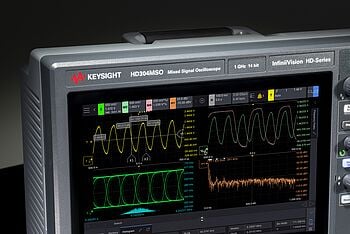
The oscilloscope is a support instrument in an EV battery lab, not the centerpiece. The cycler does the testing; the scope layer explains the failures. Labs that skip it may still see the failures, but they have fewer tools to explain them.
See the InfiniiVision HD3 (HD304MSO) certified used offer and request a quote.
Ready to Close the Logging Blind Spot? See Live Offers
Which EV Measurements Need 14-Bit Resolution?
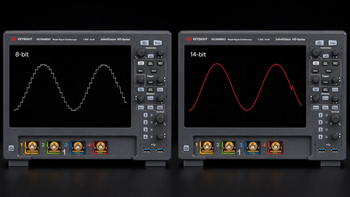
EV electrical measurement often means millivolt signals riding hundred-volt offsets, and that is where low-resolution front ends can struggle.
Leading production battery-management silicon now specifies cell-voltage measurement accuracy of ±1 mV (Texas Instruments BQ79718-Q1, announced January 2023). Peer-reviewed work on LFP chemistry shows why that number matters: a flat open-circuit-voltage curve can turn millivolt-scale bias into larger state-of-charge error (Yi et al., 2024). Validating electronics specified at ±1 mV requires a bench with enough resolution, noise performance, and calibration documentation to support sub-millivolt decisions.
| Measurement | Why it is hard | What helps resolve it |
|---|---|---|
| 48 V rail ripple | mV detail on tens of volts (ISO 21780-class systems) | 14-bit ADC + ~50 µVRMS floor |
| High-voltage bus ripple (400 to 800 V platforms) | mV detail on hundreds of volts, via high-voltage differential probes | 14-bit + probe headroom |
| BMS AFE validation | ±1 mV-class accuracy targets in battery systems | 14-bit resolution + documented calibration |
| Individual cell sense lines | Sub-millivolt noise budgets at cell taps | Low noise floor + proper probing |
| Contactor switching and inrush events | µs timing with fine amplitude detail | 3.2 GSa/s sample rate + deep memory |
Measurement
Why it is hard
What helps resolve it
48 V rail ripple
Title
mV detail on tens of volts (<a href="https://www.iso.org/standard/71607.html">ISO 21780</a>-class systems)
mV detail on tens of volts (<a href="https://www.iso.org/standard/71607.html">ISO 21780</a>-class systems)
Title
14-bit ADC + ~50 µVRMS floor
14-bit ADC + ~50 µVRMS floor
High-voltage bus ripple (400 to 800 V platforms)
Title
mV detail on hundreds of volts, via high-voltage differential probes
mV detail on hundreds of volts, via high-voltage differential probes
Title
14-bit + probe headroom
14-bit + probe headroom
BMS AFE validation
Title
±1 mV-class accuracy targets in battery systems
±1 mV-class accuracy targets in battery systems
Title
14-bit resolution + documented calibration
14-bit resolution + documented calibration
Individual cell sense lines
Title
Sub-millivolt noise budgets at cell taps
Sub-millivolt noise budgets at cell taps
Title
Low noise floor + proper probing
Low noise floor + proper probing
Contactor switching and inrush events
Title
µs timing with fine amplitude detail
µs timing with fine amplitude detail
Title
3.2 GSa/s sample rate + deep memory
3.2 GSa/s sample rate + deep memory
On the 800 V side, the platform trend is documented in the IEEE review by Aghabali et al. (2021): 800 V architectures enable 350 to 400 kW charging and force re-validation across subsystems, which is precisely where the measurement bench earns its slot. For the resolution fundamentals, see the vertical resolution glossary; a dedicated 14-bit oscilloscope buying guide goes deeper on ENOB and noise floors.
What Completes the Electrical Measurement Bench?
One quote can cover the scope, SMU, analyzer, loads, and supplies together because the measurement bench works as a system:
| Instrument | Battery lab job | Example used listing |
|---|---|---|
| Oscilloscope (14-bit MSO) | Transients, ripple, bus decode | InfiniiVision HD3 (HD304MSO) |
| 2-quadrant SMU | Battery drain analysis: sources and sinks like a battery while measuring current from sleep to burst modes | N6781A |
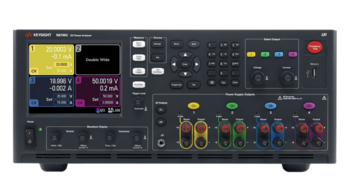
| DC power analyzer | Multi-channel source/measure for BMS boards and fixtures | N6705C |
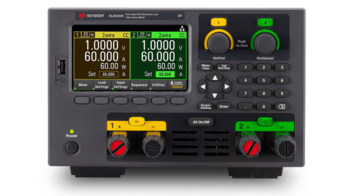
| Electronic load | Converter and charger load steps and soak testing | EL34243A (dual input, 0 to 150 V, 0 to 60 A, 600 W total) |
| DC power supplies | Rails, cell simulation, fixture power | DC power supplies |
Instrument
Battery lab job
Example used listing
Oscilloscope (14-bit MSO)
Title
Transients, ripple, bus decode
Transients, ripple, bus decode
Title
<a href="t3://page?uid=4622">InfiniiVision HD3 (HD304MSO)</a>
<a href="t3://page?uid=4622">InfiniiVision HD3 (HD304MSO)</a>
2-quadrant SMU
Title
Battery drain analysis: sources and sinks like a battery while measuring current from sleep to burst modes
Battery drain analysis: sources and sinks like a battery while measuring current from sleep to burst modes
Title
<a href="t3://page?uid=3734">N6781A</a>
<a href="t3://page?uid=3734">N6781A</a>
DC power analyzer
Title
Multi-channel source/measure for BMS boards and fixtures
Multi-channel source/measure for BMS boards and fixtures
Title
<a href="t3://page?uid=3730">N6705C</a>
<a href="t3://page?uid=3730">N6705C</a>
Electronic load
Title
Converter and charger load steps and soak testing
Converter and charger load steps and soak testing
Title
<a href="t3://page?uid=3738">EL34243A (dual input, 0 to 150 V, 0 to 60 A, 600 W total)</a>
<a href="t3://page?uid=3738">EL34243A (dual input, 0 to 150 V, 0 to 60 A, 600 W total)</a>
DC power supplies
Title
Rails, cell simulation, fixture power
Rails, cell simulation, fixture power
Title
<a href="t3://page?uid=4110">DC power supplies</a>
<a href="t3://page?uid=4110">DC power supplies</a>
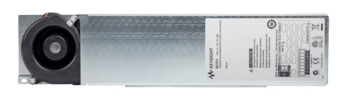
The N6781A is built for battery drain analysis, with 2-quadrant operation that can source and sink current while measuring device behavior across sleep, active, and burst modes. The N6705C puts up to four source/measure slots in one mainframe for BMS board bring-up, a bench class many equipment lists do not mention. The smaller EL34143A covers 350 W bench loads, and the power supplies hub carries the wider range.
You can quote the bench in one request. List the oscilloscope, SMU, analyzer, loads, and supplies, and our team can price the configuration together, confirm the installed options on each unit, and align the calibration documentation for your quality file. One supplier, one purchase order, one delivery window.
Pricing the layer? Browse the certified used inventory and request a quote on the full bench.
Which Test Standards Drive EV Battery Labs?
Standards define what must be tested at the cell, module, pack, and vehicle levels. The lab plan turns those requirements into equipment choices. Every row below resolves to its issuing body (verified July 2026):
| Standard | Level / scope | What it means for equipment |
|---|---|---|
| UN 38.3 | Transport: tests T.1 to T.8 (altitude, thermal, vibration, shock, short circuit, impact, overcharge, forced discharge) | Chambers, shakers, cyclers; logging for evidence |
| IEC 62660-1:2018 | Cell performance and life for EV propulsion | Cyclers + chambers, long-duration logging |
| IEC 62660-2:2018 | Cell reliability and abuse | Isolating chambers, instrumented abuse rigs |
| ISO 12405-4:2018 | Battery pack/system performance test spec (high-power and high-energy applications) | Pack-scale cyclers, DAQ, bench verification |
| SAE J2464 (2021) | Electric and hybrid vehicle rechargeable energy storage system (RESS) abuse testing practice, cell to pack; deliberately sets no pass/fail criteria | Abuse rigs + high-fidelity capture of events |
| UN GTR No. 20 / UN GTR No. 20 | Vehicle level: electric power train requirements including REESS (R100 Annex 9; phased from Sept 2023) | Vehicle-level test capability, evidence records |
| UL 2580 | Pack/module abuse standard; does not evaluate performance | Abuse test capability + documentation |
Standard
Level / scope
What it means for equipment
<a href="https://unece.org/fileadmin/DAM/trans/danger/publi/manual/Manual%20Rev5%20Section%2038-3.pdf">UN 38.3</a>
Title
Transport: tests T.1 to T.8 (altitude, thermal, vibration, shock, short circuit, impact, overcharge, forced discharge)
Transport: tests T.1 to T.8 (altitude, thermal, vibration, shock, short circuit, impact, overcharge, forced discharge)
Title
Chambers, shakers, cyclers; logging for evidence
Chambers, shakers, cyclers; logging for evidence
<a href="https://webstore.iec.ch/en/publication/28965">IEC 62660-1:2018</a>
Title
Cell performance and life for EV propulsion
Cell performance and life for EV propulsion
Title
Cyclers + chambers, long-duration logging
Cyclers + chambers, long-duration logging
<a href="https://webstore.iec.ch/en/publication/27387">IEC 62660-2:2018</a>
Title
Cell reliability and abuse
Cell reliability and abuse
Title
Isolating chambers, instrumented abuse rigs
Isolating chambers, instrumented abuse rigs
<a href="https://www.iso.org/standard/71407.html">ISO 12405-4:2018</a>
Title
Battery pack/system performance test spec (high-power and high-energy applications)
Battery pack/system performance test spec (high-power and high-energy applications)
Title
Pack-scale cyclers, DAQ, bench verification
Pack-scale cyclers, DAQ, bench verification
<a href="https://saemobilus.sae.org/standards/j2464_202108-electric-hybrid-electric-vehicle-rechargeable-energy-storage-system-ress-safety-abuse-testing">SAE J2464 (2021)</a>
Title
Electric and hybrid vehicle rechargeable energy storage system (RESS) abuse testing practice, cell to pack; deliberately sets no pass/fail criteria
Electric and hybrid vehicle rechargeable energy storage system (RESS) abuse testing practice, cell to pack; deliberately sets no pass/fail criteria
Title
Abuse rigs + high-fidelity capture of events
Abuse rigs + high-fidelity capture of events
<a href="https://www.unece.org/fileadmin/DAM/trans/main/wp29/wp29wgs/wp29gen/wp29registry/ECE-TRANS-180a20e.pdf">UN GTR No. 20</a> / <a href="https://unece.org/sites/default/files/2024-01/R0100r3e.pdf">UN GTR No. 20</a>
Title
Vehicle level: electric power train requirements including REESS (R100 Annex 9; phased from Sept 2023)
Vehicle level: electric power train requirements including REESS (R100 Annex 9; phased from Sept 2023)
Title
Vehicle-level test capability, evidence records
Vehicle-level test capability, evidence records
<a href="https://www.shopulstandards.com/ProductDetail.aspx?productId=UL2580">UL 2580</a>
Title
Pack/module abuse standard; does not evaluate performance
Pack/module abuse standard; does not evaluate performance
Title
Abuse test capability + documentation
Abuse test capability + documentation
Two honesty notes the listicles skip: SAE J2464 is a Recommended Practice that does not set pass/fail criteria, and UL 2580 does not evaluate performance. Neither replaces the performance standards beside them. Across all rows, the common requirement is evidence: instrument records supported by documentation. That is where a bench with current calibration certificates becomes more than a nice-to-have.
What Does the Measurement Layer Cost?
Cyclers and chambers set much of the capex, but the measurement bench is where certified used options can make the budget go further. Certified used instruments bought direct from Keysight can save 40 to 90% versus new list, with additional online, education, and research discounts available when eligible. Certified used units can include calibration documentation and up to 5 years of warranty options. Keysight Premium Used instruments pass a final 101-point quality check, remanufactured by Keysight with the same final test as new: all the same, except for the price. KeysightCare support can back the bench, and downtime belongs in the cost file. Keysight notes that 78% of customers lose more than $25,000 a day when equipment fails.
| Ownership path | What you get | What to check |
|---|---|---|
| New instruments | New instruments Current list price, full factory coverage | Budget approval timeline |
| Certified used | 40 to 90% savings, up to 5 years warranty options | Stock and configuration per listing |
| Keysight Premium Used | Remanufactured by Keysight, same final test as new | When audit documentation matters |
| Rental | Short-term coverage | Configuration risk; see buy vs rent |
Ownership path
What you get
What to check
New instruments
Title
New instruments Current list price, full factory coverage
New instruments Current list price, full factory coverage
Title
Budget approval timeline
Budget approval timeline
Certified used
Title
40 to 90% savings, up to 5 years warranty options
40 to 90% savings, up to 5 years warranty options
Title
Stock and configuration per listing
Stock and configuration per listing
Keysight Premium Used
Title
Remanufactured by Keysight, same final test as new
Remanufactured by Keysight, same final test as new
Title
When audit documentation matters
When audit documentation matters
Rental
Title
Short-term coverage
Short-term coverage
Title
Configuration risk; see <a href="t3://page?uid=3771">buy vs rent</a>
Configuration risk; see <a href="t3://page?uid=3771">buy vs rent</a>
For procurement, the one-purchase-order path can matter as much as the discount: scope, SMU, analyzer, loads, and supplies from one source, direct from Keysight, with aligned documentation and education or research pricing where R&D and university labs qualify.
There is also a sustainability reporting point. The Global E-waste Monitor 2024 reports a record 62 million tonnes of e-waste in 2022, with only 22.3% documented as formally collected and recycled and 82 million tonnes projected by 2030. Equipping the measurement layer with certified used instruments keeps calibrated assets in service and gives the lab a quantifiable circularity line for sustainability reporting. The Keysight Premium Used line supports the documentation-heavy end of that story.
EV lab buildouts often run on the lead time for cyclers, chambers, and other large systems, which can be measured in quarters. Use that lead time: create a free Used Equipment Portal account, save the bench configurations you plan to buy, and get notified when matching certified used units come into stock inside your build window.
Ready for numbers? Request a quote on a certified used bench, from the HD304MSO out.
How Do You Avoid Buying the Wrong Equipment?
The expensive mistakes are buying overlapping instruments and ordering used units with unconfirmed configurations. Both are avoidable:
- Buying a scope to do the DAQ's job or trusting the DAQ to do the scope's: they answer different timescales, per the sampling numbers above
- High-voltage work without differential probes rated for the bus, or without the documentation your high-voltage competence case requires
- Unconfirmed used configurations: decode licenses, memory options, and bandwidth licenses vary by unit, so ask for the configuration sheet and calibration documentation before you commit
- Mixed-vendor benches with unaligned calibration documentation, which makes measurement disagreements harder to arbitrate
- Skipping the probe budget: the refurbished oscilloscope probes guide belongs in the same quote as the scope
The configuration check is the shortcut: request a quote on the exact units, and our team can confirm installed options across the bench against your requirements. Calibration remains the trust anchor either way. The oscilloscope calibration guide covers what current paperwork should show.
One analyzer can replace several fixture supplies: see the N6705C DC power analyzer listing and request a quote.
Conclusion: Map First, Then Measure
Three takeaways belong in the lab plan. The six-layer map is the real shopping list because it shows what each purchase actually does. The measurement bench captures what the logger can miss, including microsecond events that can change a program's direction. Certified used instruments can help finish that layer at 40 to 90% below list, with up to 5 years of warranty options, inside the budget left after cyclers and chambers.
Browse the certified used inventory and request a quote.
Sources
Frequently Asked Questions
They do different jobs. The DAQ logs voltage, current, and temperature per channel on slow intervals, which is exactly right for cycle-life records. What it may miss is everything fast and small: contactor switching, inrush, and BMS events at microsecond scale, and bus ripple hiding at millivolt scale. The scope layer helps capture what the logger averages away.
See the measurement bench options and request a quote
The recommended instrument is the Keysight InfiniiVision HD3 (HD304MSO):
- Native 14-bit ADC, 50 µVRMS noise floor
- 3.2 GSa/s, 200 MHz to 1 GHz bandwidth options
- 4 analog + 16 digital channels, 20 to 100 Mpts
- HD300AUTA adds vehicle bus decode
See the HD304MSO offer and request a quote
Yes, with the HD300AUTA automotive package, which decodes CAN, CAN FD, CAN XL, LIN, and SENT beside the analog channels. Bus traffic and rail events can land in one capture, with the 16 digital channels carrying the logic side. On a used unit, confirm the license is installed before you commit.
Ask us to confirm a listing's options
A supply only sources; a 2-quadrant SMU can source and sink current while measuring, which is what battery-facing electronics need. The N6781A class is built for battery drain analysis, with precision current measurement from sleep to burst modes. Pair it with the scope when you need to correlate current behavior with fast events.
See the N6781A listing and request a quote
Yes, as one quoted set from one source, direct from Keysight, calibration documentation included:
- HD304MSO oscilloscope, N6781A SMU, N6705C analyzer
- EL34243A class loads and DC supplies
Cyclers, formation systems, and chambers are not our categories; the rest of the bench is.
Request a quote on the full bench
Certified used instruments can include up to 5 years of warranty options, KeysightCare technical support access, and calibration documentation that supports audits and grant compliance. Keysight Premium Used units additionally pass a final 101-point quality check.
Browse available options and request a quote
Yes: recycling recovers lithium, nickel, and cobalt, and reuse and second-life paths are growing. The numbers still lag, though: across electronics overall, only 22.3% of 2022's e-waste was formally recycled (UN, 2024). Keeping test instruments in service follows the same circular-economy logic.
See how certified used supports sustainability goals
For the vehicle owner asking: many manufacturers advertise 8-year / 100,000-mile class coverage, and usage, climate, and charging habits move the real-world range. This guide covers the lab benches that help validate those designs, not vehicle service.
Building the lab? Browse the certified used inventory