
Buying Guide
VNA Calibration Kit Buying Guide: ECal vs Mechanical, and Which Frequency to Choose



Introduction
Ordering the wrong VNA calibration kit can cost you twice: once for the module that won't mate with your test ports, and again for every measurement you cannot fully stand behind while the replacement is on order. Frequency and connector decide most of the purchase. One option code on the Keysight N469xD family changes a test-port limit that is easy to miss if you stop at the frequency line.
You will learn the practical difference between electronic and mechanical calibration, how to match the frequency and connector your vector network analyzer (VNA) needs, and which certified used module fits a 50 GHz bench. Keysight manufactures and characterizes the N469xD Series ECal modules, so the Official Keysight Used Equipment Store can give you the module's factory data, documentation options, and warranty options instead of a reseller's description. The featured recommendation is the N4693D Electronic Calibration Module (ECal), 50 GHz, 2.4 mm, 2-port.
Overview
- A VNA calibration kit is electronic or mechanical hardware that establishes known reference standards so VNA measurements can be corrected accurately.
- Keysight states that a full two-port calibration with an ECal module takes less than half the time and number of connections of a traditional mechanical cal kit.
- The N4693D covers 10 MHz to 50 GHz (or DC to 50 GHz with Option 0DC) at 2.4 mm, 2-port, and is the featured recommendation in this guide.
- As of October 2026, the N4693D-0DC configuration carries a 50% promotion in the Keysight Used Equipment Store through November 1, 2026.
- Certified used modules from the Keysight Used Equipment Store save 40 to 90% versus new, with up to 5 years of warranty options and the 101-point quality check on Keysight Premium Used units, depending on the listing. Keysight Premium Used ECal modules are calibrated by Keysight before shipment; for non-refurbished units, a fresh Keysight calibration can be added to the order if the unit is not already calibrated.
- The N469xD family (N4690D (18 GHz, Type-N), N4696D (18 GHz, 7 mm), N4691D (26.5 GHz, 3.5 mm), N4692D (40 GHz, 2.92 mm), N4693D (50 GHz, 2.4 mm), and N4694D (67 GHz, 1.85 mm)) spans 18 GHz to 67 GHz across the six connector types used on coaxial VNA test ports.
What Is a VNA Calibration Kit, and Why Does It Matter?
A VNA calibration kit is a set of known impedance standards, electronic or mechanical, that helps remove systematic measurement error before a device under test (DUT) is measured. A vector network analyzer, sometimes called simply a network analyzer, measures these standards during calibration, and its firmware uses the known characteristics of these standards to determine systematic errors in the measurement system and apply error correction to subsequent measurements.
An uncalibrated reading is hard to trust. Cable loss, connector mismatch, and the other systematic errors of the test setup all affect the raw measurement before it reaches the display. A 2-port S-parameter measurement on an amplifier, for example, depends on the calibration that preceded it: any systematic error left uncorrected shows up directly in the reported gain, return loss, and phase data.
Buyers choose between two families of calibration hardware. An electronic calibration (ECal) module completes a full calibration in one connection cycle: the module attaches to the VNA's test ports, the VNA controls it over USB, and the VNA uses the module's stored factory characterization data to calculate the error correction. A mechanical short-open-load-thru (SOLT) kit uses separate standards that an operator connects by hand, one after another.

If you don't yet own the VNA this kit calibrates, the used network and impedance analyzers category lists certified used instruments across the same frequency and connector ranges covered below.
VNA Calibration Kit at a Glance
| VNA Calibration Kit at a Glance | Detail |
| Calibration type | Electronic (ECal) or mechanical (SOLT) |
| How it works | Known standards measured; systematic errors characterized and corrected |
| Manual connection cycles | One ECal connection cycle, USB-controlled, versus one per standard, per port (mechanical) |
| Why it matters | An uncalibrated reading is not trustworthy for any downstream test |
Related reading: what is a VNA, network analyzer vs spectrum analyzer, and what is a network analyzer.
ECal vs Mechanical Calibration Kits: What's the Real Difference?
In a typical coaxial SOLT calibration using a mechanical calibration kit, the operator manually connects the required short, open, load, and thru standards, and the VNA measures them as part of the calibration sequence. An ECal module replaces that sequence with one connection cycle: the module attaches to the test ports, the VNA recognizes it over USB, and the firmware switches through the module's internal impedance states on its own.
Keysight's ECal product documentation states that calibration accuracy is comparable between electronic and mechanical methods, so accuracy usually is not the deciding factor. The practical difference is time, connection count, and operator technique. ECal modules are transfer standards: each module is individually characterized at the Keysight factory, using a precision technique Keysight describes as similar in accuracy to TRL, and stores that module's unique S-parameter data in the module's own memory for highly repeatable, programmable impedance states. That characterization is traceable to national metrology institutes that are signatories to the CIPM Mutual Recognition Arrangement, per Keysight.
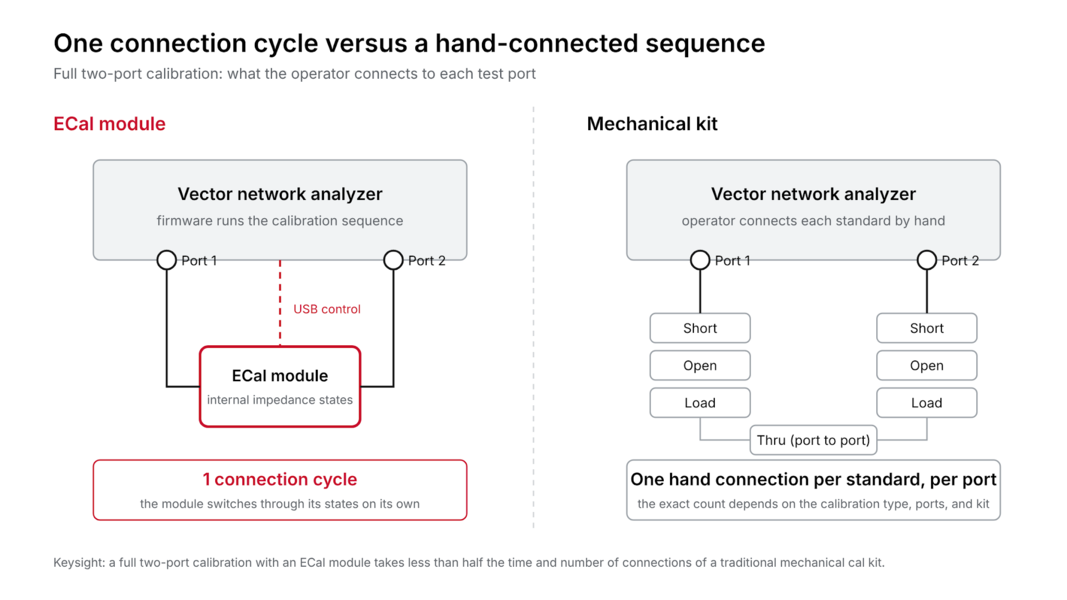
ECal vs Mechanical Calibration Kit Comparison
| ECal Module | Mechanical Kit | |
| Manual connection cycles | One, to the test ports, USB-controlled | Several (one per standard, per port) |
| Typical calibration time | Less than half the mechanical-kit time, per Keysight | Longer, and grows with the number of ports and standards |
| Operator skill dependency | Low (firmware controls the sequence) | Higher (manual torque wrench technique varies by operator) |
| Traceability basis | Keysight characterization of the module, traceable to NMIs | Calibration of the kit's standards, traceable to NMIs |
If you're still choosing the VNA itself, start with the network analyzer buying guide.
How Many Connections Does a Full 2-Port Calibration Really Take?
Keysight states this on its N469xD product pages: a full two-port calibration with an ECal module takes less than half the time and number of connections of a traditional mechanical cal kit. The operator connects the module to the VNA's test ports and USB port, and the firmware runs the rest of the sequence.
Fewer connections matter beyond convenience. Each mating cycle wears the test port and the calibration standards, and a damaged precision connector (2.4 mm, 2.92 mm, or 1.85 mm) can take a test bench out of service until it is repaired or replaced. A mechanical calibration requires several manual standard connections per port during the sequence, including the open, short, load, and thru standards, and the exact number depends on the calibration type, number of ports, and standards in the kit. An ECal module needs one connection cycle, and its internal switching handles the rest. Precision radio frequency (RF) and microwave test equipment depends on connector integrity to hold accuracy over years of service.
Letting the VNA firmware control the sequence over USB also reduces operator-error risk. The torque wrench technique a mechanical calibration depends on varies from technician to technician, so calibration repeatability can vary with it. When the sequence is firmware-controlled, that variation is reduced.
IEEE Std 287, the IEEE standard for precision coaxial connectors, governs the 3.5 mm, 2.92 mm, 2.4 mm, and 1.85 mm interfaces this guide discusses, and its current editions are 287.1-2021 and 287.3-2021. Every mating cycle counts against a precision connector’s service life, which is why fewer connections help protect the test port.
Which Frequency and Connector Do You Actually Need?
Start with your own instrument. Its datasheet or front panel gives you 2 facts: its frequency ceiling and its test-port connector type, and the calibration module has to match both. A module rated below the VNA's ceiling leaves the top of the range uncalibrated. A module with the wrong connector won't mate at all.
The N469xD family makes that decision straightforward. The N4690D reaches 18 GHz on Type-N connectors and the N4696D reaches 18 GHz on 7 mm, the N4691D reaches 26.5 GHz on 3.5 mm connectors, the N4692D reaches 40 GHz on 2.92 mm, the N4693D reaches 50 GHz on 2.4 mm, and the N4694D reaches 67 GHz on 1.85 mm. Because each ceiling is paired with the connector type normally fitted to VNAs at that frequency, the two checks usually point to the same module: a 50 GHz PNA with 2.4 mm ports needs the N4693D, and a 26.5 GHz instrument with 3.5 mm ports needs the N4691D. All six are 2-port modules that calibrate the same way, through one connection cycle under firmware control.
The low end of the range is the second thing to check. The N4690D, N4691D, and N4696D start at 300 kHz, and the N4692D, N4693D, and N4694D start at 10 MHz. If your work needs coverage below that, Option 0DC extends any of the six modules down to DC without changing its ceiling, and the next section explains what that option changes at the test port. Connector gender is the third check: each module ships as male/male, female/female, or male/female, per Keysight, so order the male and female mix that mates with your VNA's test ports rather than choosing based only on what happens to be in stock.
One connector caution: the 3.5 mm, 2.92 mm, 2.4 mm, and 1.85 mm interfaces are precision types, mechanically distinct from the SMA and Type N connectors common on lower-frequency gear. Type N and 7 mm ports belong to instruments that top out around 18 GHz, which is where the N4690D and N4696D fit, not to millimeter-wave test ports. An SMA connector looks like a 3.5 mm at a glance and is not built to the same tolerances, and at higher frequencies that difference shows up in the measurement. A 2.92 mm connector and a 2.4 mm connector will not mate with each other. Confirm the connector type from the datasheet rather than by sight. All of these are 50 ohm (50Ω) interfaces, the standard characteristic impedance for a coaxial VNA test system.
N469xD Family Frequency and Connector Matrix
| Model | Base Frequency | Frequency with Option 0DC | Connector | Ports |
| N4690D | 300 kHz to 18 GHz | DC to 18 GHz | Type-N, 50 Ω | 2 |
| N4696D | 300 kHz to 18 GHz | DC to 18 GHz | 7 mm | 2 |
| N4691D | 300 kHz to 26.5 GHz | DC to 26.5 GHz | 3.5 mm | 2 |
| N4692D | 10 MHz to 40 GHz | DC to 40 GHz | 2.92 mm | 2 |
| N4693D (featured) | 10 MHz to 50 GHz | DC to 50 GHz | 2.4 mm | 2 |
| N4694D | 10 MHz to 67 GHz | DC to 67 GHz | 1.85 mm | 2 |
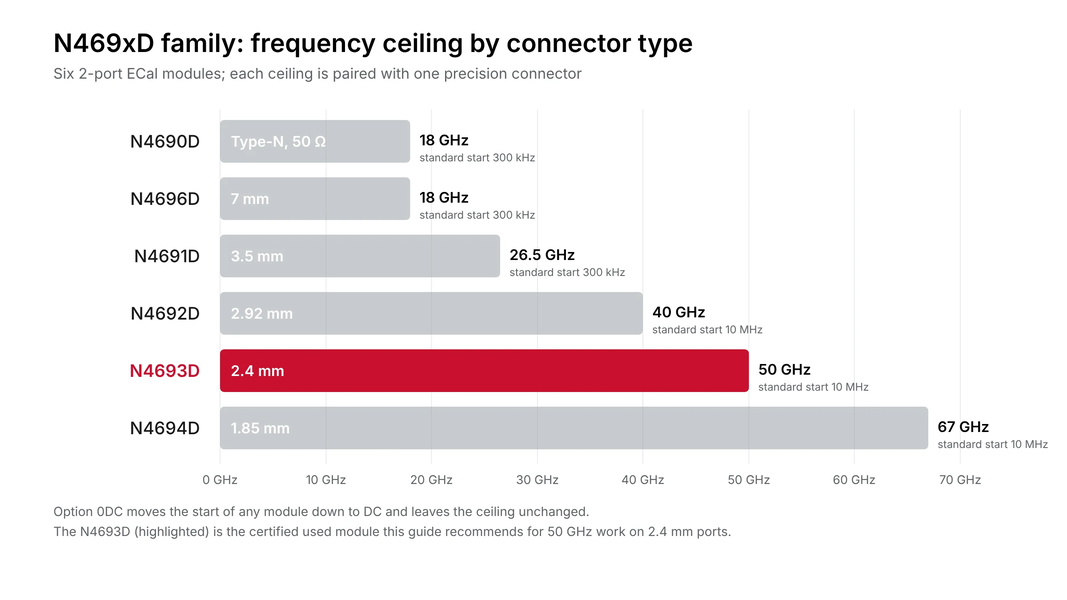
When the VNA's ceiling sits between two family members, keep the rule simple: choose the module whose ceiling is at or above the VNA's, then let the connector decide between neighbors. The FAQ below works through the 30 GHz case.
Related listings: the N4691D Electronic Calibration Module (26.5 GHz family alternate) and the N4694D Electronic Calibration Module (67 GHz family alternate) round out the family; check the used network and impedance analyzers category hub for current availability.
Why Is the N4693D the Recommended ECal Module for Most 50 GHz VNA Work?
The N4693D pairs a 50 GHz ceiling with 2.4 mm test ports, which makes it the family match for 50 GHz-class VNA work on 2.4 mm ports, such as millimeter-wave device test in high-end defense, satcom, and 5G FR2 programs. The N4693D Electronic Calibration Module (ECal), 50 GHz, 2.4 mm, 2-port, performs a full vector network analyzer calibration for electromagnetic measurements up to 50 GHz in one connection cycle.
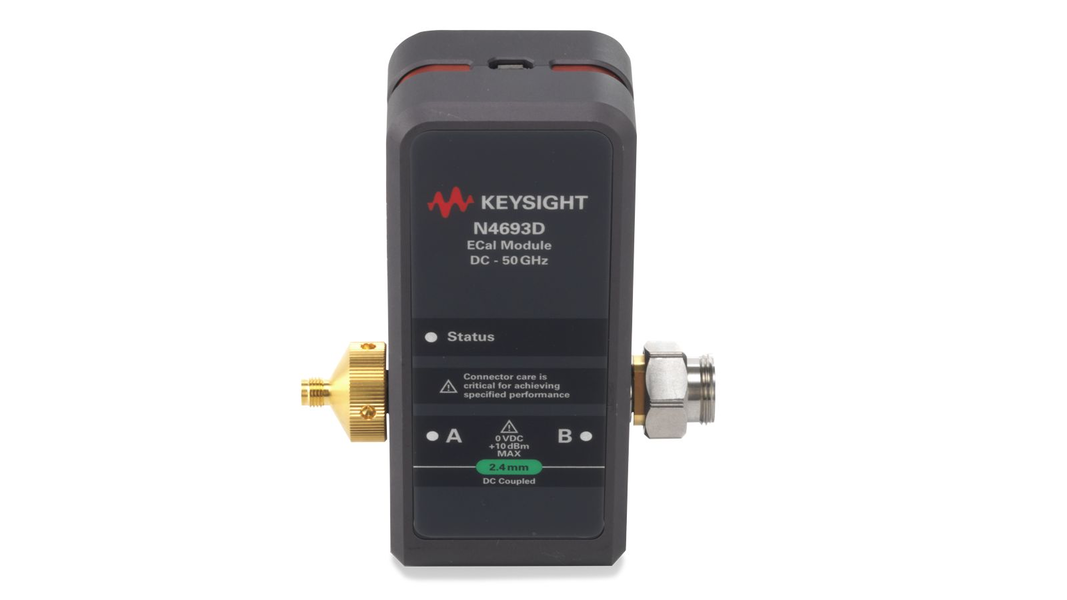
The key specs are straightforward. Frequency coverage runs 10 MHz to 50 GHz standard, or DC to 50 GHz with Option 0DC, and control is direct USB from a Keysight vector network analyzer with no external PC required. The spec sheet below covers the rest.
As of October 2026, the Keysight Used Equipment Store lists the N4693D-0DC (DC start) as a Keysight Premium Used unit at a 50% promotion through November 1, 2026; the N4693D-100 (10 MHz start) configuration was listed earlier in 2026, so check the category hub for the configurations in stock today. Keysight Premium Used modules ship calibrated by Keysight. The N4693D is a current model, listed as active on its Keysight product page as of August 2026.
N4693D Spec Sheet
| Spec | Value |
| Frequency coverage | 10 MHz to 50 GHz standard (DC to 50 GHz with Option 0DC) |
| Connector | 2.4 mm |
| Ports | 2 |
| Configurations | Male/male, female/female, male/female |
| Control | Direct USB from a Keysight vector network analyzer, no external PC |
| Certified used configurations | N4693D-0DC (DC start) listed as of October 2026; N4693D-100 (10 MHz start) when in stock |
| Included | Plastic storage case |
Certified used N4693D configurations are listed through the used network and impedance analyzers category as they come into stock.
What Does Option 0DC Add, and Do You Need It?
Option 0DC is worth ordering if you measure below the module’s standard start frequency or run TDR: it extends coverage down to DC and sets the allowable DC level at the test port to 0 V. On any N469xD module it moves the calibration start from 10 MHz (300 kHz on the N4690D, N4691D, and N4696D) down to DC. The module's frequency ceiling and connector don't change.
Two documented use cases make it worth considering. One is broadband device modeling that needs a DC-to-mmWave sweep under one calibration. The other is time-domain or signal-integrity analysis using enhanced time domain analysis (TDR) on the VNA, and Keysight's ECal Technical Overview recommends the DC option for calibration with TDR on its network analyzers.
If your application never measures below 10 MHz and doesn't run TDR-based signal-integrity work, the standard start frequency may be enough, and Option 0DC may add a tradeoff you do not need. Keysight's ECal datasheet lists the typical maximum DC level applied to the test port as plus or minus 10 V on the standard configuration and 0 V with Option 0DC, so a setup that puts DC bias on the test port may need the standard configuration.
An N4691D-0DC configuration is an Option 0DC example on the family's lower-frequency member; check the used network and impedance analyzers category for current availability.
How Do You Know an ECal Module's Calibration Is Traceable and Defensible?
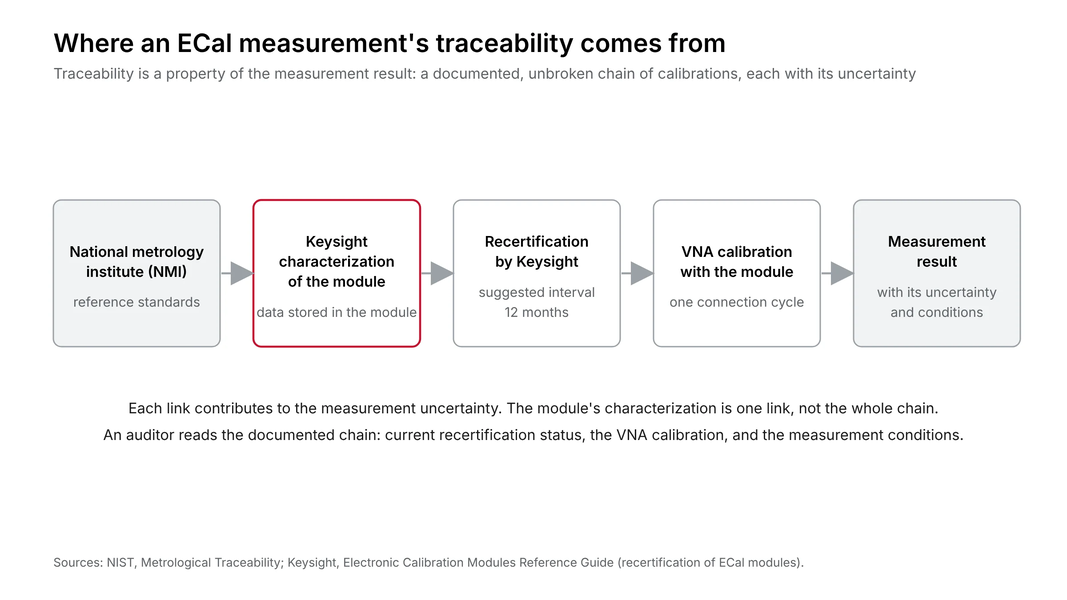
Keysight characterizes each ECal module using standards traceable to national metrology institutes (NMIs). That characterization is one link in the traceability chain for your measurements. Metrological traceability itself is a property of the measurement result: it requires a documented, unbroken chain of calibrations, each contributing to the measurement uncertainty. That documented chain is what an auditor will want to see. Keysight characterizes each module at the factory with a precision technique it describes as similar in accuracy to TRL, traceable to national metrology institutes that are signatories to the CIPM Mutual Recognition Arrangement.
A 2010 NIST study by Williams, D.F. et al. found electronic calibration units stable enough to replace mechanical verification artifacts in NIST’s own verification study.
BIPM explains that the CIPM Mutual Recognition Arrangement is what helps NMI-traceable calibration certificates be recognized across borders.
NIST, "Metrological Traceability," defines traceability as a property of the measurement result, established through a documented, unbroken calibration chain, not just a label on the module.
For an audit, document the traceability chain and the relevant calibration evidence, including the module's current calibration or recertification status, the VNA calibration performed with the module, and the measurement result with its associated uncertainty and applicable measurement conditions. Several calibration-document options are available alongside a module purchase, per Keysight's product page: calibration with uncertainties, an ANSI Z540-1 calibration, and a commercial calibration certificate with test data.
Keysight recommends a 12-month recertification interval for ECal modules, per its Electronic Calibration Modules Reference Guide. After reviewing the results of the initial recertification, a shorter interval may be appropriate depending on use and wear. Recertification is distinct from user characterization, an in-field feature that lets a calibration laboratory extend the module's reference plane to an adapter or fixture and store that result in the module's own flash memory alongside the Keysight characterization data.
Related reading: the crucial role of a certificate of calibration, calibration certificates guide, oscilloscope calibration guide, and Keysight calibration.
New vs Certified Used ECal Modules: What Changes, and What Doesn't?
"Calibration is the one thing I don't want to gamble on used" is a fair objection, and it deserves a direct answer. A module's characterization data are stored in its internal memory, while its physical specifications depend on the model and configuration. For used ECal modules, the current calibration status matters: Keysight Premium Used models always come calibrated, while non-refurbished standard used modules may already be calibrated or can be ordered with Fresh Calibration.
Keysight Used and Keysight Premium Used both come direct from the manufacturer rather than through a reseller with limited history on the unit. The module retains characterization data in its internal memory. During Keysight calibration or recertification, new S-parameter data may be stored in the module if required to meet performance specifications.
What the Keysight Used Equipment Store adds on top, depending on the listing and configuration: up to 5 years warranty options, the 101-point quality check on Keysight Premium Used units, and KeysightCare technical support. The savings case is straightforward: the range in the summary above, depending on the listing, for teams that need traceable calibration without paying new-unit pricing.
New vs Certified Used ECal Module Comparison
| Certified Used N4693D | New N4693D | |
| Characterization data | Keysight characterization data stored in the module; may be updated at a Keysight recertification | Keysight characterization data stored in the module; may be updated at a Keysight recertification |
| Module calibration | Included (Premium Used) or add-on | Included (factory) |
| Warranty | Up to 5 years warranty options | Standard new-unit coverage |
| Support | KeysightCare | KeysightCare |
| Price | 40 to 90% below new list, depending on the listing | Full list price |
Related reading: Keysight Premium Used, big discounts on premium used equipment, and how to evaluate calibration companies.
What Happened to the N4691B, and Is It Still an Option?
Keysight lists the N4691B as obsolete. The N4691D is its named replacement at the same frequency and connector. The N4691B is the previous-generation 300 kHz to 26.5 GHz, 3.5 mm, 2-port ECal module. Its official Keysight product page names the N4691D Electronic Calibration Module, 26.5 GHz, 3.5 mm, 2-port, as its direct replacement.
If you already own an N4691B, Keysight still lists calibration and repair service for it. As of October 2026, the Keysight Used Equipment Store does not list certified used N4691B stock. The N4691D is the equivalent option at the same frequency and connector, and it can be found in the used network and impedance analyzers category when in stock, so confirm availability before you order.
A Pre-Purchase Checklist for Your VNA Calibration Kit
Use six checks before you choose a module: connector, frequency floor, gender, documentation, time cost, and budget. It also gives purchasing teams and lab managers a simple way to review the decision.
- Confirm your VNA's connector type and frequency range from its own datasheet or front panel before selecting a module.
- Decide whether your work needs measurements below the module's standard start frequency; if so, plan for Option 0DC and confirm that no DC bias reaches the test port.
- Confirm the connector gender configuration you need (male/male, female/female, or male/female) against your test port hardware.
- Ask what calibration-document option you need for your audit or customer requirements (calibration with uncertainties, ANSI Z540-1, or a commercial certificate with test data).
- Compare the time cost of a mechanical kit against an ECal module for your actual calibration routine, including how often the setup changes.
- Check whether a certified used module meets your budget and sustainability targets with the same key specs as new.
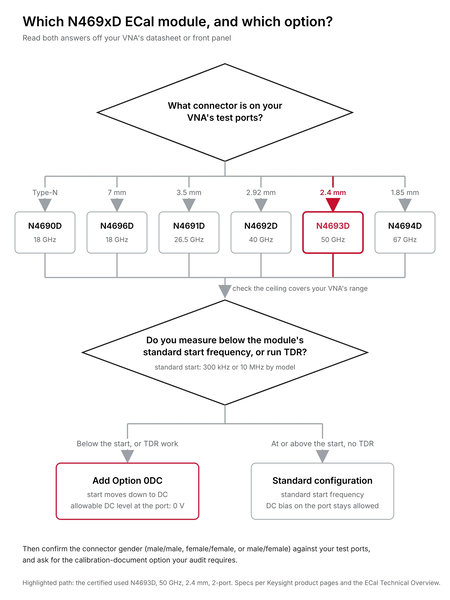
Still unsure on connector or frequency? Revisit the frequency and connector matrix above before you request a quote.
Have your checklist ready? Browse the certified used inventory and request a quote.
Related listings: used vector network analyzers, E5080B ENA Vector Network Analyzer, and E5071C ENA Vector Network Analyzer.
Select up to 3 instruments to compare
Conclusion and Next Steps
Start with frequency and connector, then choose electronic calibration if time savings and connector wear matter. The N4693D fits a 50 GHz VNA with 2.4 mm test ports, and the other five family members cover 18 GHz, 26.5 GHz, 40 GHz, and 67 GHz. Read your VNA’s datasheet, choose the module whose ceiling and connector match it, and add Option 0DC only if you need DC or TDR coverage. From there, certified used can give you the warranty options and calibration documentation your audit requires. Whichever you choose, network analyzer calibration kits, electronic or mechanical, exist to protect one thing on an RF and microwave bench: measurement accuracy you can document.
Browse the certified used inventory and request a quote.
Second-Hand. First-Class.
Frequently Asked Questions
A VNA calibration kit helps characterize and mathematically reduce systematic errors in the VNA measurement system. You connect known impedance standards (electronic or mechanical) at the reference plane, and the VNA's firmware uses those known values to mathematically correct every measurement that follows.
Match the module’s rated range to your VNA. For calibration up to 30 GHz with compatible 2.92 mm test ports, the N4692D provides the required frequency coverage because it is specified from 10 MHz to 40 GHz. Choose the N4693D only when the VNA needs coverage above 40 GHz, or when its test ports are 2.4 mm, because a 2.92 mm module will not mate with a 2.4 mm port regardless of frequency.
- Confirm your VNA's actual frequency ceiling and connector type from its own datasheet before comparing modules
- Choose the family member whose ceiling is at or above that frequency and whose connector matches the test ports
- Remember Option 0DC extends the low end to DC, not the high end past the module's rated ceiling
No. Option 0DC changes the module's low-frequency starting point and the allowable DC level at the test port (0 V instead of plus or minus 10 V, per Keysight's datasheet); it does not change the module’s 50 GHz ceiling or its 2.4 mm connector spec.
They are two different things. Factory characterization is the base data every N469xD module ships with. It is performed at manufacture and is NMI-traceable. User characterization is a separate in-field feature that lets a lab extend the reference plane to its own adapter or fixture and store that result in the module's own flash memory, alongside the factory data, without replacing it.
- Factory characterization: Keysight characterization data stored in the module and used for ECal. During recertification, Keysight may update the stored S-parameter data if required to meet performance specifications.
- User characterization: done by the lab, in the field, for a specific adapter or fixture
- Both data sets live in the module's own memory, not on an external PC
Keysight suggests a 12-month recertification interval for ECal modules, with the possibility of establishing a shorter interval based on use and wear.
SOLT, or short-open-load-thru calibration, uses four standards connected by hand. It is the traditional method used with a mechanical cal kit. TRL, or thru-reflect-line calibration, relies on the transmission-line properties of the standards themselves, which can suit certain fixture-based or non-coaxial setups. The N4693D and the rest of the N469xD family use a different approach: they are electronically switched standards, characterized at the factory using a precision technique similar in accuracy to TRL, with the resulting data stored in the module's own memory and read by VNA firmware over USB. Both SOLT and TRL are used to correct systematic errors; they differ in which standards they rely on and how those standards are connected. For one-port reflection measurements, a short-open-load (SOL) calibration can be used instead of a full two-port SOLT calibration. ECal modules support one-port calibration as well. Unlike SOL, conventional TRL calibration requires transmission measurements between two ports.
There is no single fixed interval. A calibration protects a specific measurement session against drift from room temperature, cable changes, and connector wear, so many benches recalibrate at the start of a session or whenever the setup changes. This measurement calibration interval should not be confused with ECal module recertification. Keysight suggests a 12-month recertification interval for ECal modules.
Keysight gives a stronger figure than that: its N469xD product pages state that a full two-port calibration with an ECal module uses less than half the time and number of connections of a traditional mechanical cal kit. The time savings come from replacing the sequence of hand-connected standards with one connection cycle and firmware-controlled switching inside the module.
No. The N4693D and the rest of the N469xD family connect via USB directly to a Keysight vector network analyzer, and the VNA's own firmware controls the calibration sequence. No external PC or separate control software is needed.
5 Ways We Can Help You
Browse our certified used vector network analyzers and request a quote for current pricing
Call tech support US: +1 800 829-4444
Press #, then 2. Hours: 7am – 5pm MT, Mon– Fri
Contact our sales support team
Create an account to get price alerts and access to exclusive waitlists
Talk to your account manager about your specific needs
Sources
- Williams, D.F., Lewandowski, A.C., LeGolvan, D.X., Ginley, R.A., Wang, C.M., Splett, J.D., Use of Electronic Calibration Units for Vector-Network-
- International Bureau of Weights and Measures (BIPM), CIPM MRA (CIPM Mutual Recognition Arrangement)
- National Institute of Standards and Technology, Metrological Traceability
- IEEE Standards Association, IEEE Std 287 series, IEEE Standard for Precision Coaxial Connectors (current editions 287.1-2021 and 287.3-2021)
- Keysight Technologies, Electronic Calibration Modules (8509xD, N443xD, N469xD & N755xA) Reference Guide, part number 9018-04501 (recertification of ECal modules: suggest