How to Automate Manufacturing Pass / Fail Testing with a High Channel-Density Oscilloscope

Verify Signal Quality Across Production Test Points
Automating manufacturing pass / fail testing requires applying consistent measurement checks across multiple test points while identifying defects that may appear only during specific production sequences. On an assembly line, engineers need to monitor power, control, timing, and output signals during the same test cycle to determine whether an electronic assembly meets defined quality requirements. Testing these signals separately can make it difficult to identify the source of a failure, particularly when an unexpected event occurs only once or depends on the timing of other signals. A high channel-density measurement approach enables engineers to monitor multiple signals during the same production cycle, with synchronized oscilloscopes expanding coverage as additional test points are required. This provides the timing context needed to investigate supply transients, missing enable signals, delayed responses, and signal-quality issues.
Performing the test requires an oscilloscope capable of automated waveform acquisition and pass / fail measurements across multiple test points. Engineers can synchronize additional oscilloscopes through a shared reference clock and coordinated triggering when greater channel coverage is needed. The manufacturing test program manages automated test sequences and overall pass / fail criteria while the oscilloscopes capture waveforms during each production cycle. When multiple instruments are used, real-time analysis software consolidates synchronized analog channels into a unified display, allowing engineers to correlate failed measurements with earlier signal behavior elsewhere in the assembly. Built-in tools such as mask testing and fault finding help identify waveform deviations and intermittent signal issues, while remote oscilloscope control through Standard Commands for Programmable Instruments (SCPI) integrates acquisition into the manufacturing test program. This approach supports repeatable production testing and helps engineers investigate failures more efficiently.

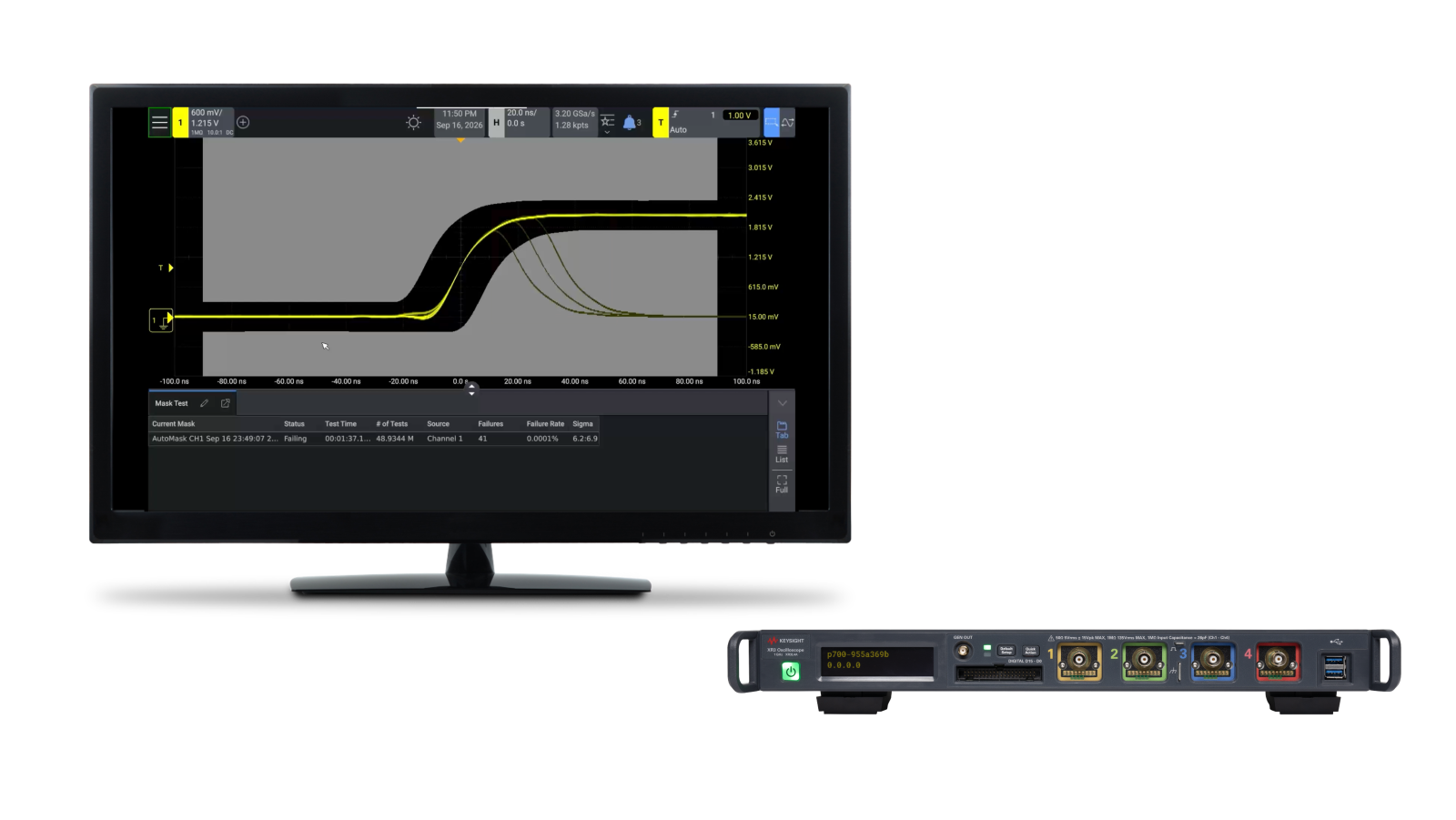
Manufacturing Test Automation Solution
Automating manufacturing pass / fail testing requires an oscilloscope with repeatable signal acquisition, waveform limit testing, and remote control capabilities. Keysight Essential oscilloscopes combine 14-bit analog-to-digital converters (ADCs) with four analog channels per 1U of rack space, while passive probes acquire voltage signals from multiple test points across electronic assemblies. Built-in mask testing automatically compares captured waveforms against predefined limits to identify signal deviations and determine waveform-level pass / fail results, while Fault Hunter evaluates signal characteristics against user-defined criteria to detect, capture, and investigate intermittent abnormalities that may otherwise go unnoticed.
Engineers can add synchronized oscilloscopes as channel requirements increase, using a shared 10 MHz reference clock, coordinated triggering, and cross-instrument deskew to preserve timing relationships across the oscilloscopes. PC-based real-time analysis software consolidates analog waveforms from multiple oscilloscopes for synchronized multi-signal review, while remote SCPI control integrates acquisition and measurements into the production station. The manufacturing test program manages sequencing and determines the final assembly-level pass / fail result. Together, these capabilities support repeatable quality checks and efficient troubleshooting in compact automated test equipment (ATE).
See Demo of Manufacturing Test Automation Solution
Explore Products for Our Manufacturing Test Automation Solution
-

![]()
XR3L4A Low Profile Oscilloscope: 4 Analog Channels


Discover Resources and Insights
Additional Resources for Manufacturing Test Automation
Related Use Cases


-
![]()
Learn More
How to Perform Precision Resistance Measurements
Characterize low- and high-resistance devices accurately using precision SMUs with 2-wire and 4-wire measurement techniques.
Learn More

-
![]()
Learn More
How to Perform Photonics IC Functional Test
Learn how to perform photonics IC functional test using swept wavelength, polarization, optical power, and SMU measurements.
Learn More
-
![]()
Learn More
How to Test DC-DC Converter Transients
Evaluate DC-DC converter performance by measuring load regulation and transient response using Keysight precision SMUs.
Learn More

Get in Touch with One of Our Experts
Need help finding the right solution for you?