



Choose a country or area to see content specific to your location
What are you looking for?
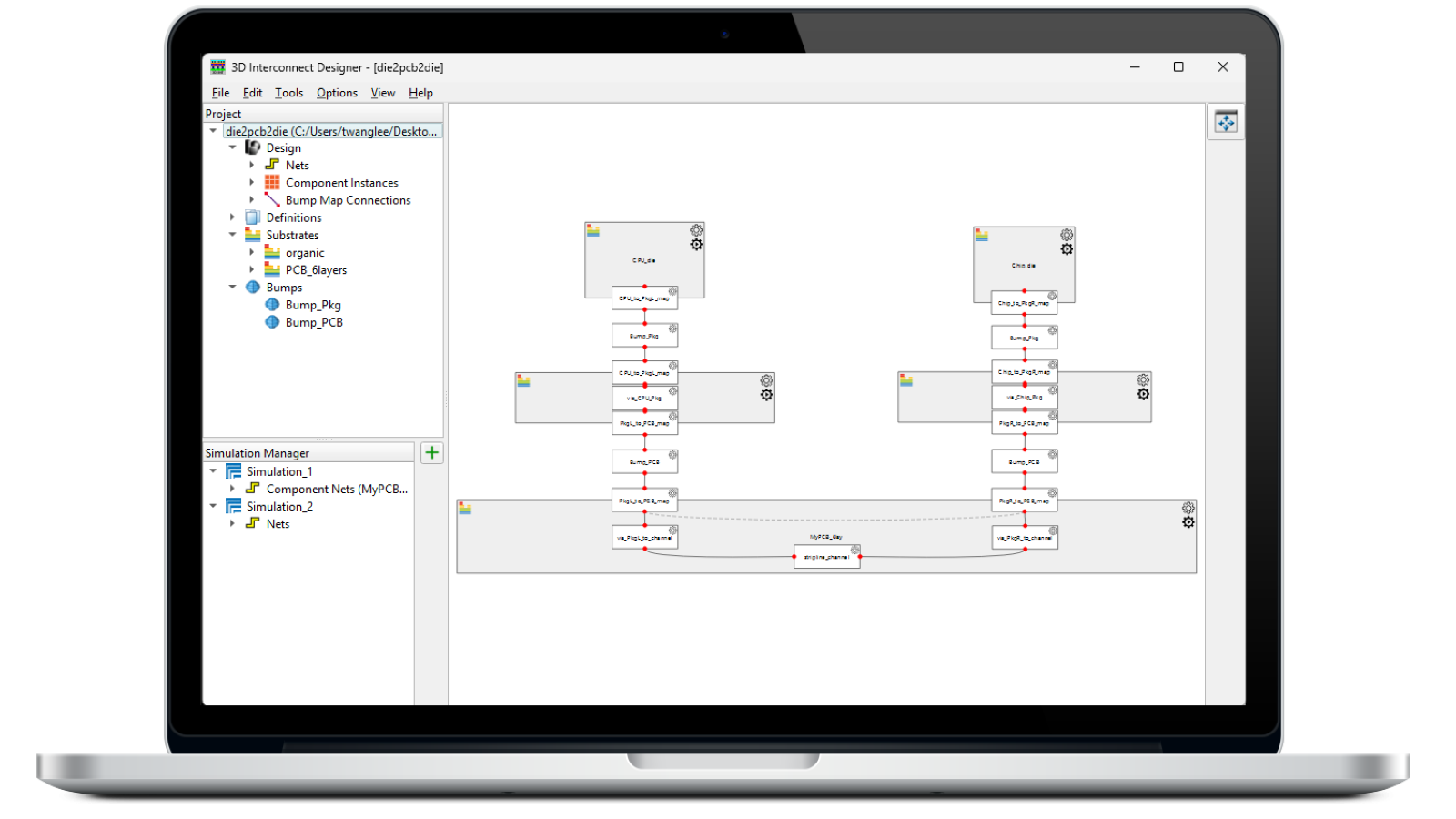
3D Interconnect Designer provides a flexible modeling and optimization environment for any advanced interconnect structure, including chiplets, stacked die, packages, and PCBs.
Get faster digital validation for less with a trade-in.
Emulate every part of your data center infrastructure. Emulate Anything. Optimize Everything.
With extra memory and storage, these enhanced NPBs run Keysight's AI security and performance monitoring software and AI stack.
Achieve fast, accurate board-level testing with robust inline and offline ICT designed for modern manufacturing.
Explore curated support plans, prioritized to keep you innovating at speed.
Achieve 200+ Gbaud multi-level modulated signals with high-speed AWGs for digital and optical standards.
Pinpoint interference with post-processing spectrum management software in the lab.
Use this selector tool to quickly identify the best power supply for your aerospace and defense ATE requirements.
Authoritative application notes, data sheets, reference designs, and test procedures to accelerate design and validation decisions.
Hands‑on bootcamps that teach system design, test methods, and production workflows engineers can apply immediately.
Success Stories
Quick access to support related self-help tasks.
Additional content to support your product needs.
Explore services to accelerate every step of your innovation journey.
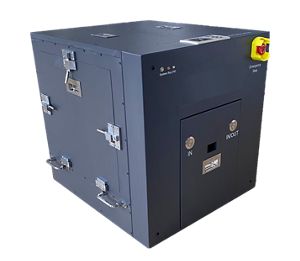
Designed for integration with our cellular network emulation solutions, the Keysight Manufacturing Chamber is a compact, mountable chamber optimized for mmWave device testing in production, repair, and R&D workflows. It features up to four adjustable horn antennas, integrated mmWave switches, and an Ethernet‑controlled pneumatic door to enable fast, tool‑free OTA measurements. With support for 24 to 43.5 GHz, direct far-field testing, and DUTs up to 2 kg, the manufacturing chamber delivers high-throughput validation with precision and repeatability. Want to learn more about this solution? Explore the resources below.
Enable fast port selection and reduce external hardware requirements with built-in mmWave switches supporting up to four test antennas.
Easily align test paths by repositioning horn antennas inside the chamber for optimized coverage and polarization control using the supplied adjustment tool.
Speed up loading and unloading cycles using an Ethernet-controlled pneumatic door designed for automated, repeatable operation.
Save space in production lines or labs with a mountable design that supports DUTs up to 2 kg in small form factors.
Maximum angles of arrival
1
Frequency range
24 GHz to 43.5 GHz, 60 GHz to 90 GHz
Measurement type
Direct far field (DFF), Indirect far field (IFF)
Maximum DUT weight
2 kg to 10 kg
Use cases
Production, Repair, Automotive Radar Manufacturing
Innovate at speed with curated support plans and prioritized response and turn-around times.
Get predictable, lease-based subscriptions and full lifecycle management solutions—so you reach your business goals faster.
Experience elevated service as a KeysightCare subscriber to get committed technical response and more.
Ensure your test system performs to specification and meets local and global standards.
Make measurements quickly with in-house, instructor-led training, and eLearning.
Download Keysight software or update your software to the newest version.
A direct far-field (DFF) test chamber is a type of anechoic chamber that positions the device under test (DUT) at a sufficient distance from the measurement antenna so that the radiated signal can be observed as a plane wave. In other words, the spherical wave emitted by the DUT has traveled far enough that it has flattened out, simulating the conditions the device will encounter in real-world communication scenarios.
For millimeter-wave (mmWave) testing, this is especially important because devices often rely on directional antennas, phased arrays, and beamforming techniques that require precise far-field conditions for accurate characterization. In the DFF chamber, engineers can evaluate parameters such as total radiated power, beam accuracy, and throughput performance without relying on mathematical transformations or reflector-based techniques. While chamber size must increase as frequency decreases, at mmWave frequencies the required far-field distance is small enough to make DFF testing practical in a compact chamber designed for manufacturing environments.
In mmWave OTA testing, the orientation and alignment of measurement antennas are critical for capturing accurate results. Adjustable antennas inside the chamber allow engineers to fine-tune positioning in both azimuth and elevation, ensuring that beams from the DUT are measured precisely as they are steered across different angles. This flexibility is particularly valuable when characterizing devices with multiple antenna arrays, since their performance may vary significantly with direction.
Adjustability also allows the same chamber to support a wide range of DUT sizes and form factors. By aligning antennas to match the DUT’s radiation pattern, engineers can maximize measurement sensitivity and reduce errors caused by misalignment. In manufacturing applications, this leads to more consistent results across high test volumes, reducing the need for re-tests and improving throughput without sacrificing accuracy.
Manufacturing chambers for mmWave OTA testing handle a wide variety of devices while maintaining compact size and repeatability. These chambers are typically designed to accommodate DUTs weighing up to around 2 kilograms and measuring up to 250 millimeters in size. This range covers most handheld and portable electronics as well as many modular components used in wireless systems.
Common examples include wireless modules that integrate antennas directly on the board, smartphones and tablets that require full-device certification, and Internet of Things (IoT) devices such as wearables, smart home sensors, and industrial trackers. In addition, the chamber can test mmWave radio units, phased-array antenna components, and other elements that operate in the Frequency Range 2 (FR2) spectrum used by 5G.
Because these chambers are tailored for production environments, they are optimized for repeatability and speed. Automated positioners and test scripts allow large numbers of devices to be evaluated consistently, ensuring each unit meets performance and regulatory requirements before leaving the factory. This makes them an important tool not only for R&D but also for large-scale deployment of mmWave-capable devices.