
M5402AxxA Quantum Benchmark
Visão Geral Técnica
- Overview
Current quantum computing architectures are prone to miscalculations due to errors occurring during computation steps. Because these errors limit the performance of quantum computing, they are of central interest for a wide community including hardware makers as well as QC users and developers.
The True-Q software solutions are designed to equip the QC community with state-of-the-art methods to both identify and mitigate performance-limiting effects. True-Q provides methods to measure, assess, calibrate, and optimize the performance of quantum devices. These include diagnostic tools that generate quantum circuits that measure noise properties of the quantum computer. These also include runtime error suppression solutions that tailor and reduce noise profiles.
All of True-Q’s tools can be used for any application/algorithm on any gatebased quantum platform including superconducting, ion-trap, and photonic quantum computers. True-Q provides methods for interfacing with other major software platforms for cross-compatibility.
Core Components of True-Q
True-Q consists of four core components:
1. Error Diagnostics Tools
A suite of protocols that diagnose the key aspects of the error profiles. The diagnostic results have several use cases:
- they can be fed into the True-Q simulator to emulate a real device,
- they can help hardware developers to efficiently and reliably optimize the performance of their device, and
- they can serve as a benchmark for circuit design strategies.
2. Error Suppression Tools
A suite of protocols that suppress noise in any quantum device in order to optimize performance at runtime.
3. Compiler
State-of-the-art compiling tools to bridge the gap between abstract quantum algorithms and actual quantum computing instructions. True-Q compiling tools are highly versatile, which makes the True-Q software an ideal platform to explore different circuit design strategies.
4. Simulator/Emulator
A fully customizable quantum emulator informed by real-world error models to simulate a quantum computation on any ideal or error-prone device.
Error Diagnostic Tools
In order to improve the performance of error-prone quantum devices, one needs to diagnose the errors affecting the device. True-Q has many tools to characterize errors in quantum computing devices to help hardware developers and end users to better understand and optimize the system. Individual error diagnostic protocols can be used to retrieve specific information about the noise in a system.
1. Streamlined Randomized Benchmarking (SRB) provides an estimate of the average fidelity (or probability of correctness) of particular sets of single- or two-qubit gates. Randomized benchmarking is the canonical example of a fast error diagnostic protocol, and our streamlined implementation minimizes the number of circuits needed to run the protocol.
2. Interleaved Randomized Benchmarking (IRB) estimates the probability of an error occurring when implementing a user-specified gate. This is useful when noise is not uniform for every operation as it provides users with a more detailed understanding of the error landscape.
3. Extended Randomized Benchmarking (XRB) provides an estimate which quantifies how much of the noise is coherent. This is valuable because it informs users how much performance can be gained by suppressing coherent errors using randomized compiling (one of True-Q’s proprietary error suppression techniques) and gives an indication of how much of the error is due to calibration, which is exceedingly useful information for hardware developers.
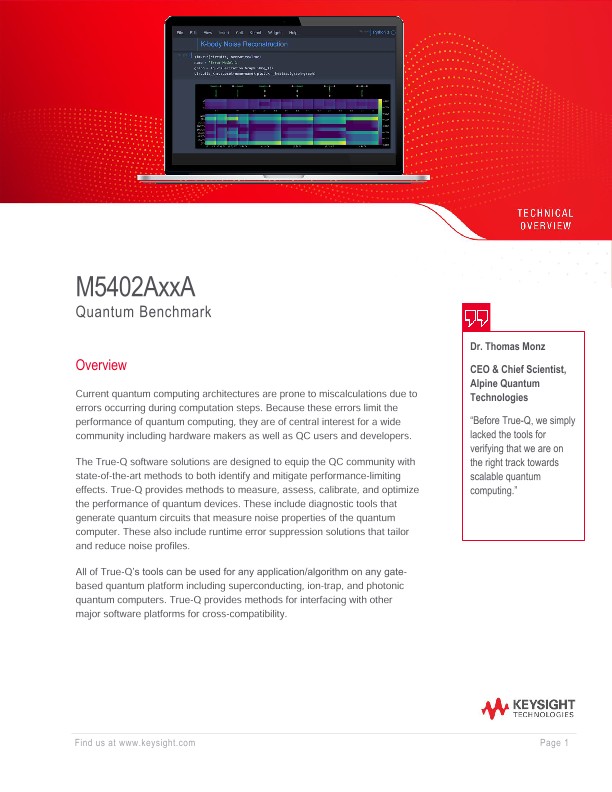
4. K-Body Noise Reconstruction (KNR) is a scalable, efficient state-of-the-art protocol which provides a blueprint of the noise acting on a system. More precisely, KNR estimates the probabilities of Pauli errors acting on up to “K” qudits, where K is user-specified. The output can be displayed as a heat map.
5. Crosstalk Diagnostics locates and quantifies crosstalk errors in a system. Crosstalk is one of the most common and most difficult to characterize sources of noise in quantum devices. It is introduced when an operation is applied to some qubits and other qubits are inadvertently impacted.
6. Quantum Capacity (QCAP) estimates the total error on any user-specified circuit using information from some of our fundamental error diagnostic tools. This is effectively a plugand-play solution that enables users to determine whether a specific circuit will return reliable results if run on their noisy device.
7. Custom Configuration allows True-Q users to combine the fundamental error diagnostic protocols to retrieve relevant information about the error landscape in a device.