










- Overview
- All Models
- Support
High-resolution for high-precision SMU measurements
Keysight Expert source measure units (SMUs) are available in both single- and dual-channel configurations, providing greater flexibility for parallel IV measurements and power electronics testing. With pulsed measurement capabilities, Keysight Expert SMUs offer 7-in-1 functionality — ideal for capturing detailed IV curves using short pulses that minimize power and heat, protecting sensitive devices in semiconductor and advanced materials testing. Choose one of our popular configurations or configure one specific to your application.
7-instruments-in-1
Combines a pulse generator, DMM, power supply, current source, electronic load, AWG, and digitizer in one instrument, eliminating the need to sync or configure multiple devices.
High-output current
Delivers up to 3 A output, ideal for testing high-current devices like MOSFETs or high-brightness LEDs in power electronics or faster charging / discharging for battery testing.
Dual-view mode
Displays both numerical data and graphical plots on the front-panel display, enabling instant correlation of measured values and device behavior.
Deep memory
Supports high-volume data collection for long-duration automated testing, with 100,000 points of memory per channel and an infinite number of trigger counts.
-
Source resolution
5.5 digits
-
Minimum current measurement resolution
100 fA
-
Number of channels
1 to 2
-
Pulse output
Yes
-
Maximum voltage per output
210 V
-
Maximum current per output
3.0 A DC / 10.5 A pulse
-
Maximum sample rate
50 kSa/s
-
Minimum sampling interval
20 µs
Most popular configurations
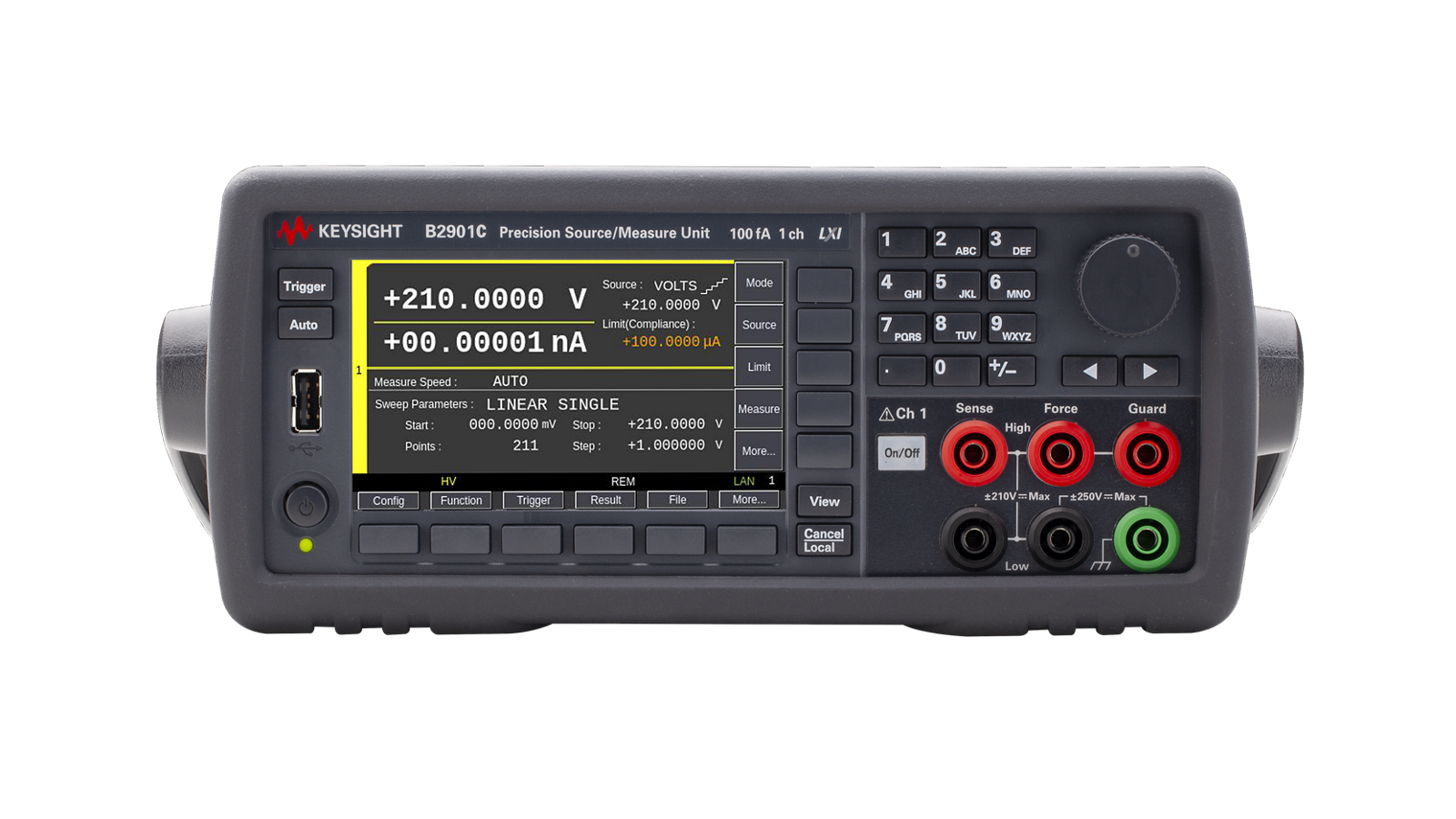
SM2-class Benchtop Source Measure Unit, single-channel, 100 fA resolution
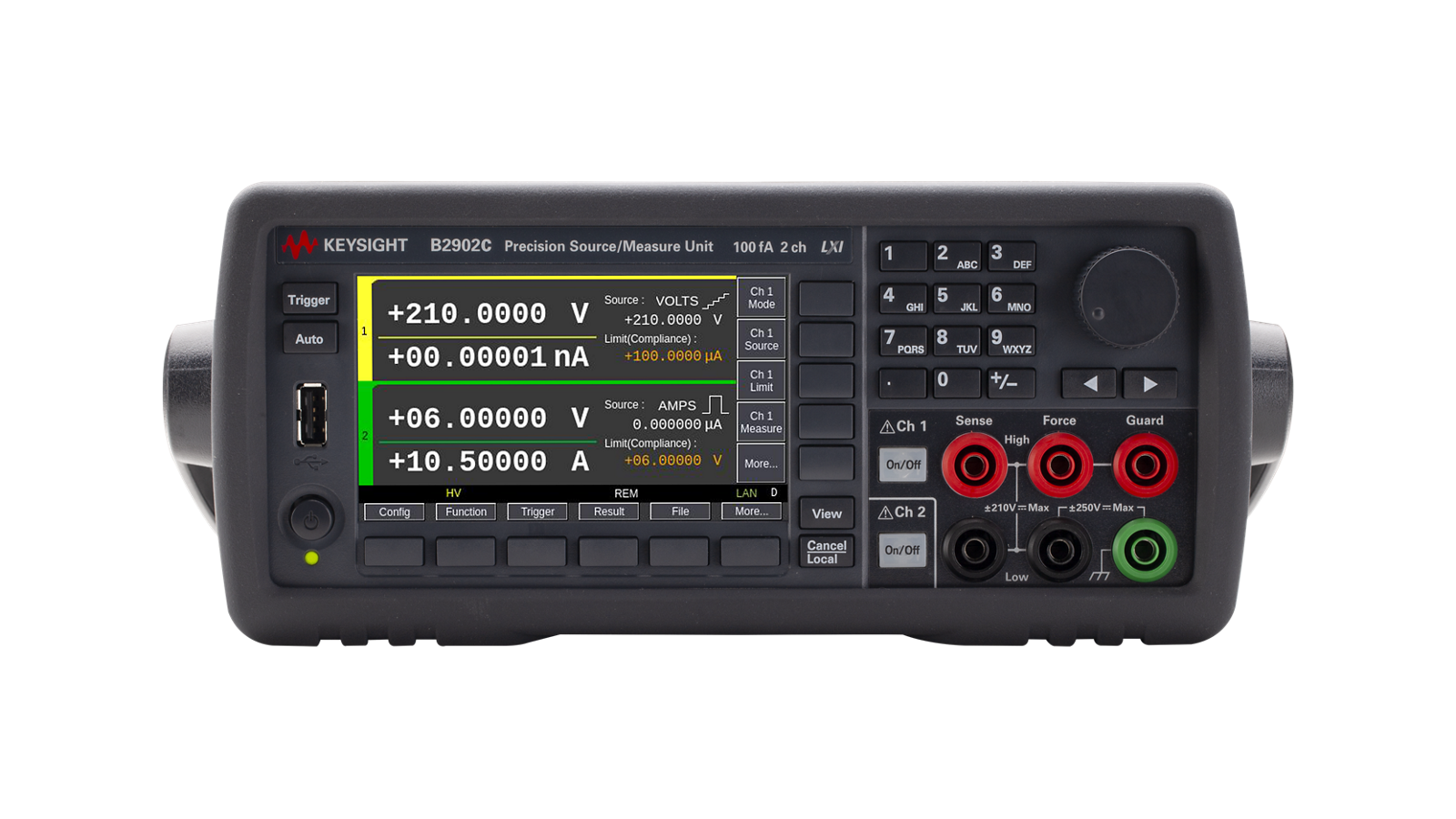
SM2-class Benchtop Source Measure Unit, dual-channel, 100 fA resolution
Services and support
Innovate at speed with curated support plans and prioritized response and turn-around times.
Get predictable, lease-based subscriptions and full lifecycle management solutions—so you reach your business goals faster.
Experience elevated service as a KeysightCare subscriber to get committed technical response and more.
Ensure your test system performs to specification and meets local and global standards.
Make measurements quickly with in-house, instructor-led training, and eLearning.
Download Keysight software or update your software to the newest version.
Frequently asked questions
When selecting a Source Measure Unit (SMU), several key specifications must be considered to ensure it meets the requirements of the intended application.
Voltage and current range are crucial, as SMUs vary in their ability to source and measure low to high voltages (e.g., microvolts to hundreds of volts) and currents (from femtoamperes to several amperes). This makes them suitable for applications ranging from nanotechnology to power electronics testing.
Resolution and accuracy define how precisely the SMU can source and measure signals. High-end models offer sub-nanovolt (nV) and femtoampere (fA) precision, which is essential for low-leakage current measurements and semiconductor characterization.
Another important factor is the 4-quadrant operation, which allows the SMU to source and sink power. This capability is helpful for battery simulation, component testing, and power management applications.
The measurement speed (sampling rate) and settling time impact test efficiency, particularly in automated production environments. Faster measurement speeds help optimize throughput and improve test reliability.
Compliance (limit) settings are essential for protecting sensitive devices by restricting voltage or current to safe levels and preventing potential damage during testing. Connectivity options such as USB, GPIB, LAN, or LXI are important for remote control and automation, enabling seamless integration into test systems.
Additionally, software support for IV curve tracing, programmable sweeps, and scripting enhances usability, making it easier to perform complex measurements and automate test sequences.
Considering these factors ensures the selected SMU provides the necessary precision, flexibility, and performance for research, development, and production testing.
Source measure units (SMU) play a crucial role in semiconductor device testing by providing precise current and voltage sourcing, accurate measurements, and advanced automation capabilities. They are used to characterize various semiconductor components such as transistors, diodes, MOSFETs, IGBTs, and integrated circuits (ICs).
Semiconductor devices require highly accurate IV (current-voltage) characterization, and SMUs enable this by offering 4-quadrant operation. This allows both sourcing and sinking of current and voltage, making them suitable for testing both active and passive devices.
SMUs are used to determine critical semiconductor parameters such as threshold voltage (Vth), leakage current (Ioff), breakdown voltage (BV), on-resistance (Rds(on)), and gain characteristics. Their ability to measure low currents (in the femtoampere range) and high voltages with minimal noise and drift makes them essential for testing both low-power and high-power semiconductor devices.
Additionally, SMUs provide pulse testing capabilities, which help reduce self-heating effects in power semiconductor devices. This ensures accurate characterization without altering the device’s electrical properties.
In automated semiconductor testing, SMUs integrate seamlessly with probe stations and wafer testers, enabling efficient parametric testing in both R&D and production environments.
Their programmable sweeps, compliance limits, and high-speed measurement capabilities allow engineers to conduct precise, repeatable, and safe testing. This makes SMUs indispensable in semiconductor research, failure analysis, and quality assurance across the industry.
A source measure unit (SMU) performs current-voltage (IV) characterization by precisely sourcing voltage or current while simultaneously measuring the corresponding response of the Device Under Test (DUT) with high accuracy. This process is essential for analyzing the electrical properties of semiconductors, diodes, transistors, resistors, LEDs, batteries, and other electronic components.
The SMU can operate in voltage source mode (applying a voltage and measuring the resulting current) or current source mode (applying a current and measuring the resulting voltage). This flexibility allows for IV curve generation, which is critical for understanding a device's behavior under different electrical conditions.
By using programmable sweeps, an SMU can automatically vary the voltage or current across a specified range while continuously measuring the corresponding output. This enables the plotting of IV curves that reveal characteristics such as threshold voltage, leakage current, resistance, and breakdown voltage.
Additionally, compliance limits can be set to protect sensitive devices from excessive voltage or current, ensuring safe and reliable testing.
Advanced SMUs also support pulse sourcing, which minimizes device heating during testing, and 4-quadrant operation, which allows testing under both sourcing and sinking conditions.
This level of precision and control makes SMUs the preferred tool for semiconductor device characterization, power electronics testing, and material research in both R&D and production environments.
The difference between DC and pulse measurements in the source measure unit (SMU) lies in how voltage or current is applied and measured over time. This impacts accuracy, power dissipation, and the suitability of each method for different applications.
In DC measurements, the SMU applies a continuous, steady voltage or current to the Device Under Test (DUT). This allows for precise, long-duration measurements essential for IV curve tracing, leakage current testing, and steady-state semiconductor characterization. However, continuous DC sourcing can cause self-heating effects, which may alter the DUT’s electrical properties, especially in power devices, MOSFETs, and LEDs.
In contrast, pulse measurements apply a short-duration voltage or current pulse, significantly reducing thermal effects. This enables higher voltage or current testing without overheating or damaging the DUT. Pulse mode is particularly beneficial for high-power semiconductor testing, thin-film materials, and battery simulations, where excessive heating could lead to inaccurate readings or device degradation.
Advanced SMUs offer programmable pulse parameters, including pulse width, rise time, and duty cycle, enabling precise control over the applied signal. By choosing between DC for steady-state analysis and pulse for minimizing thermal impact, engineers can optimize their measurements for accuracy, repeatability, and reliability in R&D and production testing