What are you looking for?
What Is Automotive Exterior Lighting?
Definition of Automotive Exterior Lighting
Automotive exterior lighting covers all lights around the perimeter of a motorized vehicle. This can be a car, truck, or motorcycle. Automotive exterior lighting is required by law, and there are rigid regulations that must be fulfilled for any light function to be road-legal. Exterior lights are also considered the jewelry of a car, as lights have evolved from purely technical elements to design highlights that serve as a brand identifier or create a distinct look that catches the eye on the road.
For illumination purposes, the lighting functions on a vehicle include into two groups: signal lamps and headlamps.
Table of Contents
What Types of Exterior Lighting Are There?
Automotive exterior lighting cover the front, rear, and sides of a vehicle, although some special functions may be on the roof as well. For the two main purposes of illumination and signaling, various lighting functions are defined by law in their photometric requirements, position, size, color of light, and many more aspects.
Front exterior lighting includes the:
- Low beam headlamp (passing beam)
- High beam headlamp (driving beam)
- Front fog headlamp
- Daytime running light (DRL)
- Turn indicator
- Front position lamp
Along the sides of a vehicle, there may be:
- A side turn indicator (fender or side mirror)
- Side marker lights
In the rear, the lighting includes the:
- Taillight position lamp (tail lamp)
- Taillight stop-lamp
- Turn indicator
- Reversing light
- Rear fog lamp
- Center high-mounted stop light (CHMSL)


Special Lighting
There are other special lights that may be on a vehicle, including:
- License plate illumination lights: A special group of lights illuminate the license plate to make sure legal plates are visible in darkness or visually demanding weather conditions.
- Signature lights: In addition to the required lighting functions, some countries allow signature light elements, such as illuminated logos of the original equipment manufacturer (OEM) brand, used on the exterior.
- Other lights include official authority/emergency light functions for:
- Firefighters, police, ambulance (blue)
- Road maintenance
- Extended size vehicles
- Hazard transport warning lights (yellow)
- Vehicle to X (V2X) lights: With the advent of autonomous cars and electric cars, a very special group of lighting functions has emerged. These V2X lighting functions are a hot topic of interest and research, along with sensor systems such as cameras, light detection and ranging (LiDAR), and radar. V2X systems are a means of light-based visual communication to signal to pedestrians or other traffic participants (“X”) the status or intention of a silent vehicle, or one without a driver.
What Are the Specific Functions of Automotive Exterior Lighting?
Signal lamps are designed to deliver visual signals directly to traffic participants. They are a major element of the visibility of a vehicle and an important aspect of road safety. The purpose of these lamps is to communicate a position or action, like taking a turn or braking. They also create an impression of the outer dimensions of the vehicle by correct placement of position lights.
Headlamps (low beam and high beam) make driving vehicles at night possible. They are designed to illuminate the road ahead so drivers can see where they are going. They create contrast in case any obstacles or other vehicles are in the driving path.
Low beams use a cutoff line in the beam pattern to prevent glare for oncoming traffic. They primarily illuminate the road and its immediate surroundings, but do not shine light into oncoming traffic.
High beams are also called driving beams. These are the headlights with the most range and create the best driver view at night. However, you must only use them when there is no oncoming traffic, as they can be blinding to those drivers. In this scenario, high beam headlights must be deactivated manually or must be controlled by an adaptive driving beam (ADB) system.
What Problems Does Automotive Exterior Lighting Solve?
Automotive exterior lighting serves to ensure safety in road traffic. Headlights with the high beam, low beam and fog light functions help the driver illuminate the lane and clearly see the road, obstacles, and traffic signs.
For drivers on the road, exterior lighting ensures that road users perceive the presence of the vehicle, recognize a driver's intentions, and can react accordingly to them. These include daytime running lights, turn lights, and brake lights.


Why Is Modeling Exterior Lighting on a Car Important?
All exterior lighting of a vehicle is subject to country-specific legal regulations to ensure safe driving. Lighting must not be a glare to oncoming drivers, and signal lights, such as turn signals and stop lights, must be clearly visible. These legal regulations are the first step of development when modeling an exterior lamp.
In addition to legal regulations, branding and aesthetics play an important role. Taillights, for example, offer a strong opportunity for distinctive design and differentiation between model series using recurring design elements.
How Do You Develop and Model a Headlamp?
The basic workflow:
- Define optical performance requirements.
- Design reflector in LucidShape. Meet optical performance requirements.
- Test model and optimize.
- Design CAD model in LucidShape CAA V5 Based.
How Can Keysight Help with Light Modeling?
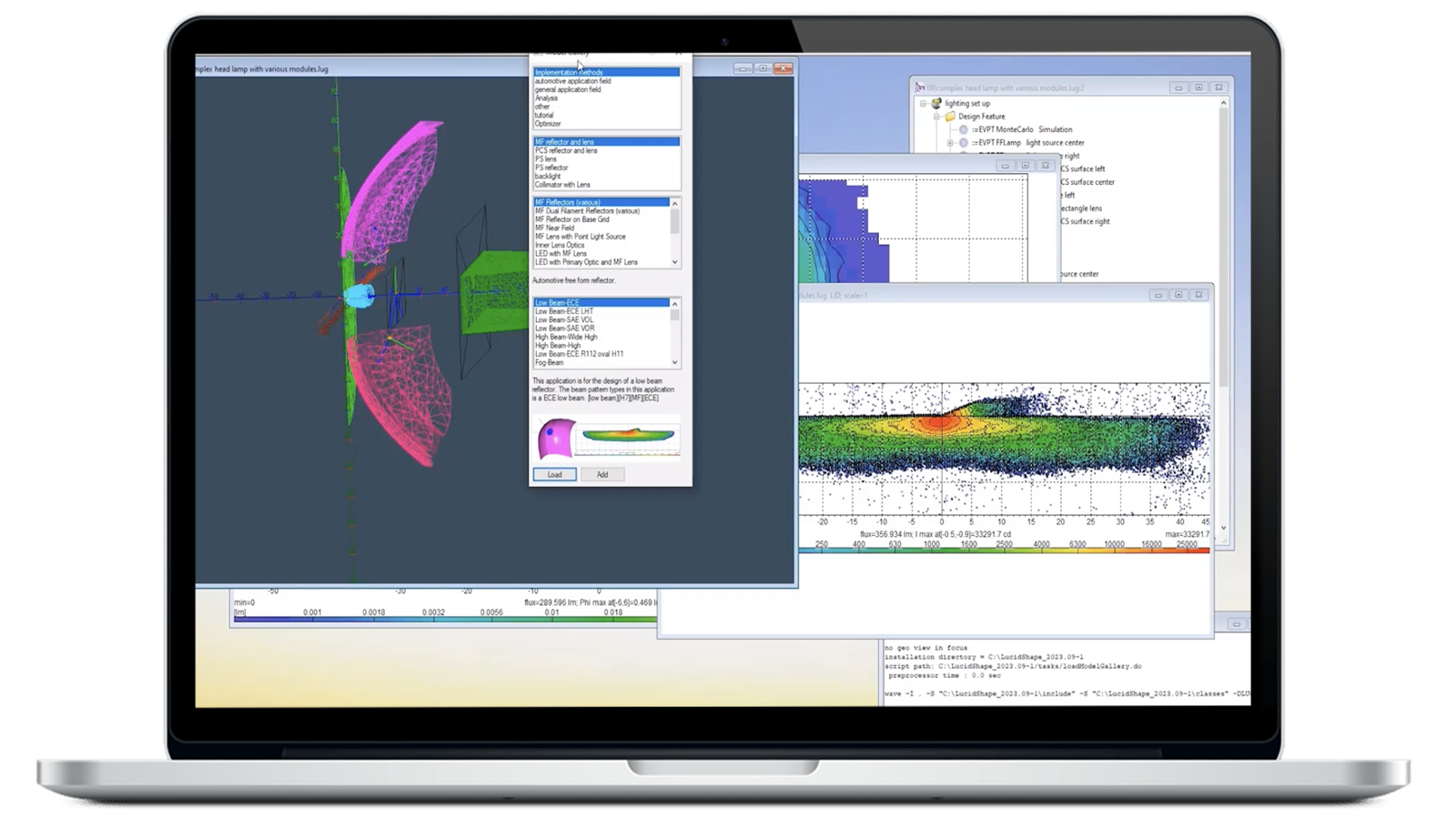
For modeling the design and real-time simulation of automotive forward, rear, and signal lighting, Keysight’s LucidShape software provides a complete set of design, simulation, and analysis tools for superior automotive optical designs.


LucidShape
LucidShape allows you to execute the whole development process in a standalone version independently of your CAD software.


LucidShape CAA V5 Based
LucidShape CAA V5 Based is a CATIA integrated optical design software that enables you to use CATIA operations and functionalities immediately in the development process.


LucidShape Modules
LucidShape and LucidShape CAA V5 Based offer additional modules that help you make the development process for automotive lighting even more effective.
- To demonstrate luminance effects when light sources in a model are illuminated and depict all interactions between system geometry and light sources, use LucidShape Visualize Module. Designers can then evaluate how the human eye will perceive a lighting system such as turn signals and brake lights.
- The Light Guide Designer Module for LucidShape CAA V5 Based enables you to create and optimize automotive light guides applications such as daytime running lamps, turn indicators, or tail lamps. With this model you can automatically optimize the spatial uniformity or light direction of a light guide.


LucidDrive
LucidDrive is a night driving simulator that focuses on simulating and visually analyzing of headlamp light distributions.
LucidDrive complements LucidShape design tools by enabling you to analyze automotive headlamps with various road scenes. It provides a virtual reality in which to perform simulations prior to expensive fabrication and testing.
Explore Keysight Software for Automotive Exterior Lighting
Discover how LucidShape and other Keysight software tools and services can help you to bring your automotive exterior lighting designs to market faster and more efficiently.

Explore Related Blogs



Want help or have questions?