What are you looking for?
Meet the EU Alternative Fuels Infrastructure Regulation (AFIR) With Confidence
Future-proof your EV charging set up with Keysight’s AFIR-ready test solutions.
Is Your AC/DC Charging Strategy Ready for 2027?
Europe’s new Alternative Fuels Infrastructure Regulation (AFIR) is now in force, and the impact is immediate. Starting in January 2027, every new or upgraded public and private AC and DC charging station in the EU must support ISO 15118-20, including secure TLS 1.3 communication, advanced Plug & Charge (PnC) features, and V2G-ready capabilities. In other words, smart charging and seamless EV-to-grid integration are no longer optional. If you’re a testing manager, CTO, or product lead, the pressure is on.
This is a profound shift. ISO 15118-20 is not an incremental update — it's a full redesign of EV/EVSE communication, security, and service negotiation. The challenge is even bigger for AC charging, where ISO’s official test plans are not yet available, but AFIR will still require full support in less than one year.
The compliance gap: AFIR arrives faster than ISO standards will become available
The first editions of ISO 15118-21 / -23 conformance standards present a major challenge:
- ISO/IS 15118-21: Covers common requirements
- ISO/PAS 15118-23: Covers DC conformance only
- Lack of AC test coverage – both for uni- and bidirectional power flow
This means charging manufacturers must implement AC Mode 3 ISO 15118-20 before the ISO AC test plans are officially published. The ISO/PAS 15118-23 is developed towards an international standard throughout 2026 and will ultimately fill the gap for AC test plans.
- TLS 1.3 mutual authentication
- Certificate installation, update, and revocation
- Advanced PnC workflows
- Service and AC/DC charge parameter negotiation
- BPT readiness (DC today, AC-DER emerging)
- Timing-critical AC and DC charge loops
Why Choose Keysight for Your Charging Test Solution?


Accelerate Innovation with Proven Expertise
We support transition to ISO15118-20-enabled charging, leveraging decades of experience in communication and power electronics, as well as automotive testing, to enable faster time-to-market for reliable, standards-compliant, and interoperable charging solutions.


Standards Leadership and Future-Readiness
By contributing to the development of test requirements, we ensure that your solutions meet current and future charging standards needs. As a result, Keysight solutions are recognized as CharIN Conformance Test Systems (CCTS) for Basic and Extended DC EVSE application profiles.


Scalable Solutions for Every Development Stage
We offer scalable tools and services tailored to your needs. Our modular platforms grow with your project, enabling efficient testing from prototype to production.


Trusted by Industry Leaders
Major OEMs, Tier-1 suppliers, and global test laboratories such as DEKRA rely on Keysight for CCS interoperability, high-power charging validation, and ISO 15118 conformance. Read more here.
Keysight Solutions: Accelerate AFIR Compliance at Every Stage
You can meet ISO 15118-20 and AFIR requirements efficiently without overhauling your entire development process. Keysight’s expertise – from lab equipment to automated test software – helps you design, validate, and certify with confidence. We offer a turnkey solution that covers your entire development cycle, so you can affirm your charging future with less risk. Explore Keysight's charging test portfolio here.
Stage 1 – SECC Communication Development
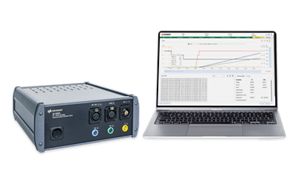
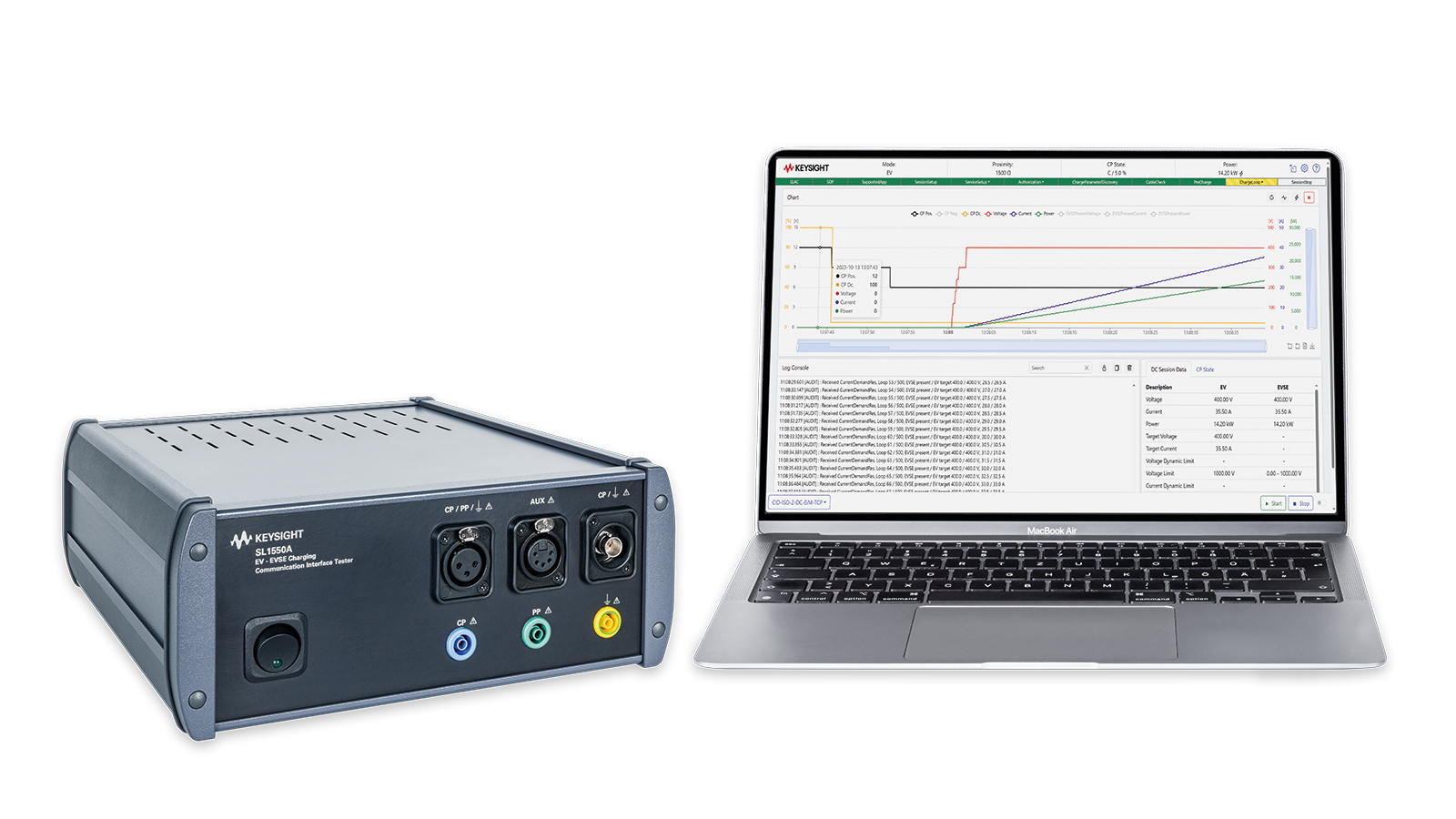
Catch issues at the component level using the Keysight SL1550A EV/EVSE Charging Communication Interface Tester. Simulate advanced scenarios with Smart Charging Emulation software to ensure protocol compliance from day one.
Outcome: A fully functional, robust ISO 15118-20 communication layer before hardware prototype.
Stage 2 – EVSE Hardware/Software Validation
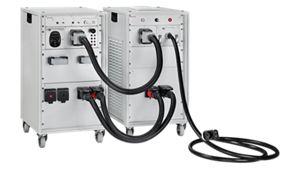
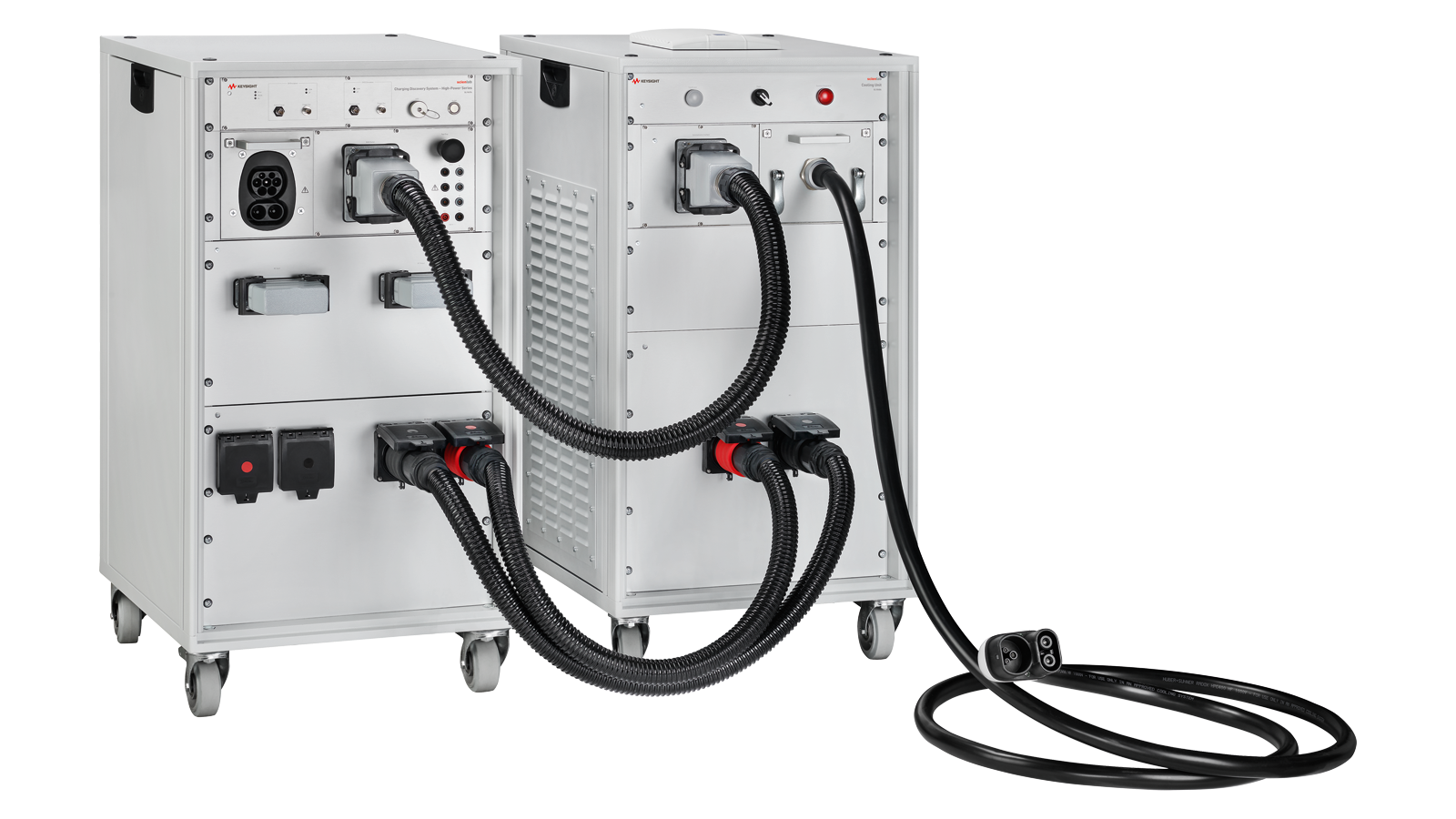
Validate your charger prototype under real-world power and load conditions using Keysight’s Scienlab Charging Discovery System (CDS) Portable or High-Power Series. Test high-power charging, fault conditions, and dynamic load changes safely in your lab.
Outcome: Your prototype behaves correctly, not just in software, but in real charging scenarios.

Stage 3 – In-House Pre-Certification
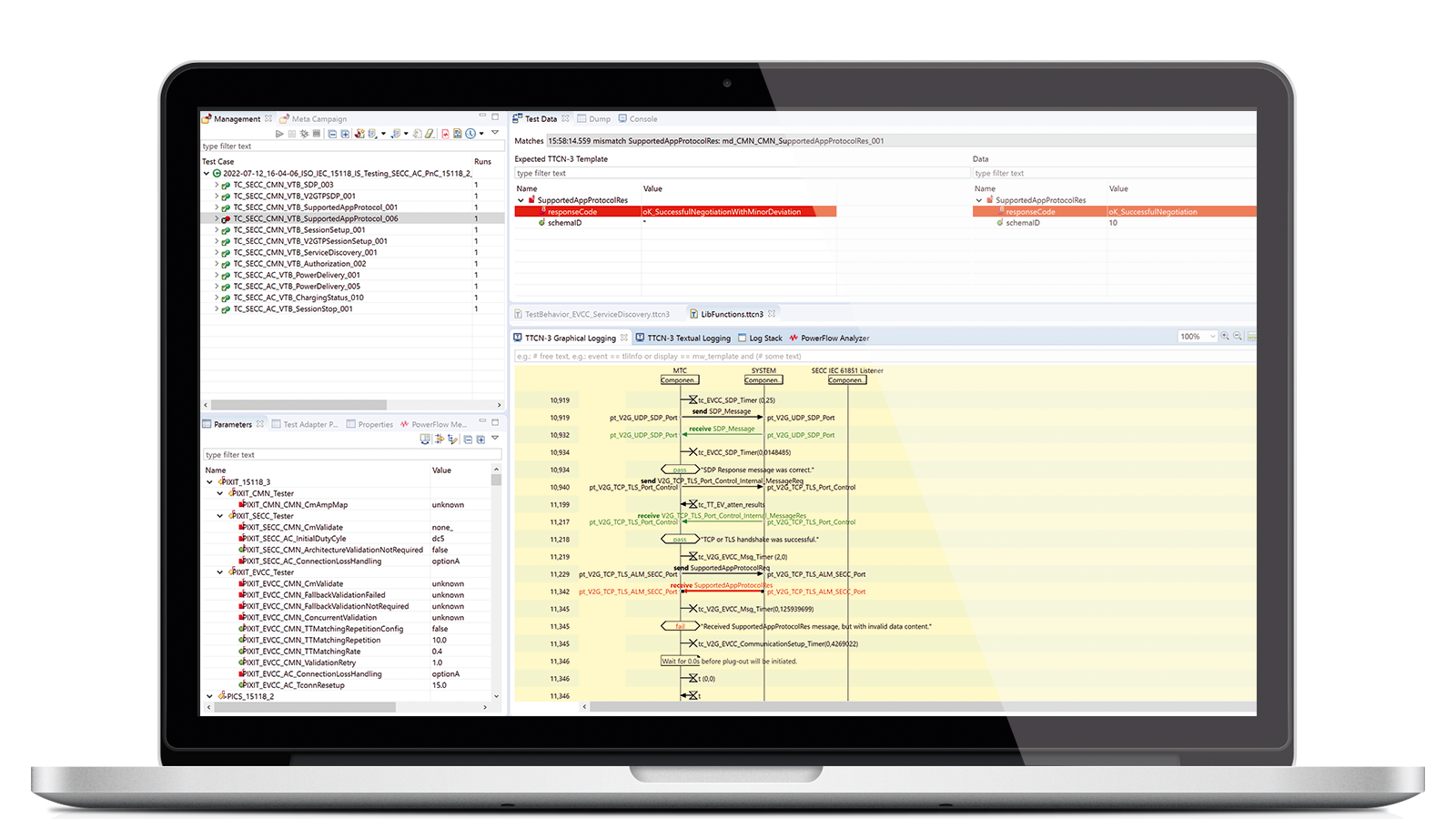
Rehearse and pre-validate all ISO 15118-20 test cases in-house using Keysight’s TTCN-3 Charging Communication Test Automation Software. Run hundreds of automated test cases aligned to the latest standards and ensure your charger is ready for certification.
Outcome: Your charger reaches certification labs already pre-compliant.
Ready to Future-Proof Your Charging Future?
AFIR and ISO 15118-20 are reshaping the e-mobility landscape. Now is the time to act and ensure your EV charging products are truly ready for the future.
With Keysight, you can accelerate development, eliminate interoperability risk, and move toward certification with confidence.


Access More Insights and Resources








AFIR – FAQs
AFIR (Alternative Fuels Infrastructure Regulation, EU 2023/1804) is a binding EU regulation that standardizes EV charging infrastructure across Europe. It ensures minimum charger coverage, full interoperability, easy ad-hoc payment, and transparent pricing, removing fragmentation and improving the EV user experience EU-wide. Its latest consolidated version from 2026-01-08 introduces extensive requirements for EV/EVSE charging communication, based on ISO 15118-2 and -20, for newly installed and renovated EVSEs.
Past:
- Apr 2024 – AFIR in force; all new public chargers must support ad-hoc payment & price transparency
- Oct 2024 – All public chargers must be digitally connected
- End 2025 – Fast-charging hubs every ~60 km on TEN-T core network (≥400 kW total)
- Jan 2026 – Newly installed and renovated AC and DC chargers that are publicly accessible must support ISO 15118-2
Future:
- Jan 2027 – All newly installed and renovated AC and DC chargers that are publicly accessible must support ISO 15118-20
- 2030+ – Expanded coverage for heavy-duty EVs and full TEN-T completion
AFIR standardizes plugs (IEC 62196-2 / -3), safety (IEC 61851-1 / -23 / -24), communication (ISO 15118-2 / -20), metering and payment (MID Directive 2014/32/EU), and digital connectivity (commonly via OCPP) to guarantee interoperable, user-friendly EV charging across the EU.
Failure to comply with AFIR is taken seriously – for both charging point operators and EU member states – and can lead to penalties or other enforcement actions. Since AFIR is an EU regulation, its requirements are legally binding. Here are some potential consequences of non-compliance:
- Potential fines and regulatory penalties
- Mandatory retrofits or shutdown of chargers
- Loss of public funding eligibility
- Reduced visibility in roaming apps and navigation systems
Manufacturers of charging equipment play a critical role in meeting AFIR’s requirements. To ensure chargers are AFIR-compliant, manufacturers should take a proactive, “compliance by design” approach.
Keysight supports AFIR compliance by providing EV/EVSE emulation, conformance and interoperability test solutions for ISO 15118-2 and ISO 15118-20 enabling manufacturers to verify their design and its compliance early and reduce certification and deployment risk.
Want Help or Have A Question?