
From Mission Requirements to Image Performance
기술 개요
Imaging-system performance depends on far more than optical design alone. Detector characteristics, sampling, noise, manufacturing tolerances, focus variations, and image processing all influence the quality of the final image. While traditional component-level metrics provide essential insight into individual design elements, they do not always reveal whether a complete imaging system will meet its intended operational requirements.
This technical overview demonstrates how ImSym enables system-level image simulation to support informed engineering decisions throughout the development of complex imaging systems. Using a representative remote-sensing trade study, it illustrates a connected workflow that progresses from initial mission objectives through optical architecture selection, detector evaluation, system-level analysis, and final image simulation.
The study begins with a Level 0 mission objective and explores how early design requirements can be translated into practical optical and detector tradeoffs. Engineers can evaluate alternative configurations, investigate system sensitivities, and understand how individual design decisions influence overall imaging performance. By incorporating detector behavior, sampling effects, focus variations, noise, and image processing, ImSym provides a more comprehensive representation of the complete imaging chain.
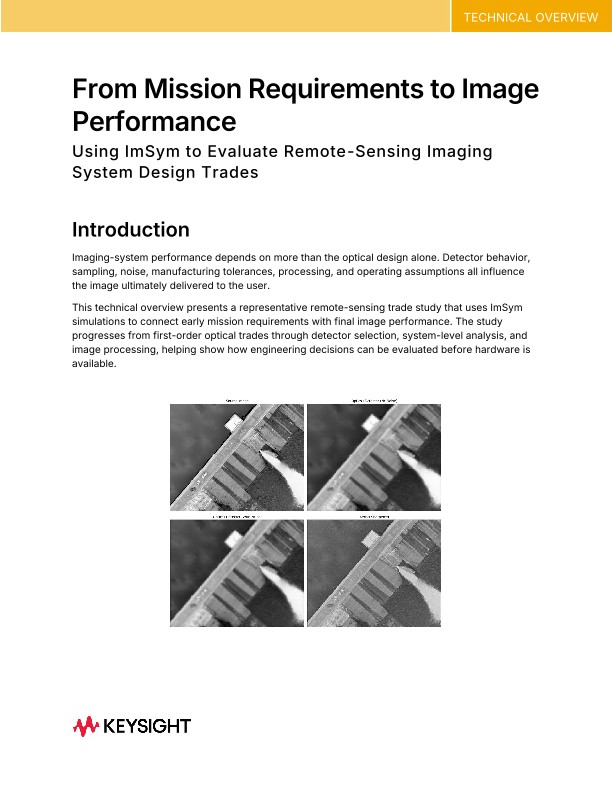
A key element of the methodology is the use of simulated imagery to connect engineering metrics with observable system performance. Realistic scenes help demonstrate how design choices affect the images ultimately delivered to users, while purpose-built targets enable quantitative evaluation against defined performance requirements. This combination provides valuable insight beyond conventional optical metrics, helping engineering teams assess whether proposed designs are likely to satisfy mission objectives.
By bringing optical, detector, and processing considerations together within a unified simulation environment, ImSym supports earlier evaluation of design alternatives and clearer communication between engineering disciplines. Teams can identify performance sensitivities, investigate potential limitations, and determine where additional analysis or refinement is required before committing to physical hardware.
This technical overview highlights how end-to-end image simulation helps bridge the gap between component-level analysis and mission-level performance, supporting more confident design decisions and efficient development of advanced remote-sensing imaging systems.