












- Overview
- All Models
- Support
Streamlined in-circuit test solution for production test
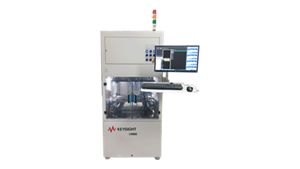
Keysight Advanced Parallel Test Systems deliver essential test coverage with a compact, cost-effective design ideal for lean manufacturing environments. The advanced parallel test systems integrate key features like boundary scan, flash programming, and vectorless test capabilities into a simplified platform, built for reliable and efficient testing of analog, digital, and mixed-signal PCBs. Its modular architecture supports scalability and customization, allowing you to tailor the system to your production requirements. With intuitive software tools and seamless automation interfaces to streamline test development and reduce time to production. Request a quote for one of our popular configurations today. Need help selecting? Check out the resources below.
Built-in digital and analog test
Perform analog and digital measurements in one system to reduce equipment overhead and enable comprehensive mixed-signal testing.
Vectorless test capability
Identify soldering and placement defects on dense PCBs without powered digital vectors, simplifying test setup and speeding development.
Boundary scan integration
Easily test digital interconnects and fine-pitch components like BGAs to improve fault coverage in dense PCB designs and ensure reliable connectivity.
Compact, standalone design
Space-saving footprint integrates without needing external controllers, making it ideal for manufacturers with limited factory floor space.
-
System width
630 mm to 1200 mm
-
Maximum node count
512 to 3456
-
Fixture actuation
Press down
-
Maximum parallel testing
1, 4
Most popular configurations
Flexicore i1000 Automated Inline Parallel ICT System
- In-Circuit Testing for High-Speed, Complex Electronics
- How to Perform Automotive Fuse Box Testing
- How to Integrate the Board Handler with In-Circuit Testers
Services and support
Innovate at speed with curated support plans and prioritized response and turn-around times.
Get predictable, lease-based subscriptions and full lifecycle management solutions—so you reach your business goals faster.
Experience elevated service as a KeysightCare subscriber to get committed technical response and more.
Ensure your test system performs to specification and meets local and global standards.
Make measurements quickly with in-house, instructor-led training, and eLearning.
Download Keysight software or update your software to the newest version.
Frequently asked questions
A parallel test system allows multiple devices or board assemblies to be tested simultaneously rather than sequentially. This increases throughput by utilizing shared test resources, reducing idle time, and optimizing tester utilization. This approach minimizes bottlenecks and improves efficiency without requiring additional test stations in high-volume manufacturing. Parallel testing also supports scalable configurations, enabling manufacturers to adjust capacity based on demand.
With the ability to isolate and execute independent test plans per site, such systems provide flexibility in handling different products or test requirements on the same platform. Engineers can perform concurrent functional, in-circuit, or parametric tests, speeding up production cycles while maintaining test coverage and accuracy.
Parallel test architecture is especially valuable when testing multi-board panels or assemblies with similar architectures. It is ideal for consumer electronics, automotive ECUs, and communications products where fast, repeatable, and reliable testing is critical.
Maintaining test integrity in a parallel environment is essential to ensure accurate and reliable results. To do this, a well-designed test system employs electrical isolation and independent measurement channels for each unit under test (UUT). Each site operates autonomously with dedicated signal switching, power sourcing, and measurement resources to prevent crosstalk or interference. Software-level management ensures proper test sequencing, synchronization, and data logging without overlap or error. Built-in diagnostics and real-time monitoring continuously assess the health of each channel, identifying anomalies that could affect results.
Additionally, site-specific calibration ensures measurement precision across all UUTs, regardless of their load or signal conditions. Parallel systems also support fail-safe mechanisms and error handling that isolate failing units without disrupting ongoing tests on other channels. This architecture ensures that the advantages of speed and efficiency in parallel testing do not compromise the quality, repeatability, or traceability of test outcomes.
A parallel test system supports various test methodologies, making it suitable for comprehensive validation of electronic assemblies. Commonly supported tests include in-circuit testing, functional testing, parametric measurements, continuity checks, and analog/digital signal verification. The system can also execute boundary scan testing and power-on self-tests for embedded components. Each channel can be configured independently, allowing simultaneous execution of distinct test sequences for different board designs or revisions.
Additionally, the system can handle high-speed digital signals, mixed-signal circuits, and communication interfaces such as USB, CAN, or Ethernet. Advanced signal switching and instrumentation integration can validate power consumption, clock frequency, and timing parameters. The platform’s flexibility allows integration with external instruments, such as oscilloscopes or spectrum analyzers, for extended test capability.
This system is ideal for industries that require rigorous and repeatable testing, including automotive, telecommunications, consumer electronics, and industrial control applications.
Implementing a parallel test strategy introduces some complexities that must be managed carefully. One of the primary challenges is ensuring signal isolation and avoiding interference between multiple active test sites. This requires careful hardware design, shielding, and grounding practices. Another concern is managing the increased data flow from multiple test points, which can overwhelm traditional data processing systems if not properly architected.
To address this, efficient test sequencing software and high-performance computing resources are often employed. Test development becomes more complex, as engineers must create scripts and logic that support concurrent execution, conditional branching, and site-specific test plans. Fixture design is also critical; poor fixture tolerances can lead to contact failures or false results. Debugging failures in a multi-site environment may be more difficult, as issues may be isolated to specific channels. Thorough validation, robust diagnostics, and real-time monitoring tools are essential to deploy and maintain a reliable parallel test operation successfully.