Choose a country or area to see content specific to your location
What are you looking for?
-
-
Integrated Physics Suite
Bridging design and physical testing to evaluate drop, impact, shock, and vibration compliance before hardware exists.


-
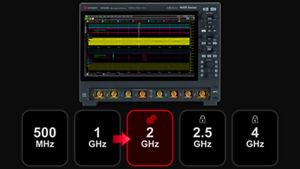
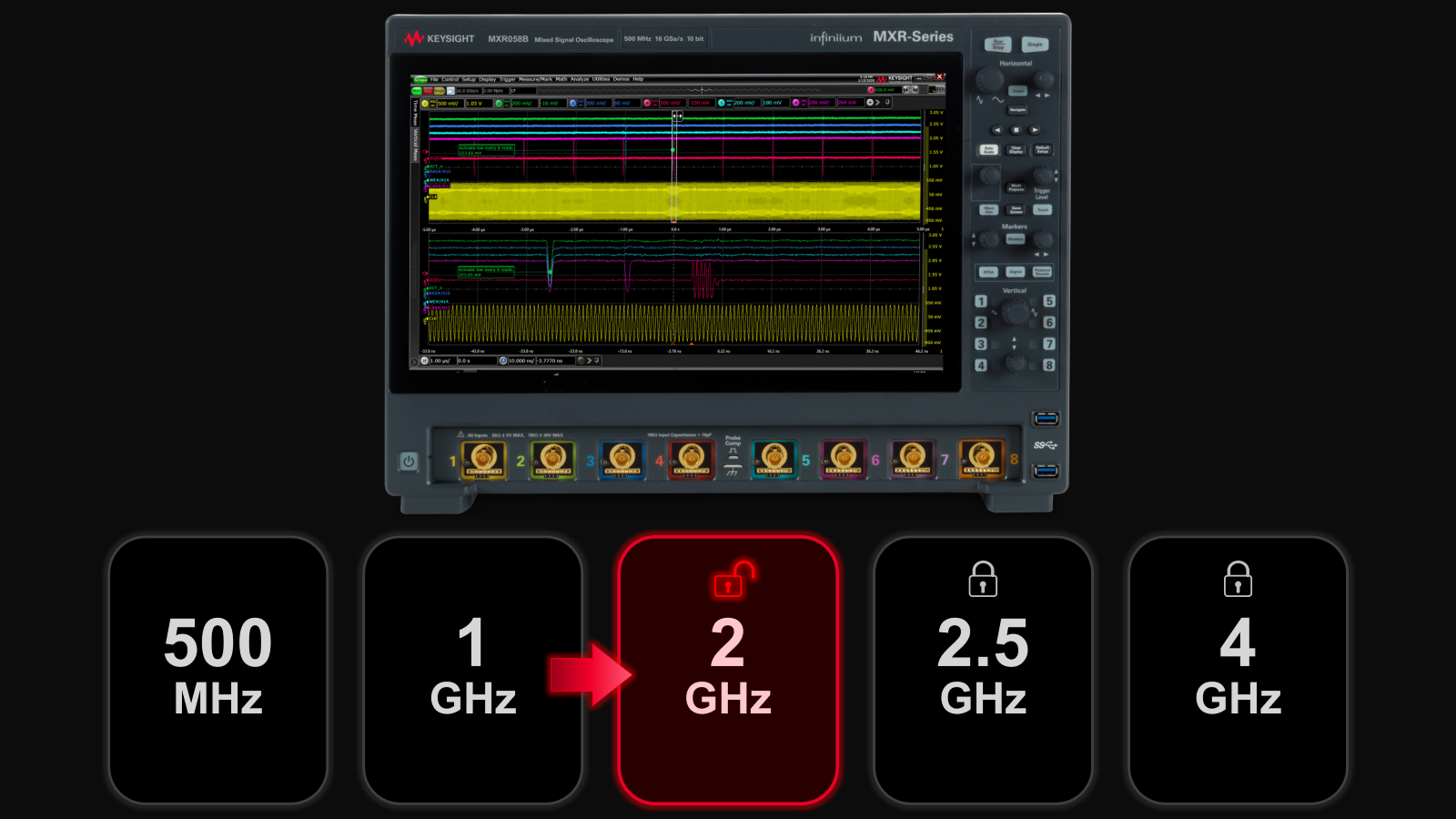
Buy an Expert Oscilloscope, Boost Your Bandwidth
Unlock your free upgrade to the next bandwidth tier.
-
End-to-End Validation for AI Data Center
Strengthen 1.6T network reliability for AI-scale workloads from transceivers to interconnects.

-
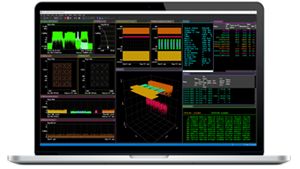
Take On Complex MIMO Signals
Pair Keysight VSA software with the new XA5 signal analyzer for advanced visualization, demodulation, and analysis — start your 30-day trial today.
-
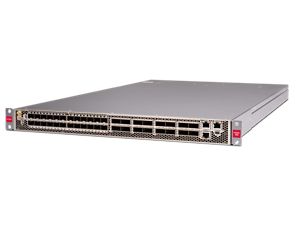
Introducing AI-Enhanced Packet Brokers
With extra memory and storage, these enhanced NPBs run Keysight's AI security and performance monitoring software and AI stack.
-
Accelerate Semiconductor Innovation
Explore end-to-end workflows spanning IC design, validation, wafer test, and photonics.
-
Accelerate Your Innovation Engine
Explore curated support plans, prioritized to keep you innovating at speed.

-
448 Gb/s Waveform Generation
Achieve 200+ Gbaud multi-level modulated signals with high-speed AWGs for digital and optical standards.
-
The Right Connection Makes the Measurement
Maximize accuracy and performance with precision accessories engineered for Keysight instruments.

Analyze Complex RF Signals FasterExplore dual-channel and ultra-wideband signal analysis for demanding RF workflows.
 Digital Validation. Faster.
Get faster, clearer insights with our new multicore, 12-bit oscilloscope up to 33 GHz. Trade in your old oscilloscope and get credit toward a new XR8.
-
-
Purpose-built solutions engineered for the design and test challenges unique to your industry.
Use Cases mapped to every stage of your product lifecycle, from design through operations.
Success Stories
HPE Juniper Networking Builds Next-Gen AI Infrastructure -
Authoritative application notes, data sheets, reference designs, and test procedures to accelerate design and validation decisions.
FeaturedHands‑on bootcamps that teach system design, test methods, and production workflows engineers can apply immediately.
Learning Hub
AI TechnologyExplore methodologies, test strategies, and technical resources for designing, validating, and scaling AI systems and networks.
-
Quick access to support related self-help tasks.
Additional content to support your product needs.
Do more with Keysight ServicesExplore services to accelerate every step of your innovation journey.










Full Vehicle OTA Testing Measurement solution using advanced software methods to accelerate passive and active testing of vehicle-integrated antennas


- Overview
- All Models
- Accessories
- Software
- Support
Optimize Full Vehicle OTA Testing for Reliable Connectivity
The Full Vehicle OTA Testing solution combines RF instrumentation and advanced OTA (over-the-air) antenna measurement software, integrated in an automotive-grade anechoic chamber, to improve efficiency in full vehicle antenna testing. It supports passive and active measurements such as TRP, TIS, EIRP, and EIS for both SISO and MIMO antennas. It helps reduce test time, complexity, and the required chamber size.
Advanced OTA Methodologies
Leverage differentiated ANF and RTS methods to improve OTA measurement efficiency across full‑vehicle validation workflows.
Repeatable Results
Patented AUT offset compensation reduces sensitivity to antenna positioning offsets for more consistent, repeatable outcomes.
SISO and MIMO Coverage
Measure and validate performance across single‑input, single‑output (SISO) and multiple‑input, multiple‑output (MIMO) antenna configurations.
Higher Throughput, Lower Cost
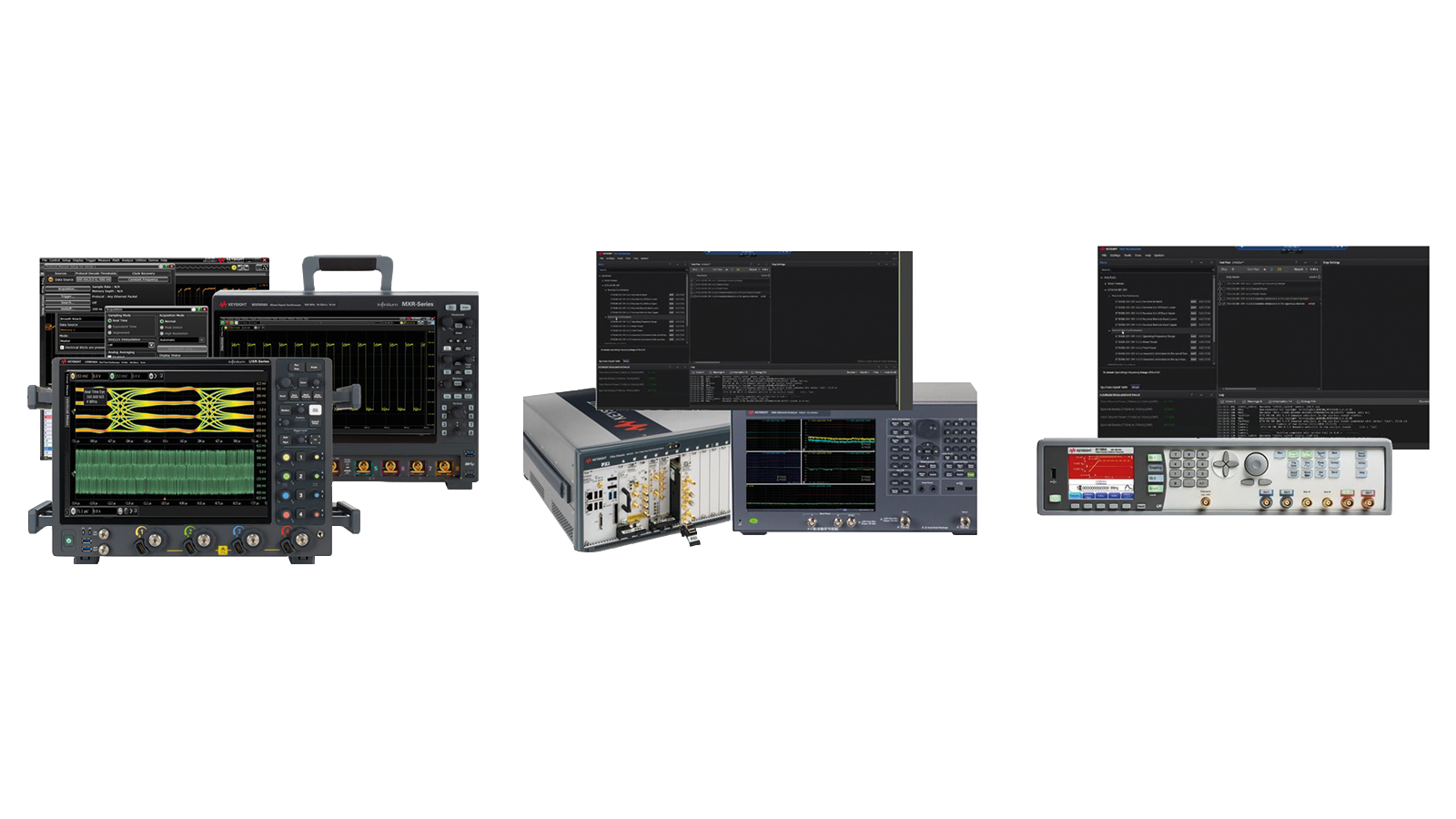
Keysight’s Automotive Over-the-Air (OTA) Measurement Sub-System combines test equipment and innovative software to boost test efficiency while reducing costs.
-
Measurement type
RP, TIS, EIS, EIRP, Antenna Radiation Pattern
-
Technology
LTE, 5G NR, GNSS, UWB
-
Use cases
Active and Passive Antenna OTA Testing
Most Popular Configurations
Automotive Over-the-Air Testing Solution
AT1000L Automotive OTA measurement sub-system for SISO/MIMO antennas, passive and active test (TRP/TIS/EIS/EIRP) for reliable automotive connectivity.
AT1000L Automotive OTA measurement sub-system for SISO/MIMO antennas, passive and active test (TRP/TIS/EIS/EIRP) for reliable automotive connectivity.
Automotive Over-the-Air Testing Solution
AT1000L
AT1000L Automotive OTA measurement sub-system for SISO/MIMO antennas, passive and active test (TRP/TIS/EIS/EIRP) for reliable automotive connectivity.
Innovative Automotive Over-the-Air Methodologies Improving Testing Efficiency
In the evolving automotive connectivity landscape, vehicles use various antennas to support functions like entertainment, navigation, safety, autonomous driving, and intelligent transportation. Testing full vehicle antenna is complex and costly due to the need for enormous size chambers. High sampling rates remove the eccentricity issue while decreasing the test efficiency. In this comes challenges of cost, complexity, and time-to-market.
Addressing these challenges, Keysight’s Automotive Over-the-Air (OTA) Measurement Sub-System offers measurement instruments and innovative software to reduce testing complexity and time. For both passive and active tests, Single Input, Single Output (SISO), and Multiple Input Multiple Output (MIMO) testing. The sub-system provides comprehensive testing capabilities for vehicle antennas, ensuring reliable performance and connectivity. Leverage innovative software methods to boost test efficiency and reduce costs.
- Passive and active tests (TRP, TIS, EIS, EIRP)
- Differentiated Asymptotic Near Field (ANF) method testing software
- Enabling fast EIRP/EIS SISO testing
- No requirements for large chamber
- Radiated-Two-Stage (RTS) method for MIMO testing software
- Total Radiated Multi-Antenna Sensitivity (TRMS)
- Throughput, uncertainty
- Patented Antenna Under Test (AUT) offset compensation software
- Pathwave Test Automation software
- Cooperate with global system integrators
- Keysight provides the instruments and software as a sub-system, while the system integrator supplies the anechoic chamber and handles full integration, resulting in a comprehensive vehicle OTA testing solution
Services and support
Innovate at speed with curated support plans and prioritized response and turn-around times.
Get predictable, lease-based subscriptions and full lifecycle management solutions—so you reach your business goals faster.
Experience elevated service as a KeysightCare subscriber to get committed technical response and more.
Ensure your test system performs to specification and meets local and global standards.
Make measurements quickly with in-house, instructor-led training, and eLearning.
Download Keysight software or update your software to the newest version.
Frequently Asked Questions
Full-vehicle OTA testing measures an antenna’s wireless performance with all antennas and modules integrated into the final vehicle environment. It validates real-world effects like antenna radiation patterns, sensitivity, and total radiated performance, including interference and co-existence issues that can be introduced by the vehicle structure, materials, and onboard electronics. This takes place in a fully shielded (anechoic) chamber that eliminates external interference signals, ensuring accurate, reproducible results.
The number of wirelessly connected devices integrated into vehicles is increasing, and with it the system’s complexity. Crosstalk and interference negatively impact their operation, and ultimately, the quality-of-service experienced by the user. Testing the integrated system before vehicle roll out helps mitigate those physical layer challenges on time.
With increasing operating frequencies, the antenna far field increases. As antennas are installed in various spots on or within the vehicle’s metallic hull, their far field, and therefore, the antenna radiation pattern, changes. Additionally, multiple antenna’s co-existence within the same vehicle must be tested in a realistic setup.
Large antenna far fields require extremely large anechoic chambers. Near field to far field NF2FF transformation algorithms are time consuming. High sampling rates remove the antenna placement eccentricity while decreasing test efficiency. This results in increased cost, complexity, and time-to-market.