How to Verify Automotive Ethernet Transmitter Compliance
Perform Automotive Ethernet Electrical Tests Using IEEE and OPEN Alliance Specifications
Physical layer electrical tests for automotive Ethernet transmitter compliance involve executing a wide range of conformance tests with different tests for different data rates. Two standards governing bodies for automotive Ethernet, the IEEE, and the OPEN Alliance, specify the conformance tests and test cases. The tests are defined to verify a deployment ready transmitter for data rates ranging from 10 Mbps to 10 Gbps. Supported technologies include 10BASE-T1S, 100BASE-T1, 1000BASE-T1, multigigabit Automotive Ethernet (2.5GBASE-T1, 5GBASE-T1, and 10GBASE-T1).
Performing the automotive Ethernet conformance test requires an oscilloscope. Additional equipment is required for a few of the tests including a network analyzer for MDI return loss and MDI mode conversion loss, and an arbitrary waveform generator (AWG) or function generator is required for transmitter distortion testing at 100 Mbps and 1 Gbps. In addition to measurement data, a wide range of electrical tests must be performed to obtain a margin analysis report showing how closely each automotive Ethernet device passed or failed each test.
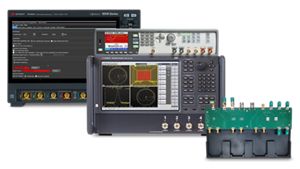

Automotive Ethernet Transmitter Compliance Test Solution
See Demo of Automotive Ethernet Transmitter Validation
Explore Products in our Automotive Ethernet Transmitter Compliance Solution
-

![]()
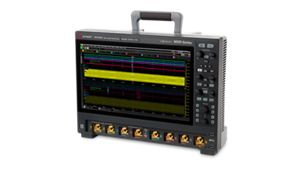
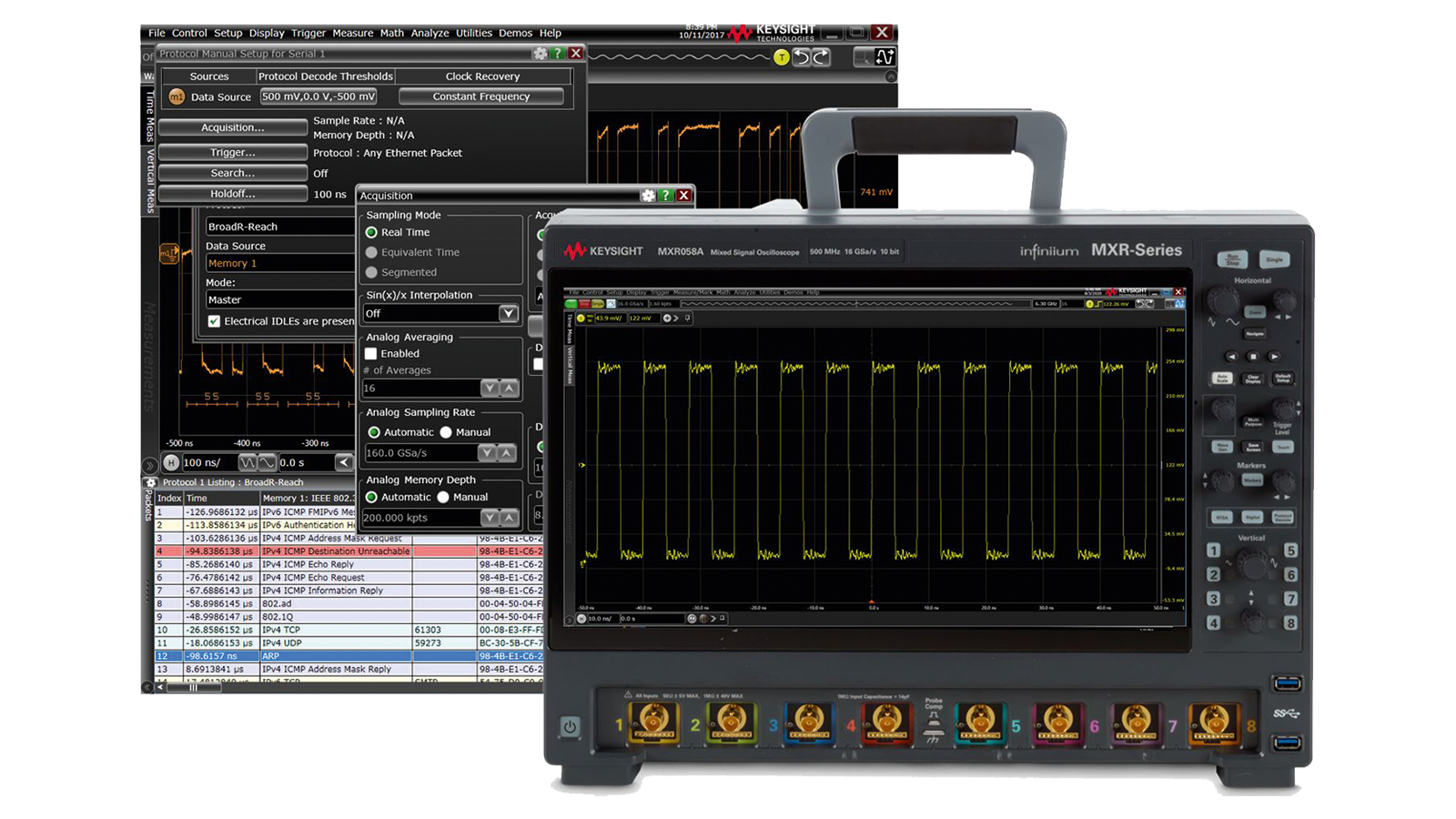
MXR058B Infiniium MXR B-Series Oscilloscope: 500 MHz, 8 Channels
-
![]()
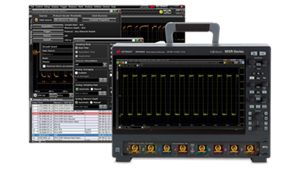
AE6000T Automotive Ethernet Tx Compliance Solution


Discover Resources and Insights
Additional Resources for Automotive Ethernet Transmitter Compliance Test
Related Use Cases

-
![]()
Learn More
How to Characterize Automotive Serial Buses
Characterizing automotive serial buses requires debugging and correlating data transfers with other mixed-signal interactions. Learn how to use an oscilloscope and protocol decode software to debug CAN, CAN FD, CAN XL, LIN, and other automotive serial bus standards.
Learn More

-
![]()
Learn More
How to Monitor Battery Health and Temperature
Designing and testing battery systems in e-mobility applications requires precision measurements across many signal types, wide temperature ranges, and multiple channels. Learn how to use a data acquisition system, multi-channel switch multiplexer modules, DAQ PC application software, bidirectional DC power supplies, and various temperature sensors to monitor battery health and temperature.
Learn More
-
![]()
Learn More
How to Test Autonomous Driving NCAP Scenarios
Emulating complex traffic scenes requires a full-scene emulator that bridges the gap between software, simulation, and on-road testing. Learn how to quickly test autonomous driving systems with radar sensors to a high degree of confidence and with highly complex, multi-target scenes against New Car Assessment Program (NCAP) scenarios.
Learn More
Frequently Asked Questions About Automotive Ethernet
Automotive Ethernet is a high-speed, low-latency physical layer in-vehicle communication network designed for automotive connectivity applications. It is adapted from the established Ethernet standards and complements the traditional controller area network or CAN bus, suited for cost-sensitive low-speed control applications. Unlike the traditional Ethernet, automotive Ethernet offers high-speed data transfer and high-volume data communication, all in a single twisted pair cable for full duplex communication. It has low latency, which is critical for real-time systems like advanced driver-assistance systems (ADAS).
The ethernet standard has been adapted into the automotive industry with amendments to incorporate additional requirements and features to enable the explosion of in-vehicle infotainment, ADAS, onboard diagnostics, and wireless connectivity, such as 5G and V2X. Unlike conventional automotive networks that can only support data transfer rates of up to 1 Mbps, automotive Ethernet provides much higher bandwidth and lower latency for mission-critical data transmission between sensors such as radar, lidar, cameras, and onboard controls. The in-vehicle network is transitioning towards automotive Ethernet and SerDes for high-speed, low-latency data communications applications. Check out this blog on "Why use 10Base-T1S instead of CAN and its variants?" on the transition towards a more homogenous automotive Ethernet network.
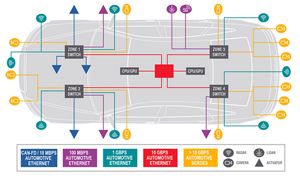
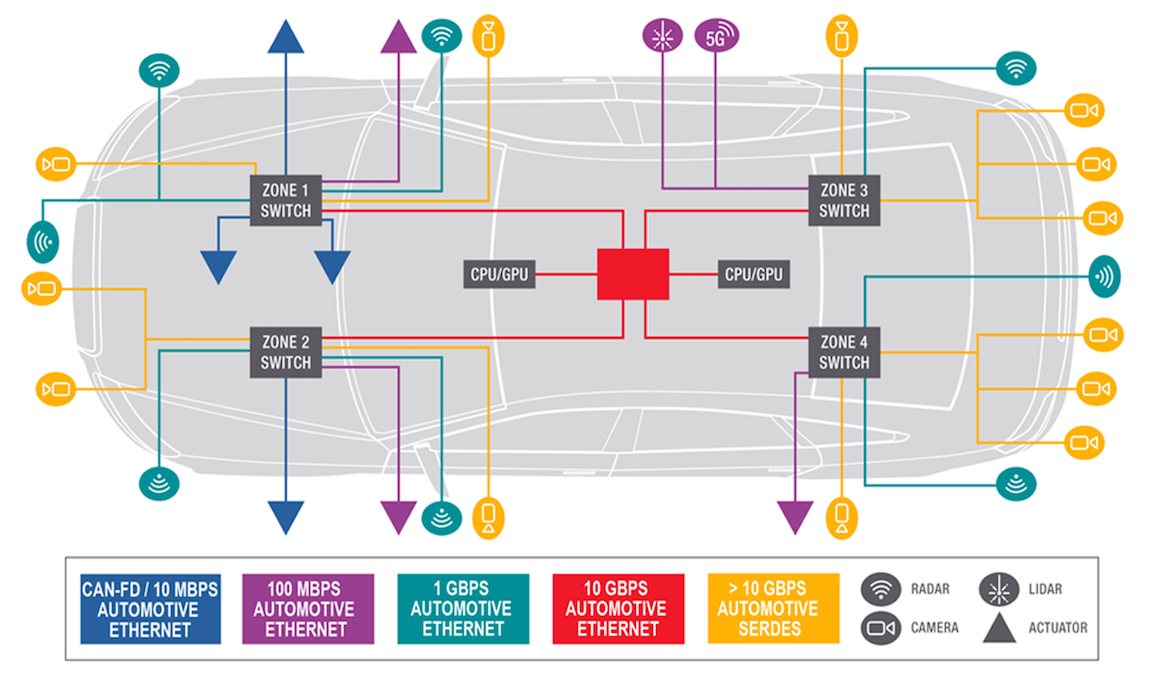
Automotive Ethernet offers higher data rates, making them ideal for mission-critical ADAS and autonomous driving applications.
Implementing automotive Ethernet for in-vehicle networks requires making sure the designs comply with industry standards, including:
- Transceiver testing for Open Alliance TC1, TC8, TC12, TC15 and IEEE 802.3cg, 802.3bw, 802.3bp, and 802.3ch
- Receiver testing for OPEN Alliance TC1, TC12, IEEE 802.3bw and 802.3bp
- Protocol trigger and decode for IEEE 802.3bw and 802.3bp
- Channel testing for Open Alliance TC1, TC9, TC15, IEEE 802.3bw, 802.3bp and 802.3ch
You can use protocol triggering and decode software to configure protocol-level trigger conditions specific to automotive Ethernet. This allows you to eliminate errors by viewing packets at the protocol level. Decoding at the protocol layer enables you to map errors back to the physical bus and debug the root causes of the errors.
Automotive Ethernet first saw the introduction of lower speeds (10 Mbps) and multigigabit speed applications in 2019 and 2020. Now automotive Ethernet PHY standards under IEEE 802.3ch are available for 2.5 Gbps, 5 Gbps, and 10Gbps, called IEEE 802.3ch. The NAV Alliance has working groups working to create physical layer specifications and management parameters for 25 Gbps and 50 Gbps electrical interfaces for automotive Ethernet networks.

Get in Touch with One of Our Experts
Need help finding the right solution for you?