











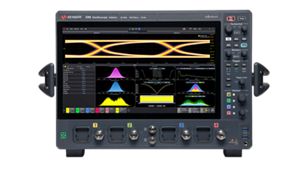


- Overview
- All Models
- Support
Broad frequency coverage, compact design, and precise testing
Keysight multiband RF vector transceivers are now offered in one capability class, the VT5-class, and include the S9100A-S9130A multiband RF vector transceivers. These transceivers provide broad frequency coverage and wide bandwidth, enabling comprehensive testing of 5G infrastructure equipment, including transmit, receive, fading simulation, and over-the-air (OTA) scenarios. They support both 5G frequency range 1 (FR1, sub-6 GHz) and frequency range 2 (FR2, mmWave) bands in a compact, scalable system that streamlines setup and adapts to evolving needs. Leverage the extensive Keysight software portfolio for signal generation and analysis and streamlined automation. Choose on of our popular configurations or configure one specific to your application. Need help selecting? Check out the resources below.
Full-spectrum 5G testing
Supports end-to-end 5G testing across FR1 (sub-6 GHz) and FR2 (mmWave) bands in a single system, minimizing rack space and simplifying test setups.
Wide instantaneous bandwidth
Enables single-measurement capture and analysis of complex wireless signals, improving test speed, accuracy, and support for technologies like multiple-input multiple-output (MIMO) and beamforming.
Integrated and scalable
Combines critical test functions, including transmit, receive, fading simulation, and over-the-air (OTA) testing, into a single scalable system, ensuring interoperability and optimized workflows.
Multichannel synchronization
Enables tight timing and phase alignment across multiple transmit and receive paths, important for complex wireless testing like multi-antenna systems and phased array validation.
-
Maximum frequency
6 GHz to 49.2 GHz
-
Maximum bandwidth
600 MHz to 1.2 GHz
-
Wireless standard
FR1, FR2, NTN
Most popular configurations
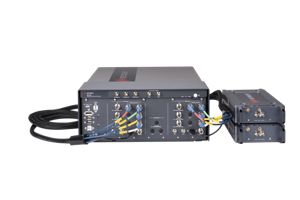

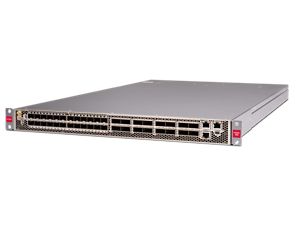
VT5-class Vector Transceiver, for 5G multiband testing
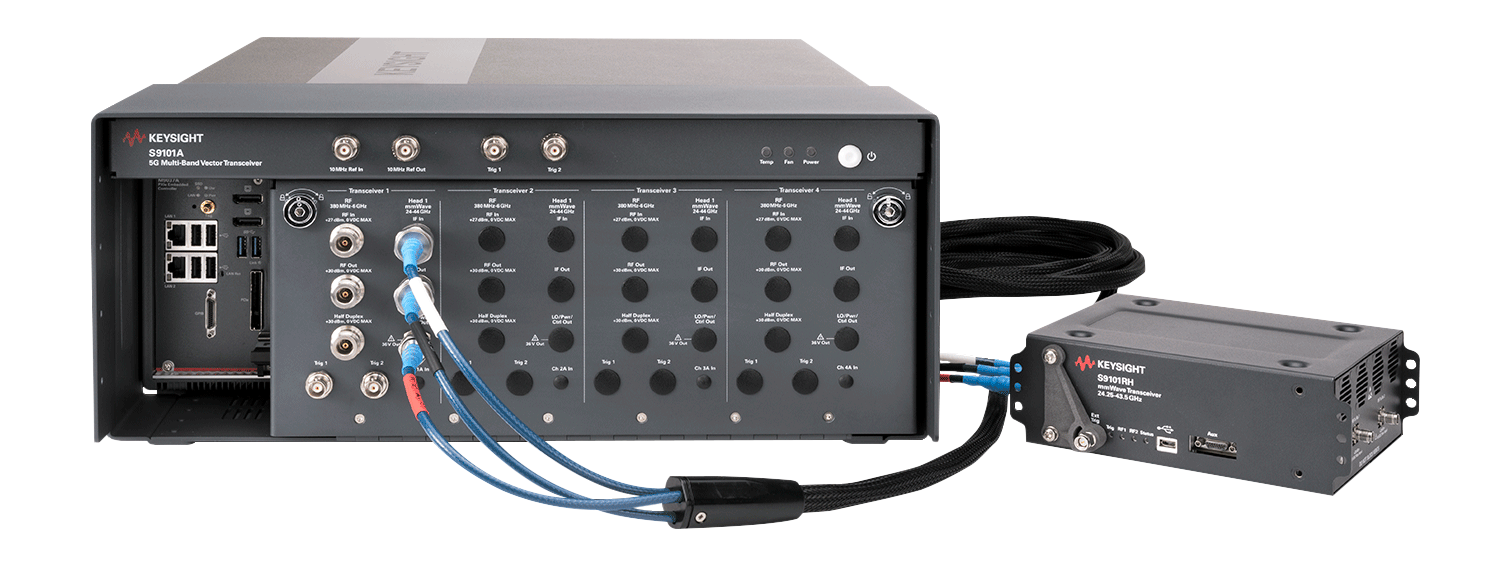
VT5-class Vector Transceiver, for 5G multiband testing
Services and support
Innovate at speed with curated support plans and prioritized response and turn-around times.
Get predictable, lease-based subscriptions and full lifecycle management solutions—so you reach your business goals faster.
Experience elevated service as a KeysightCare subscriber to get committed technical response and more.
Ensure your test system performs to specification and meets local and global standards.
Make measurements quickly with in-house, instructor-led training, and eLearning.
Download Keysight software or update your software to the newest version.
Frequently asked questions
Beamforming requires precise, real-time channel state information (CSI) from the UE to customize the beam. It needs full digital control of the amplitude and phase at every antenna element. In a predominantly Line-of-Sight (LoS) channel with users in different locations, beamforming will generate a beam towards each user simultaneously. More transmit/receive (Tx/Rx) antennas help compensate for high losses at mmWave frequencies. A greater number of radiating elements enables you to steer the antenna in a certain direction. The beams become narrower and more defined as the number of antenna elements increases. All the available power is transmitted in a certain direction instead of being wasted in many different ones.
In the 5G New Radio (NR) initial access procedure, multiple synchronization signal blocks (SSBs) are sent in a burst set period, each SSB potentially in a different beam. The UE identifies every SSB in the burst set using the physical broadcast channel demodulation reference signal (PBCH DMRS) and the rest of the SSB index carried by the broadcast channel. After sweeping the beam, the UE then selects the best SSB and establishes the connection.
OTA RF testing refers to the process of evaluating the performance and behavior of wireless devices by transmitting and receiving RF signals through the air, without using direct cable connections. Unlike traditional conductive testing, OTA tests replicate real-world usage scenarios, including the effects of antenna performance, propagation conditions, multipath, interference, and environmental influences.
OTA testing typically involves placing the Device Under Test (DUT) within an RF-shielded chamber equipped with calibrated antennas. Signals are radiated toward the DUT from various angles, distances, and polarizations to assess parameters such as:
• radiated power and sensitivity
• antenna efficiency and gain
• throughput and data rates
• spatial correlation and MIMO capacity
This methodology is essential for modern wireless technologies, including 4G LTE, 5G NR (especially at mmWave frequencies), Wi-Fi, IoT devices, and satellite communications, ensuring reliable real-world performance before product deployment.
Beamforming requires precise, real-time channel state information (CSI) from the UE to customize the beam. It needs full digital control of the amplitude and phase at every antenna element. In a predominantly line of sight (LoS) channel with users in different locations, beamforming will generate a beam towards each user simultaneously. More transmit/receive (Tx/Rx) antennas help compensate for high losses at mmWave frequencies. A greater number of radiating elements enables you to steer the antenna in a certain direction. The beams become narrower and more defined as the number of antenna elements increases. All the available power is transmitted in a certain direction instead of being wasted in many different ones.
In the 5G New Radio (NR) initial access procedure, multiple synchronization signal blocks (SSBs) are sent in a burst set period, each SSB potentially in a different beam. The UE identifies every SSB in the burst set using the physical broadcast channel demodulation reference signal (PBCH DMRS) and the rest of the SSB index carried by the broadcast channel. After sweeping the beam, the UE then selects the best SSB and establishes the connection.