Choose a country or area to see content specific to your location
What are you looking for?
-
-
Integrated Physics Suite
Bridging design and physical testing to evaluate drop, impact, shock, and vibration compliance before hardware exists.


-
Buy an Expert Oscilloscope, Boost Your Bandwidth
Unlock your free upgrade to the next bandwidth tier.
-
End-to-End Validation for AI Data Center
Strengthen 1.6T network reliability for AI-scale workloads from transceivers to interconnects.

-
Take On Complex MIMO Signals
Pair Keysight VSA software with the new XA5 signal analyzer for advanced visualization, demodulation, and analysis — start your 30-day trial today.
-
Introducing AI-Enhanced Packet Brokers
With extra memory and storage, these enhanced NPBs run Keysight's AI security and performance monitoring software and AI stack.
-
Accelerate Semiconductor Innovation
Explore end-to-end workflows spanning IC design, validation, wafer test, and photonics.

-
Accelerate Your Innovation Engine
Explore curated support plans, prioritized to keep you innovating at speed.

-
448 Gb/s Waveform Generation
Achieve 200+ Gbaud multi-level modulated signals with high-speed AWGs for digital and optical standards.
-
The Right Connection Makes the Measurement
Maximize accuracy and performance with precision accessories engineered for Keysight instruments.

Analyze Complex RF Signals FasterExplore dual-channel and ultra-wideband signal analysis for demanding RF workflows.
 Digital Validation. Faster.
Get faster, clearer insights with our new multicore, 12-bit oscilloscope up to 33 GHz. Trade in your old oscilloscope and get credit toward a new XR8.
-
-
Purpose-built solutions engineered for the design and test challenges unique to your industry.
Use Cases mapped to every stage of your product lifecycle, from design through operations.
Success Stories
HPE Juniper Networking Builds Next-Gen AI Infrastructure -
Authoritative application notes, data sheets, reference designs, and test procedures to accelerate design and validation decisions.
FeaturedHands‑on bootcamps that teach system design, test methods, and production workflows engineers can apply immediately.
Learning Hub
AI TechnologyExplore methodologies, test strategies, and technical resources for designing, validating, and scaling AI systems and networks.
-
Quick access to support related self-help tasks.
Additional content to support your product needs.
Do more with Keysight ServicesExplore services to accelerate every step of your innovation journey.










- Overview
- All Models
- Accessories
- Software
- Support
Inject Precise Clock Faults to Uncover Vulnerabilities
Clock glitching is a fault injection technique that manipulates the clock signal supplied to a target device, causing operations to execute outside their intended timing conditions. By introducing carefully controlled clock anomalies, security engineers can influence device behavior during security-critical operations, potentially triggering faults that reveal vulnerabilities, bypass security mechanisms, or expose weaknesses in implemented countermeasures.
Manipulate Device Timing
Uncover Security Weaknesses
Generate Precise and Repeatable Faults
Control clock behavior with accurate timing and configurable signal characteristics for consistent testing results.
Validate Security Countermeasures
Assess the effectiveness of protections designed to detect, prevent, or recover from clock-based fault injection attacks.
-
Minimum Pulse Width
10 ns
-
Input voltage range
-1 V to +4 V
-
Product type
Clock glitcher
-
Technology
Device Security
-
Input Impedance
0 to 250 Ω
Most Popular Configurations
Clock Glitcher
Clock Glitcher
DS1150A
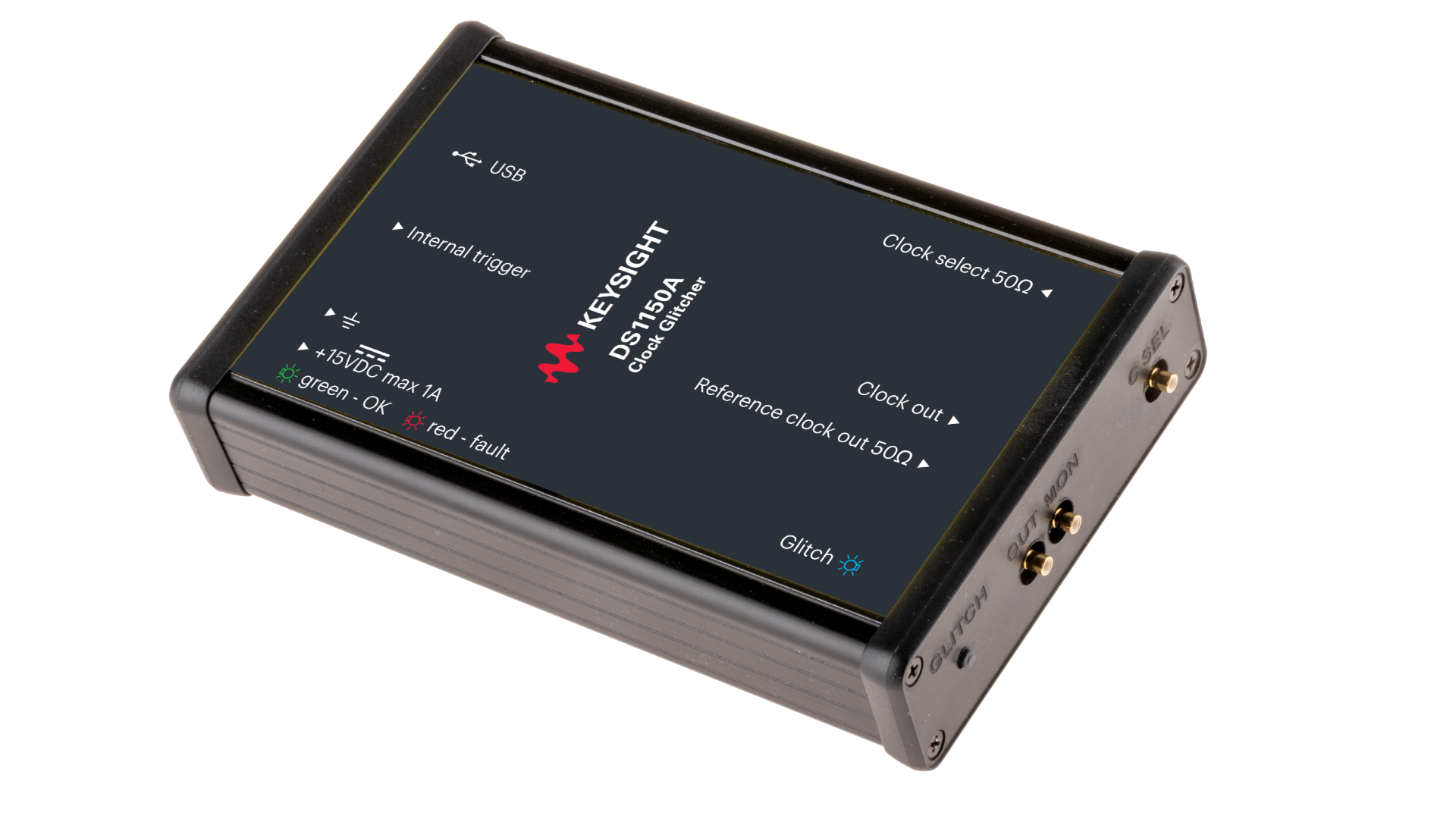
Test your device’s resistance to clock glitching attacks with the DS1150A Clock Glitcher, which includes two internal clock generators.
Test your device’s resistance to modified clock signal attacks. Clock glitching is a technique where the supplied clock of a target device is temporarily modified to different clock cycles, causing the behavior of the device to deviate from its normal behavior. This deviation can lead to vulnerabilities and exploits.
The DS1150A Clock Glitcher operates by supplying the normal clock signal as well as the modified clock signal to the target device, enabling you to test if your devices are resistant to attackers that use modified clock signals to compromise their security.
- Includes two internal clock generators that can be configured independently
- Switch between the normal clock and the glitch clock based on a trigger signal
- Clock signal between 1 KHz and 300 MHz; voltage level between -1 V and +4 V
- Glitch clock has three clock modes: configurable digital output, random digital output, and random analog output
- Flexible analog frontend allows easy interfacing with various target types
- Reference signal measures the generated clock signal
- Includes Piñata target with the clock signal exposed
Services and support
Innovate at speed with curated support plans and prioritized response and turn-around times.
Get predictable, lease-based subscriptions and full lifecycle management solutions—so you reach your business goals faster.
Experience elevated service as a KeysightCare subscriber to get committed technical response and more.
Ensure your test system performs to specification and meets local and global standards.
Make measurements quickly with in-house, instructor-led training, and eLearning.
Download Keysight software or update your software to the newest version.
Frequently Asked Questions
Clock glitching is a fault injection technique that intentionally manipulates the clock signal supplied to a device. By introducing carefully controlled timing anomalies, security engineers can cause instructions, cryptographic operations, or security checks to execute outside their intended timing conditions, potentially exposing vulnerabilities.
Clock glitching works by temporarily altering the timing characteristics of the clock signal driving a device. This may involve speeding up, slowing down, shortening, or otherwise modifying clock cycles during a specific operation.
If the fault occurs at the right moment, the device may misinterpret data, skip instructions, or execute security-critical operations incorrectly.
The clock acts as the timing reference for most digital circuits. It controls when instructions are executed, data is moved, memory is accessed, and cryptographic operations occur.
Because so many device functions depend on accurate timing, even small disturbances can create unexpected behavior that may reveal security weaknesses.
Clock glitching is commonly used to investigate:
- Secure boot bypasses
- Authentication bypasses
- Cryptographic vulnerabilities
- Timing-related security weaknesses
- Fault injection resistance
- Security countermeasure effectiveness
The technique helps identify whether security-critical operations can be disrupted through carefully timed faults.
Successful clock glitch attacks often depend on modifying the clock signal during a very specific operation, such as a security check or cryptographic calculation.
Accurate timing allows engineers to consistently target the same operation, improving attack repeatability and making it easier to reproduce and analyze successful fault conditions.
Yes. Clock glitching can be integrated with Inspector software and automated test workflows to perform parameter sweeps, trigger-based attacks, campaign execution, and result analysis. Automation helps identify successful attack conditions more efficiently.
Yes. Security engineers often combine clock glitching with voltage glitching, electromagnetic fault injection (EMFI), or laser fault injection to evaluate a device from multiple attack angles and better understand its overall resilience.
Yes. The DS1150A integrates with Inspector software, enabling automated attack campaigns, parameter exploration, trigger management, and result analysis. This helps security teams perform repeatable and scalable clock fault injection evaluations.