How to Measure Millimeter-Wave Power Above 90 GHz

Measure Power at D-Band Frequencies
Measuring radio frequency (RF) power above 90 GHz introduces challenges that differ from conventional microwave measurements because signal transmission increasingly relies on precision waveguide interfaces rather than coaxial connections. At D-band frequencies, small discontinuities, waveguide mismatch, connection quality, and losses in the measurement path can influence the power delivered to the measurement plane. Engineers therefore need a waveguide-based measurement configuration designed for direct power measurements at these frequencies while maintaining appropriate calibration and correction conditions.
The setup includes a D-band waveguide power sensor connected to a compatible power meter and millimeter-wave source or device under test. Engineers establish the waveguide measurement plane, verify flange alignment and connection, set the frequency, and apply the appropriate sensor calibration factor before measuring power. The sensor covers 110 to 170 GHz, enabling direct D-band power measurements. This configuration supports source output verification, component characterization, and available power measurements in high-frequency test systems for emerging communications, device research, and millimeter-wave component development.

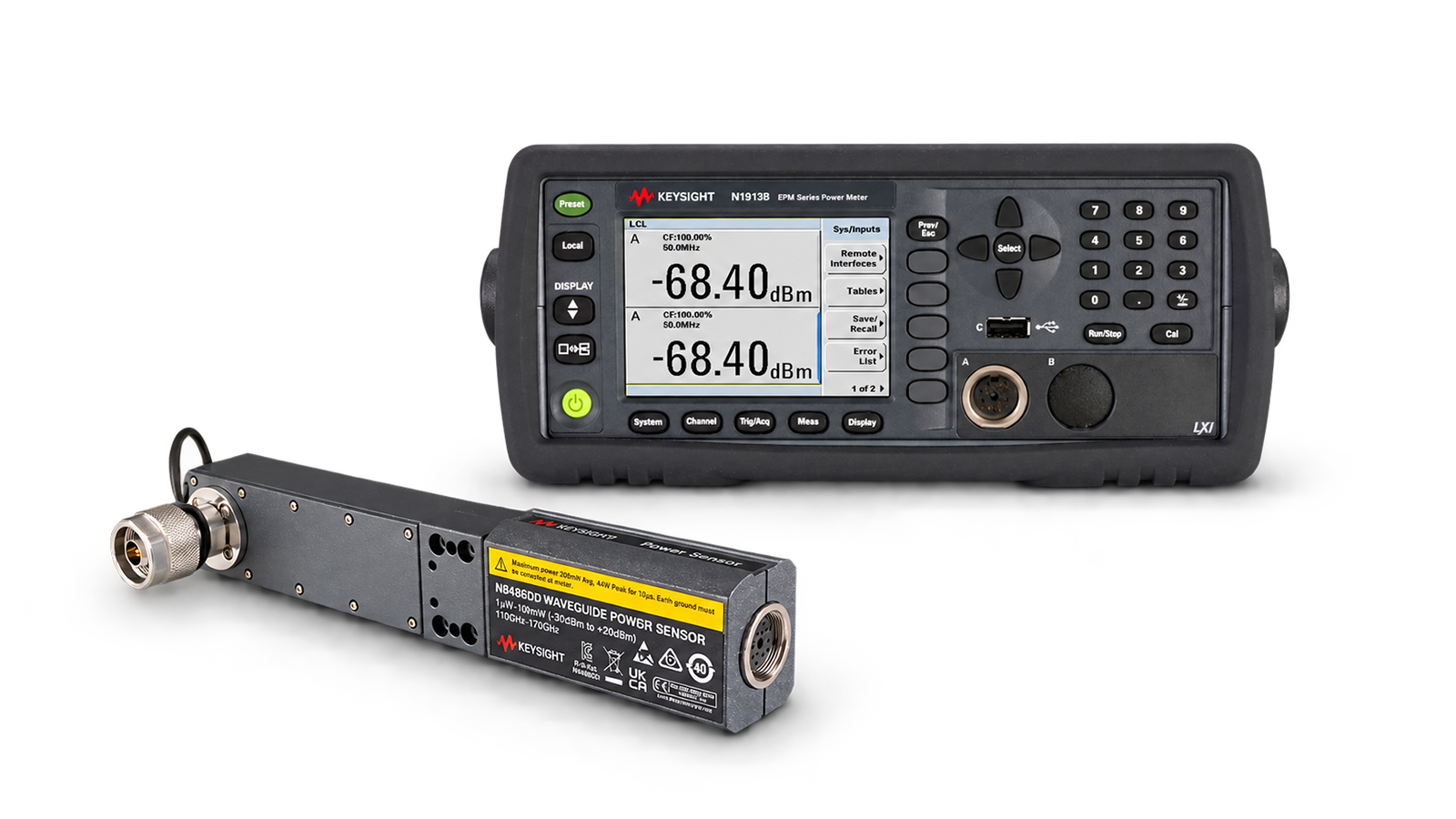
D-Band Power Measurement Solution
See Block Diagram of D-Band Power Measurement Solution


Explore Products in Our D-Band Power Measurement Solution
-


![]()
N8486DD 110 to 170 GHz Waveguide Power Sensor
-
![]()
N1913B EPM Series Single-Channel Power Meter


Discover Resources and Insights
Additional Resources for Millimeter-Wave Power Measurement
Related Use Cases

-
![]()
Learn More
How to Perform Burst Power Measurement
Measure burst RF signal power using time-gated averaging with power meters, sensors, and automated control software for TDMA systems.
Learn More

-
![]()
Learn More
How to Measure RF Power During Rapid Amplitude Switching
Measure RF power during rapid amplitude transitions using a power meter, fast-response sensors, continuous acquisition, and automated measurement techniques.
Learn More
-
![]()
Learn More
How to Measure Average Power of Frequency-Hopping Signals
Measure average RF power of frequency-hopping signals using power meters, sensors, and time-aligned measurement techniques for accurate results.
Learn More

Get in Touch with One of Our Experts
Need help finding the right solution for you?