

Why Choose Keysight Quantum Design Suite
Accelerate quantum hardware design—from layout to system analysis.
Layout • EM • Circuits • Systems
Keysight Quantum Design Suite connects layout, electromagnetic, circuit, and quantum-system simulation in an integrated workflow. Engineers can create simulation-ready layouts, extract quantum parameters, analyze nonlinear circuit behavior, and evaluate control sequences and cryogenic effects before fabrication—supporting earlier design decisions and fewer physical iterations.
Advanced Design System (ADS)
EDA platform for Quantum Design Suite.
Keysight ADS is the premier electronic design automation (EDA) platform for the design of physical layer components that enables engineers to design, analyze, and optimize the critical components that power today's most advanced commercial and defense systems. The base platform contains powerful 3D physical layout and verification, data display, optimization, statistical analysis, Python scripting automation, and AI-Assisted design tools. High-Performance Computing (HPC) options can significantly accelerate simulation times. Additional simulation capabilities such as nonlinear circuit, electromagnetic (EM), electrothermal (ETH) and system provide engineering teams with a choice of value-packed, preconfigured combinations of software modules built for specific design workflows: RF/Microwave, High-speed Digital, Power Electronics, Photonic, and Quantum.


Quantum System Design provides a design environment that accelerates the development of complex quantum systems.


Quantum Circuit Simulation offers a comprehensive circuit design environment that accelerates the development of complex quantum circuits.


QuantumPro is the EDA industry's first integrated workflow tailored for the seamless design of superconducting qubits.

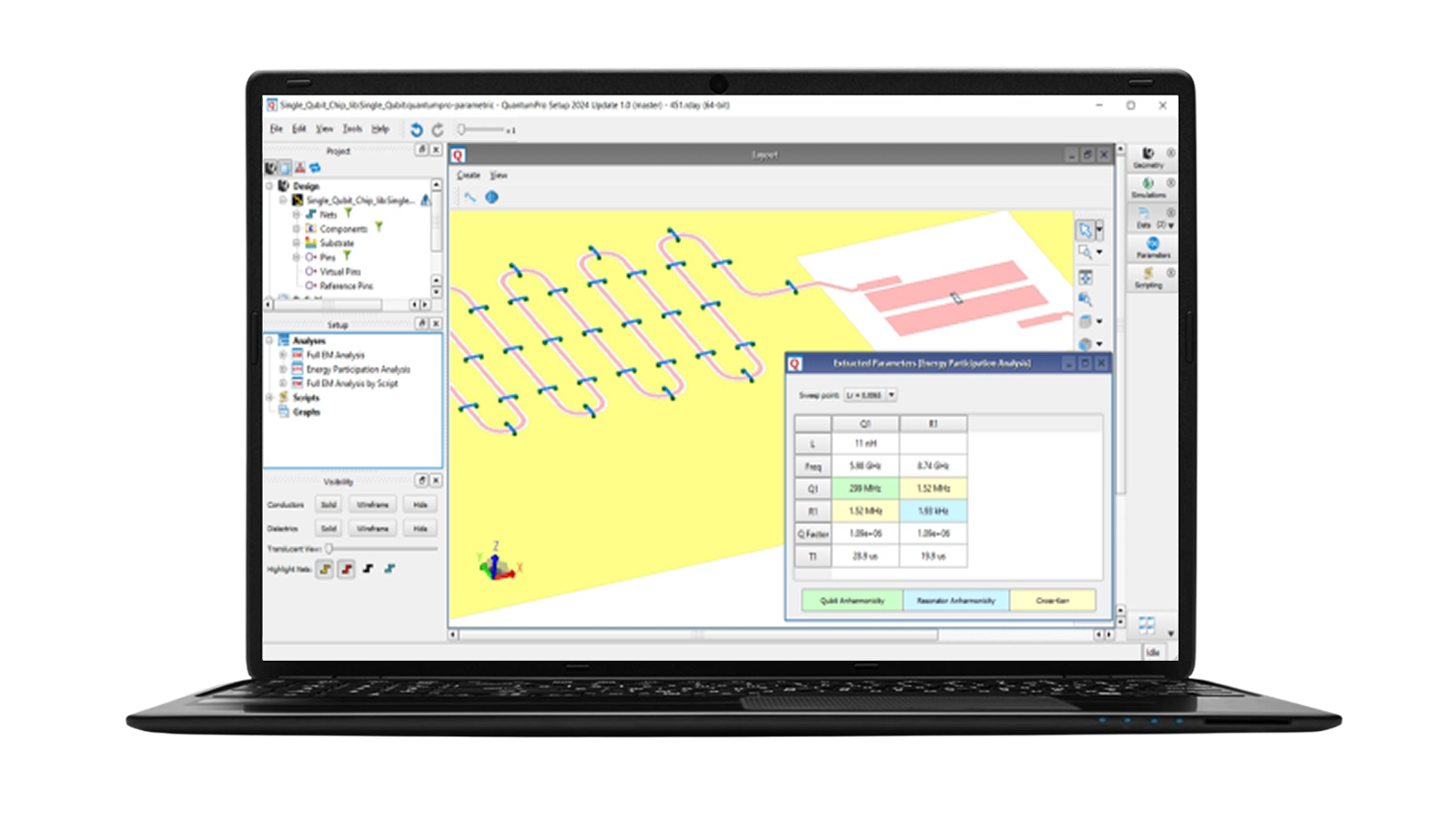
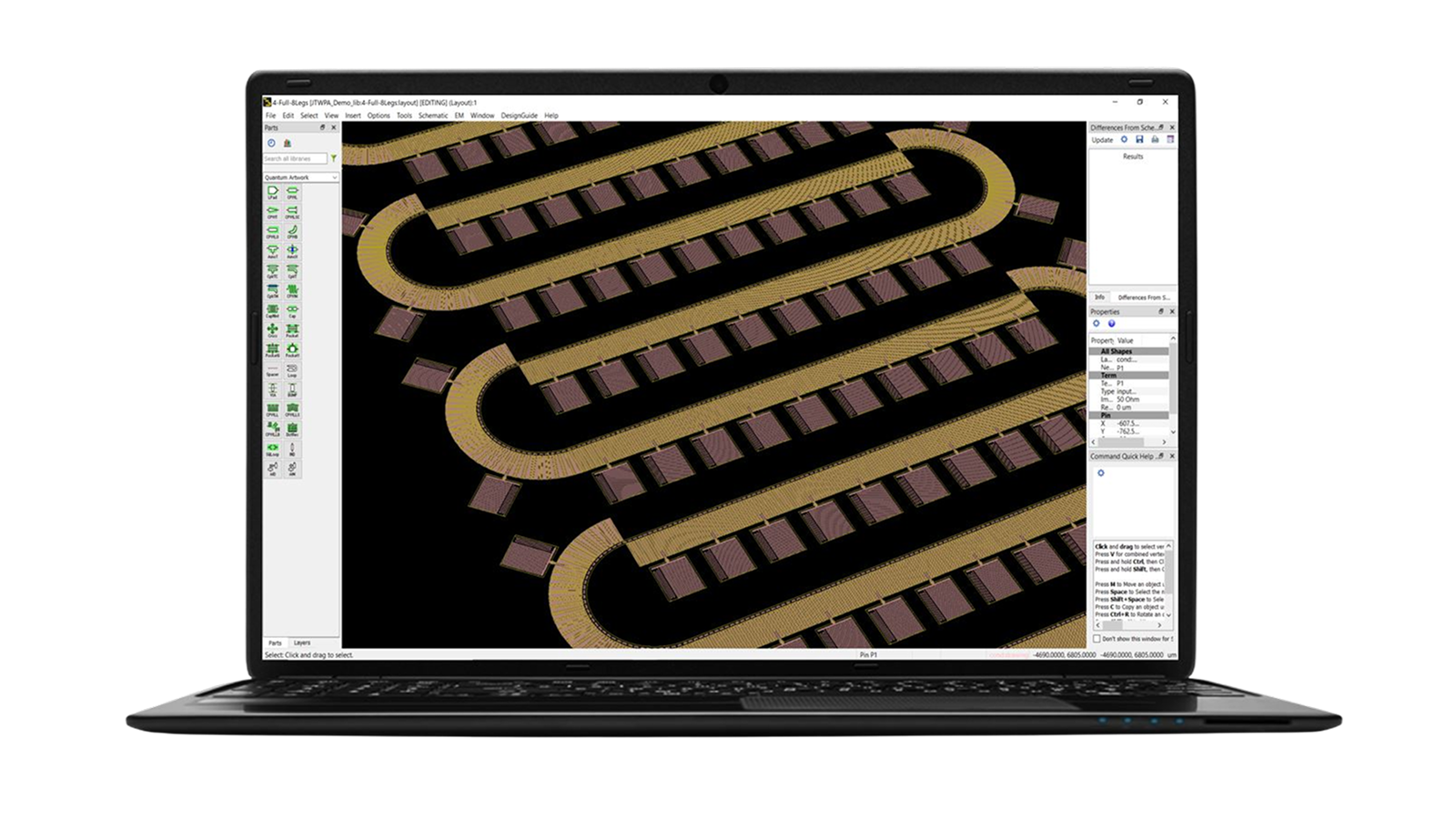
Advanced Design System (ADS) includes a library of quantum layout components.



Design Cloud (HPC)
Complex product designs need massive and time-consuming simulations. Keysight Design Cloud leverages High-Performance Computing (HPC) technologies that let you run parallel simulations in the cloud, cluster, or server to reduce simulation time and expedite time-to-market significantly.
Resources to Get You Started
This webinar explores how Quantum EDA techniques, tailored to the unique requirements of quantum circuits, can facilitate the design process by providing tools for simulation, verification, and optimization.


BOOTCAMPS
Superconducting Quantum Design Challenges

How-To Videos
Quantum EDA Examples

How-To Videos
Quantum EDA Solutions
blogs
Designing Tomorrow’s Quantum Computers with Today’s EDA Tools

Have Questions? We've Got Answers
Quantum EDA tools help engineers design, simulate, analyze, and optimize superconducting quantum hardware within an integrated workflow. From schematic capture and layout creation to electromagnetic (EM) analysis, nonlinear circuit simulation, quantum parameter extraction, and system-level modeling, EDA software enables designers to evaluate performance before fabrication.
A typical superconducting quantum design workflow begins with defining the qubit architecture and creating schematics and layouts. Engineers then perform electromagnetic simulations to extract quantum parameters such as frequencies, coupling strengths, and participation factors. Next, circuit simulations are used to evaluate nonlinear quantum behavior, followed by system-level simulations that model time-domain experiments such as Rabi and Ramsey sequences. Design iterations continue until performance targets are achieved, after which the design moves to fabrication, packaging, and hardware validation. Quantum EDA platforms streamline this process by connecting these workflows in a unified environment.
EDA tools enable quantum engineering teams to shorten design cycles, reduce fabrication iterations, and improve first-pass success rates. By combining electromagnetic, circuit, and quantum-level simulations, designers can gain deeper insight into qubit performance, amplifier behavior, coupling effects, and package interactions before building hardware. Integrated quantum workflows also help teams scale designs more efficiently as quantum processors become larger and more complex.
Modern Quantum EDA tools combine electromagnetic solvers, nonlinear circuit simulation, Hamiltonian analysis, and time-dynamics modeling to predict qubit behavior. These capabilities allow engineers to simulate qubit frequencies, anharmonicity, coupling mechanisms, energy levels, and experimental pulse sequences. System-level analysis can model real-world experiments such as Rabi and Ramsey measurements, helping designers understand how qubits will behave under operating conditions before fabrication and testing.
Superconducting quantum devices are highly sensitive to geometry, material properties, fabrication variations, packaging effects, and environmental noise. Accurately predicting loss mechanisms, parasitic modes, thermal photon leakage, and nonlinear behavior requires advanced multiphysics and quantum-aware simulation techniques. Quantum EDA tools address these challenges by combining full-wave EM analysis, nonlinear quantum circuit simulation, quantum parameter extraction, and cryogenic system modeling to provide a more complete understanding of device performance.