
Designing Tomorrow’s Quantum Computers with Today’s EDA Tools
Understand the challenges faced by designers of superconducting quantum chips, and explore the pioneering EDA solutions to overcome them.
Key takeaways:
- Superconducting qubits are a promising approach for quantum chips capable of solving complex, intractable problems.
- Due to error correction and other challenges, the number of qubits is restricted to a few hundred.
- Quantum chip designers need capable tools that seamlessly accelerate all the tasks in every development cycle.
During this International Year ofQuantum Science and Technology, we at Keysight have worked diligently to support quantum engineers in staying at the forefront of the field. In this blog, learn the basics of designing quantum chips, current design trends, challenges, and cutting-edge quantum EDA solutions from Keysight.
Apart from artificial intelligence, quantum technology is the other field driving advances in chip designs. Engineers in this nascent field can get overwhelmed by the advances happening at every level—in fundamental physics, low-level building blocks, and higher-level workflows.
How do quantum chips work?
A quantum chip consists of several qubits (or quantum bits), the fundamental building blocks of quantum computing, analogous to classical transistors.
A quantum processor with N qubits can represent a superposition of 2^N states. Quantum algorithms map their problem spaces to these states, carefully sequence quantum gates to orchestrate entanglement between the N qubits, and create interference such that amplitudes of only desired solutions are amplified.
The ability of quantum computers to represent exponentially large state spaces is key. This quantum advantage is essential for computationally expensive problems that take supercomputers months to solve and intractable problems beyond classical and even high-performance computers. Such issues with commercial uses include:
- quantumartificial intelligence
- quantummachine learning
- chemistrysimulations using quantum Monte Carlo techniques
- quantum cryptography
What qubit technologies are trending?
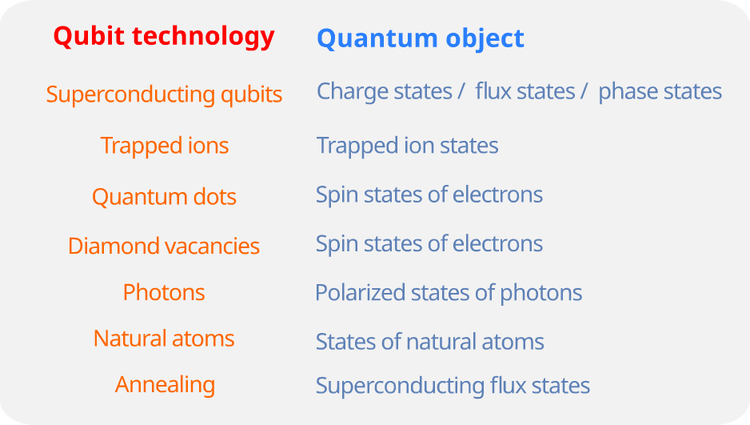
Figure 1. Qubit technologies
Currently, quantum research teams and startups are exploring multiple approaches to implement qubits. Natural objects or physical systems like trapped ions, quantum dots, diamond vacancies, photonics, cold atoms, or annealing are used to store quantum information.

Figure 2. Josephson junction and transmon qubit
A popular alternative to these natural objects is the use of various superconducting qubits, which employ Josephson junctions. Due to their larger sizes, they're easier to work with compared to natural qubits.
A Josephson junction is a simple circuit created using lithography, like classical semiconductors. It consists of two superconductor layers separated by a thin insulator layer through which electrons can tunnel. When it's cooled to near absolute zero, the entire junction acts like a single object with quantum mechanical behaviors, even though it's macroscopic with millions of atoms.
What are the components of a superconducting qubit quantum system?

Figure 3. Superconducting quantum machine
A typical superconducting quantum machine consists of the following devices:
- Quantum processing unit (QPU): The quantum processor comprises Josephson junction qubits, readout resonators to measure qubit states, and coupling elements to link the qubits.
- Quantum amplifier (QA): The output signals from qubits are extremely weak and very close to the noise floor. Quantum amplifiers improve qubit readout fidelity by amplifying these weak signals without adding significant noise or distortion.
- Microwave generator: The selected quantum algorithm is converted into a sequence of microwave pulses with precise frequencies that act as quantum gates to manipulate the states of specific qubits. For example, a pulse may be a Hadamard gate to create superposition or a conditionalNOT gate to flip a qubit based on another, thereby creating entanglement. These microwave pulses are analogous to how a control unit in a classical processor translates instructions into appropriate electrical signals for its arithmetic logic unit and other subsystems.
- Cryogenic refrigerator: For superconductivity to kick in and decoherence to slow down sufficiently to enable computations, the quantum hardware requires extremely low temperatures of a few millikelvins, just above absolute zero. A cryogenic refrigerator encases all the other components and achieves this.
- Signal cables: The microwave pulses propagate down to the qubits through coaxial cables.
What are some key aspects when designing superconducting qubits?
Let's look at some of the key aspects of superconducting qubit designs.
Types of qubits
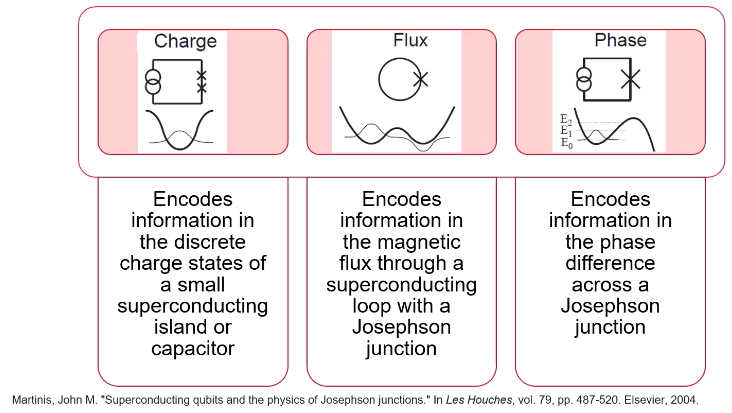
Figure 4. Types of qubits
Selecting a suitable Josephson junction qubit is essential. Based on where they store quantum information, there are charge, flux, and phase qubits. They differ in noise sensitivity, anharmonicities, resonance frequency bands, and other properties.
Additionally, qubits can either be planar or three-dimensional. Planar qubits are currently easier to manufacture but more susceptible to noise and decoherence.
Scaling

Figure 5. Multi-layer qubit design
Two-dimensional layouts are easier to design and simulate but restrict scalability. The layer designs must be three-dimensional to scale up the number of qubits. But that often complicates electromagnetic (EM) interference and cross-talk.
Control and readout
Critical design goals are reliably manipulating qubits using microwave pulses without introducing noise and amplifying qubit states with high fidelity.
Error correction
Robust error correction is critical since quantum chips operate near the noise floor. This is the biggest bottleneck restricting quantum chips to a few hundred qubits.
Grounding Challenges
Engineers must use air bridges and bond wires to prevent unexpected modes of propagation that can cause unwanted interference.
Cryogenic environment
The cryogenic refrigerator maintains Ultra-Low temperatures critical for superconductivity, coherence, and low thermal noise. Temperatures must be stable and maintain reliably.
However, current control and readout systems operate at room temperature outside the refrigerator. The large number of cables connecting them to the qubits complicates cryogenic temperature control, latency, signal integrity, noise, and scalability. So, a key goal is to move the control systems closer to the qubits and operate them at cryogenic temperatures.
What are the quantum parameters of a superconducting chip?
Apart from the above design aspects, the quantum parameters of a chip are critical properties that must be engineered carefully for design optimization. They include:
- resonance frequencies of the qubits and readout resonators needed for the microwave pulses
- anharmonicities in the excitation energy levels of the qubits, enabling microwave pulses to restrict them to the two required computational states rather than unwanted states
- cross-Kerr strengths between coupled qubits that result in crosstalk and shifts in their resonance frequencies
- dispersive shifts in resonator frequencies due to the qubits
- relaxation times of qubits to go to their ground states
- dephasing time of the states to lose their phase information
How do we extract quantum parameters?
There are different ways to extract quantum parameters with computational and accuracy trade-offs:
- Frequency domain black box quantization: The S-parameters are first determined to infer the resonance frequencies of the circuit. Then, qubit equivalent inductance and stray capacitance are added to find the qubit resonance frequencies. Finally, readout resonance frequencies are found with and without the qubit. Analyzing all frequencies produces highly accurate parameters but is computationally very expensive.
- Energy participation analysis: Parameters are extracted only at the eigenmodes instead of all frequencies, which is less computationally demanding. The circuit eigenmodes and the qubit equivalent inductances and stray capacitances are determined. The eigenmode field distributions determine the energy participation ratios (EPRs) of qubits in each mode. The quantum parameters are then determined from the EPRs.
What are the key concerns when designing quantum amplifiers?
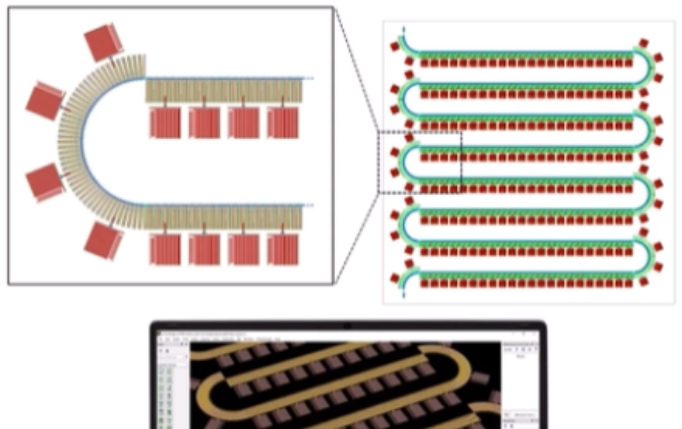
Figure 6. Quantum amplifier layout
Some key concerns of quantum amplifier designs include:
- High-fidelity readouts: Quantum amplifiers must boost the weak qubit output states without adding noise or distortion.
- Working principles: A pump signal with a specific frequency adds the energy required to amplify the qubit signal. The amplification generates new photons at frequencies distinct from the qubit output signal. By fine-tuning the system parameters, these new photons can convey information about the qubit output signal, effectively amplifying it.
- Gain adjustments: Adjusting the gain of the amplifier to a suitable level is a key design goal.
- Design complexity: These amplifiers may have hundreds to thousands of Josephson junctions, requiring robust nonlinear circuit solvers for accurate simulations.
- Phase and frequency control: The energy transfer from the pump signal to the qubit output signal and idler component requires precise phase and frequency control to ensure high gain with low noise.
What are the challenges in modeling superconducting qubit devices?
Quantum computing is a new technology that's just starting and has many decades to mature. Several challenges exist both in the technologies themselves and in the design workflows:
- Long development cycles: Current superconducting quantum chips involve long and expensive development cycles. To meet design requirements, design teams often pioneer new solutions to challenging problems. Repeated testing and incremental improvements are needed to create a single working prototype.
- Scaling challenges: The design complexity increases rapidly with the number of qubits and junctions.
- Noise and cross-talk: Current quantum chips must operate close to the noise floor, unlike classical chips. Reducing noise and cross-talk from the environment and the chip is a significant challenge.
- Unreliable error correction: Robust quantumerror correction is currently the main bottleneck preventing scaling up from tens or hundreds of qubits to a million and more required for practical commercial applications.
- Complex layouts: Quantum chip circuits use complex layouts to overcome new challenges. The knowledge hasn't matured to the large-scale semiconductor chip design level.
- Drastic effects of minute details: Minute features of microwave pulses and coplanar waveguides can drastically affect quantum operations.
- Difficulties of large quantum circuits: Engineers need robust analysis and simulation tools to address the complexity, scaling, and nonlinearity challenges of large superconducting quantum circuits and complex amplifiers, some with thousands of Josephson junctions.
- Microwave differences: Although superconducting quantum chips involve microwave signals, a steep knowledge barrier prevents engineers with radio frequency and microwave experience from becoming productive quickly.
- Inefficient design workflows: Instead of seamless end-to-end workflows, current quantum design software consists of standalone tools that don't integrate well, ad-hoc homebrew scripts, and manual actions.
How does Keysight EDA streamline superconducting quantum chip design?

Figure 7. Quantum chip design cycle
Keysight's quantumelectronics design automation (EDA) solutions address all the above technology and process challenges through seamless end-to-end workflows to streamline quantum chip and system designs.
The quantum design tools bundled with Keysight Advanced Design System (ADS) provide cutting-edge capabilities to help manufacturers accelerate and scale up their research and design efforts.
Quantum circuits and layouts

Figure 8. Quantum chip layouts in ADS
ADS Layout includes built-in support for quantum layouts with features like:
- an extensive library of quantum components — qubits, resonators, coplanar waveguides, and more — to create complex qubit circuits
- support for single-layer and multi-layer qubit designs to scale up your quantum chips
- support for complex quantum amplifier designs, like Josephson traveling wave parametric amplifiers (JTWPAs), that involve intricate arrangements of Josephson junctions and resonators
- automatic addition of air bridges to prevent unwanted modes in coplanar waveguides
- Preconfigured design flow examples for superconducting qubits, multi-layer configurations, and quantum amplifiers to jumpstart your project
- automatic generation of layouts from circuit schematics
- automated layout-vs-schematic verification
- parameter tuning
QuantumPro

Figure 9. QuantumPro
QuantumPro offers an integrated electromagnetic (EM) and parameter extraction environment to speed up superconducting qubit designs and create robust quantum computers. It supports:
- automated quantum parameter extraction using frequency domain, eigenmode, and quasi-static approaches
- linear circuit simulator for EM-circuit co-simulation
- analysis of the power-dependent response of the quantum chip through nonlinear EM and circuit co-simulation
- modeling of kinetic inductance
- seamless integration of circuit, layout, and EM design of qubits
- planar and three-dimensional EM simulations for planar qubits
- multiple analysis techniques like the frequency domain and eigenmode
- multiple solvers like method of moments (MoM) and finite element methods (FEM)
EMPro
Keysight EM Design (EMPro) accelerates the design of3D superconducting qubits by enabling:
- analysis of 3D qubits through their modeling as linearized lumped inductances
- simulation of EM effects using FEM frequency-domain and eigenmode solvers
- quantum parameter extraction and design automation of 3D qubits
Quantum Circuit Simulation (Quantum Ckt Sim)

Figure 11. Quantum Ckt Sim
Quantum Circuit Sim accurately simulates large, highly nonlinear quantum circuits to gain insights into complex amplifiers like JTWPAs.

Figure 12. Different types of supported complex quantum devices
Quantum Circuit Sim supports:
- an extensive library of real-world quantum devices like superconducting quantum interference devices (SQUIDs), superconducting nonlinear asymmetric inductive elements (SNAILs), fluxoniums, superconducting nonlinear asymmetric kinetic-inductance element (SNAKE) arrays, and JTWPAs
- simulation of flux quantization in the frequency domain by mapping it to auxiliary voltage loops that the circuit solvers can handle
- harmonic balance nonlinear circuit simulators in the frequency domain
- transient or convolution nonlinear circuit simulators in the time domain
- circuit envelop nonlinear circuit simulators in the modulation domain
- X-parameters nonlinear model generator
Scripting and automation
All the above tools publish application programming interfaces and support Python scripts, enabling your quantum computer scientists, physicists, design engineers, and test engineers to automate, customize, and verify all research and design workflows.
From quantum hype to breakthroughs with Keysight EDA
This blog provides a high-level overview of quantum chip design and the current challenges in the field. You saw how Keysight addresses these challenges with innovative, end-to-end EDA workflows.
Contact us for insights, demos, and solutions for your quantum chip design challenges.
Learn more