


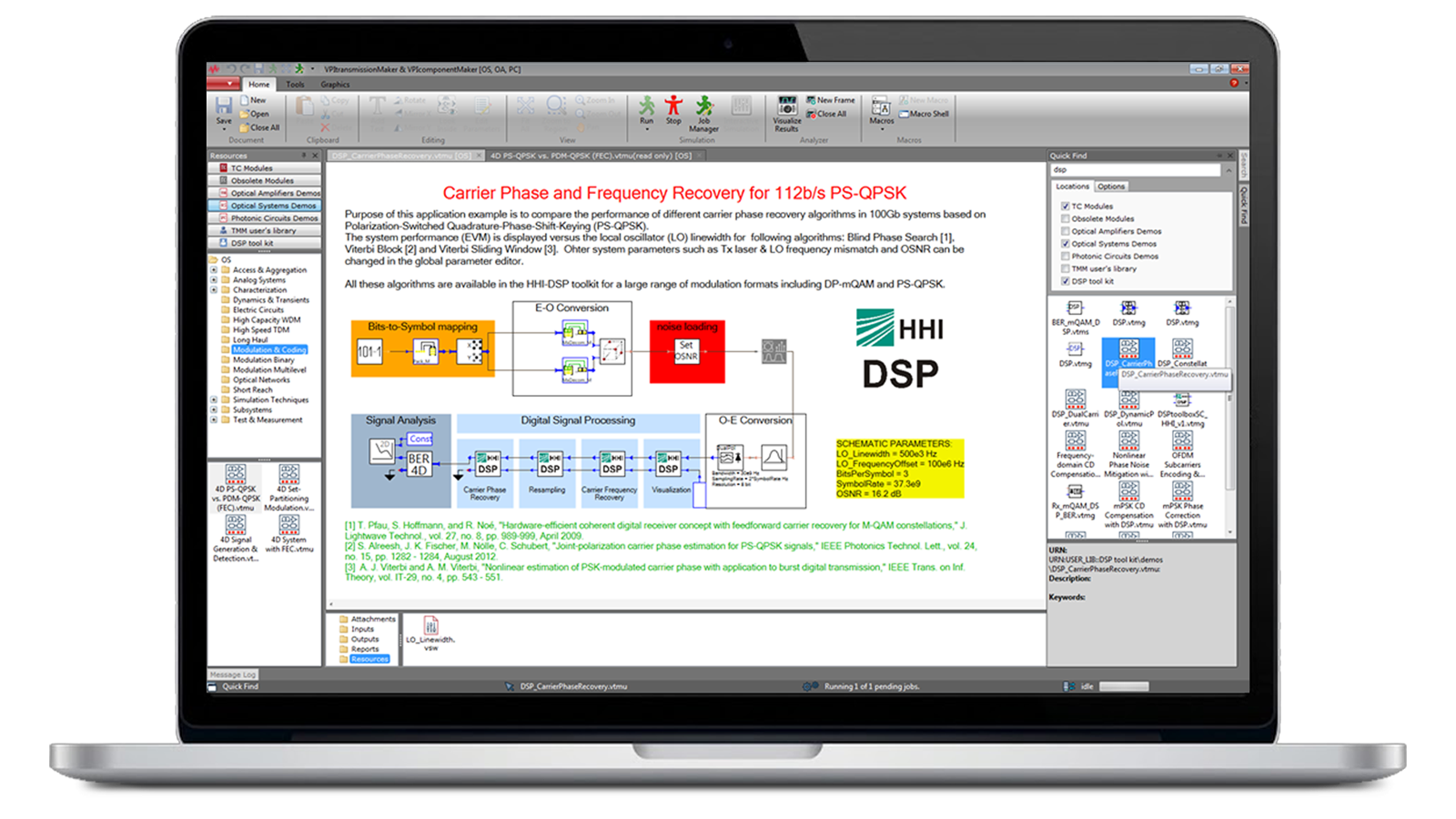
Why Use Test Signal Generation and Analysis
Accelerate optical communications research.
Transitioning photonic designs from simulation to laboratory validation can be complex and time-consuming. This solution bridges that gap by seamlessly connecting simulation environments with real-world test equipment, enabling engineers and researchers to efficiently validate, analyze, and optimize optical communication systems. Advanced signal processing and measurement capabilities support critical analyses such as BER, EVM, constellation diagrams, SNR, and CNR, helping teams gain deeper insight into system performance. Automated data transfer, signal conversion, and equipment integration reduce manual effort while improving repeatability and accuracy. By combining simulation-driven design methodologies with laboratory verification workflows, users can accelerate research, shorten development cycles, reduce testing costs, and bring innovative photonic technologies to market faster.
Key Capabilities

Connect simulation models directly with laboratory equipment.

Measure BER, EVM, SNR, and constellations.

Enable seamless signal conversion and exchange.

Interface with industry-leading test instruments.

Emulate optical and electrical components virtually.

Reduce testing effort and speed development.
Resources to Get You Started
This brochure introduces VPIlabExpert, a test signal generation and analysis platform connecting photonic simulation with laboratory equipment. It supports waveform transfer, instrument control, digital signal processing, and performance evaluation for direct-detection and coherent optical systems. Capabilities include advanced modulation, error-correction coding, equalization, and automated experimental optimization. Application examples demonstrate coherent 16QAM transmission, radio-over-fiber distribution of 5G services, and PAM-4 links for data centers and access networks.


blogs
Completing Keysight's End-to-End Photonic Design Workflow
Brochures
Photonic Design Automation for Components, Systems & Networks

Have Questions? We've Got Answers
Test Signal Generation and Analysis enables experimentalists to connect simulation environments with laboratory equipment for signal generation, capture, processing, analysis, and validation of photonic communication systems.
The software supports advanced signal and performance analysis, including BER, EVM estimation, constellation analysis, SNR measurement, and CNR evaluation.
Yes. The platform interfaces with waveform generators, bit-pattern generators, oscilloscopes, and other supported test equipment from major vendors.
Automated signal conversion, data transfer, and ready-to-use analysis functions reduce manual setup effort, improve repeatability, and accelerate validation workflows.
Researchers, photonic engineers, and optical communications developers use the software to validate new technologies, develop signal processing algorithms, and shorten R&D cycles.