How to Validate AI Inference Before Deployment

Validate Inference Infrastructure Before Hardware Deployment
Set up a pre-deployment AI inference validation environment by modeling the planned data center topology in a digital twin. Represent switching and routing paths, inference services, security controls, and the intended connections between client ingress and inference backends. Configure artificial intelligence inference workload emulation to generate realistic large language model prompts and responses, including varied prompt lengths, turn patterns, and concurrent users. Define a reproducible workload profile, specify request arrival rates, and choose representative test durations before exercising the modeled architecture. Record end-to-end response latency, time to first token, output token rate, and request completion outcomes at each workload level. Where available, correlate those inference-native observations with infrastructure telemetry from compute, network, and security layers. Use identical workload inputs across architecture variants so observed differences can be attributed to the simulated system configuration rather than changed prompt behavior.
Run a baseline at a low concurrent-user level, then increase emulated demand in controlled steps while preserving the workload distribution. Track changes in token throughput, tail response latency, completion rates, and the relationship between offered load and delivered inference capacity. Compare candidate routing, security, and inference-service arrangements within the same modeled environment; capture configuration details for each run. Examine how long-context and multi-turn sessions change demand on the modeled inference path and where the response-time distribution begins to widen. When integration makes system-level telemetry available, compare inference measurements with reported graphics processing unit, memory, and networking behavior. Separate observations from the digital twin from results that would require physical hardware validation. Document the tested workload assumptions, software and network configurations, measurement definitions, and observed limits for each candidate. These results form a repeatable pre-deployment validation record rather than a claim about guaranteed production performance.

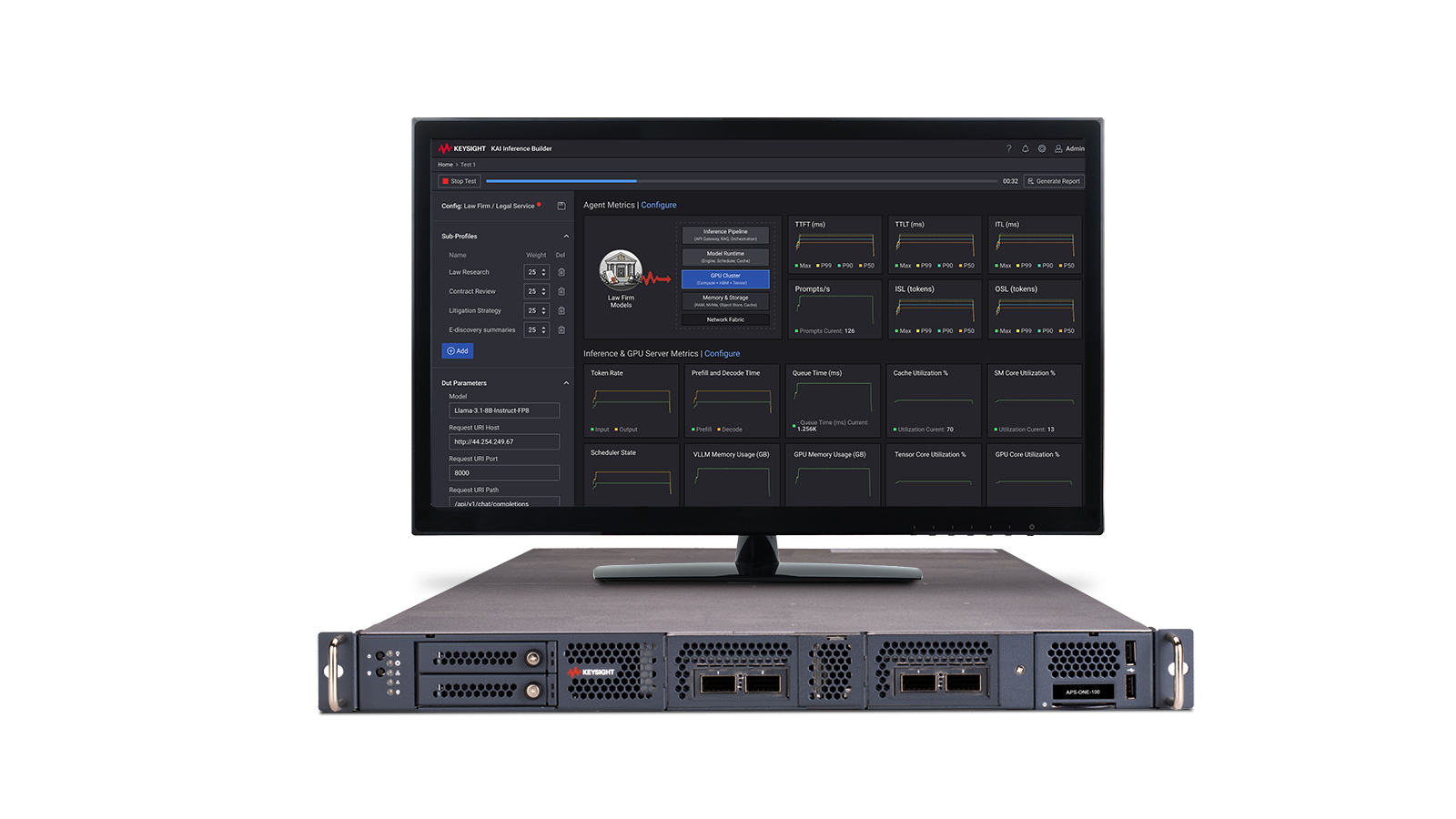
Pre-Deployment AI Inference Validation Solution
See Demo Video of Pre-Deployment AI Inference Validation Solution
Explore Products in Our Pre-Deployment AI Inference Validation Solution
-

![]()
952-1001 KAI Inference Builder Bundle with 2 Agents and up to 100 Prompts per Second


Discover Resources and Insights
Additional Resources for Pre-Deployment AI Inference Validation
Related Use Cases

-
![]()
Learn More
How to Test 1.6T Optical Receiver Sensitivity
Run automated stressed optical receiver sensitivity testing for 800GBASE and 1.6TBASE by integrating pattern and interference generation, optical stress conditioning, calibration, module control, and per-lane BER detection under optical receiver test software control.
Learn More

-
![]()
Learn More
How to Validate Electrical Evaluation Board Performance
Validate an electrical evaluation board by driving PRBSQ patterns through active or passive devices under test, routing loopbacks through the device or board, and measuring lane-by-lane bit error ratio and Forward Error Correction behavior across the configured high-speed PAM4 lanes.
Learn More
-
![]()
Learn More
How to Validate 1.6T Optical Transceivers
Benchmark a fully retimed 1.6T optical transceiver through host-side and optical loopback paths, configure supported Ethernet modes through CMIS, and measure per-lane BER and FEC statistics during short or long-duration system-level error-performance tests.
Learn More

Get in Touch With One of Our Experts
Need help finding the right solution for you?