













- Overview
- All Models
- Support
Inject Faults with Pinpoint Optical Precision
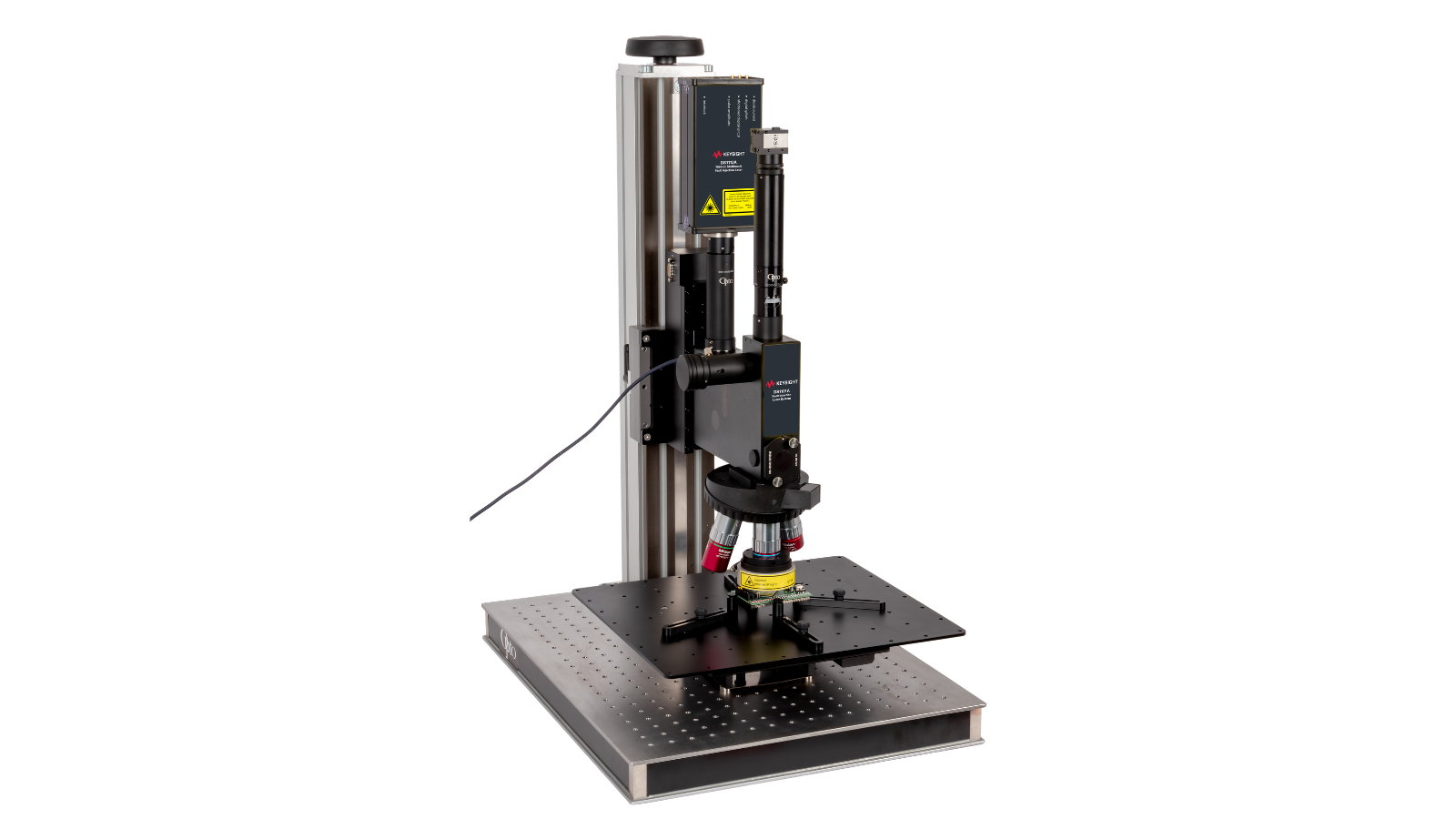
Laser fault injection systems enable security engineers to perform highly targeted optical fault attacks by delivering controlled laser pulses to specific regions of a semiconductor device. By precisely manipulating device behavior during security-critical operations, these platforms help uncover vulnerabilities, assess the effectiveness of implemented countermeasures, and validate the resilience of modern embedded systems against advanced fault injection attacks.
Perform Precise Optical Fault Injection
Target Individual Circuit Regions
Use optical imaging, positioning, and localization capabilities to focus attacks on precise locations within a chip.
Reproduce Complex Attack Scenarios
Support advanced evaluation techniques, including multi-pulse and dual-laser attacks designed to challenge modern countermeasures.
Automate and Scale Evaluations
-
Wavelength range
700 nm to 1100 nm, 370 nm to 532 nm
-
Additional features
3 objectives (optional); magnification 5x; 20x and 50x, 3 objectives; magnification 5x, 20x and 50x, NIR camera included, X-axis movement resolution: 0.16 µm, Y-axis movement resolution: 0.32
-
Product type
Fault injection laser system, Fault injection laser microscope, Dual laser fault injection system
-
Technology
Device Security
Most Popular Configurations
Fault Injection Laser System

Dual Laser Fault Injection System

400 nm – 700 nm Fault Injection Laser Microscope
Services and support
Innovate at speed with curated support plans and prioritized response and turn-around times.
Get predictable, lease-based subscriptions and full lifecycle management solutions—so you reach your business goals faster.
Experience elevated service as a KeysightCare subscriber to get committed technical response and more.
Ensure your test system performs to specification and meets local and global standards.
Make measurements quickly with in-house, instructor-led training, and eLearning.
Download Keysight software or update your software to the newest version.
Frequently Asked Questions
Laser fault injection (LFI) is a hardware security testing technique that uses highly controlled laser pulses to temporarily disturb the operation of a semiconductor device. By targeting specific regions of a chip during security-critical operations, engineers can induce faults and observe how the device responds. This helps identify vulnerabilities, validate countermeasures, and assess resistance against real-world fault attacks.
All three techniques introduce faults, but they differ in how the fault is delivered.
- Voltage fault injection disturbs the device power supply.
- Electromagnetic fault injection (EMFI) injects faults using electromagnetic pulses.
- Laser fault injection uses focused laser energy to target a specific area of the silicon.
Because a laser can be focused on extremely small regions of a chip, it often provides greater spatial precision than other fault injection techniques.
Laser fault injection is commonly used to investigate:
- Cryptographic vulnerabilities
- Secure boot weaknesses
- Authentication bypasses
- Memory corruption issues
- Countermeasure effectiveness
- Fault attack resistance
The technique is particularly valuable when understanding how specific parts of a circuit behave under fault conditions.
Typically, yes. For laser fault injection, the chip package usually needs to be opened (decapsulated) so the laser has a clear optical path to the silicon. Depending on the device architecture and evaluation objectives, attacks may be performed from either the front side or the back side of the die.
A front-side attack targets the top surface of the semiconductor die, where metal layers and circuitry are accessible.
A back-side attack targets the chip through the silicon substrate from the back of the die. Back-side approaches are often used when metal layers on the front side obstruct access to security-critical circuitry.
The most appropriate method depends on the semiconductor technology and evaluation objective.
Different wavelengths interact differently with semiconductor materials and device structures.
Selecting the appropriate wavelength can help optimize:
- Silicon penetration depth
- Target visibility
- Attack precision
- Fault effectiveness
Different semiconductor technologies, package types, and evaluation objectives may require different wavelengths to achieve the desired fault injection results.
A Dual Laser Fault Injection System enables two independent laser sources to be controlled within a single evaluation setup. This allows security engineers to perform advanced attack scenarios that may require multiple fault events at different locations or timings.
Some modern devices implement sophisticated countermeasures that may not be affected by a single fault event. A dual-laser setup can support more advanced evaluations by allowing faults to be introduced simultaneously or sequentially at different areas of the device.
Modern chips pack multiple functional blocks close together, and many countermeasures are designed to detect broad disturbances (like a whole-chip voltage glitch) but may be blind to a highly localized fault. Precise targeting lets evaluators test whether a specific piece of protected logic can be individually disturbed, the same technique a sophisticated attacker would use.
Yes. Keysight Laser Systems integrate with Inspector software to support test automation, campaign management, fault analysis, and repeatable security evaluations. Inspector can be used to control laser positioning, coordinate attack workflows, automate testing sequences, and manage evaluation results, helping security teams perform more efficient and reproducible fault injection campaigns.
While laser fault injection is one of the most advanced fault injection techniques available, modern laser systems and automation software make it increasingly accessible to evaluation laboratories, semiconductor companies, certification facilities, and product security teams. Organizations often begin with targeted vulnerability assessments and expand into more advanced attack scenarios as their security testing requirements evolve.