











- Overview
- All Models
- Support
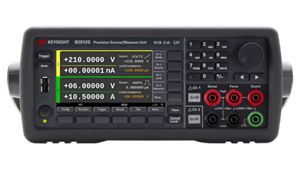
Highest performance in a workbench SMU
Keysight Pro source measure units are our most advanced and highest-performance models, ideal for ultra-high-precision measurements and high-speed transient analysis. Our Pro SMUs feature 6.5-digit source resolution, ultra-fast sampling, and the highest measurement accuracy in our benchtop SMUs, making them ideal for simulating real-world conditions for testing power-intensive devices in higher-level R&D, power electronics, and nanomaterial research. Choose one of our popular configurations or configure one specific to your application.
High source resolution
6.5-digit resolution enables highly precise measurements, which is key for testing sensitive devices and capturing low-level signals with accuracy and repeatability.
Ultra-fast sampling
Capture fast transients with 100 kSa/s sampling at 10 μs intervals, ensuring accurate data and preventing missed events in fast-switching devices.
Roll-view mode
Provides a real-time, scrolling graph of SMU measurements, ideal for continuous monitoring, slow changes, or diagnosing device behavior as it happens.
High-capacitance drive mode
Enables stable voltage or current sourcing into high-capacitance loads — like capacitors, long cables, or power devices — without oscillation or delays.
-
Source resolution
6.5 digits
-
Minimum current measurement resolution
10 fA
-
Number of channels
1 to 2
-
Pulse output
Yes
-
Maximum voltage per output
210 V
-
Maximum current per output
3.0 A DC / 10.5 A pulse
-
Maximum sample rate
100 kSa/s
-
Minimum sampling interval
10 µs
Most popular configurations
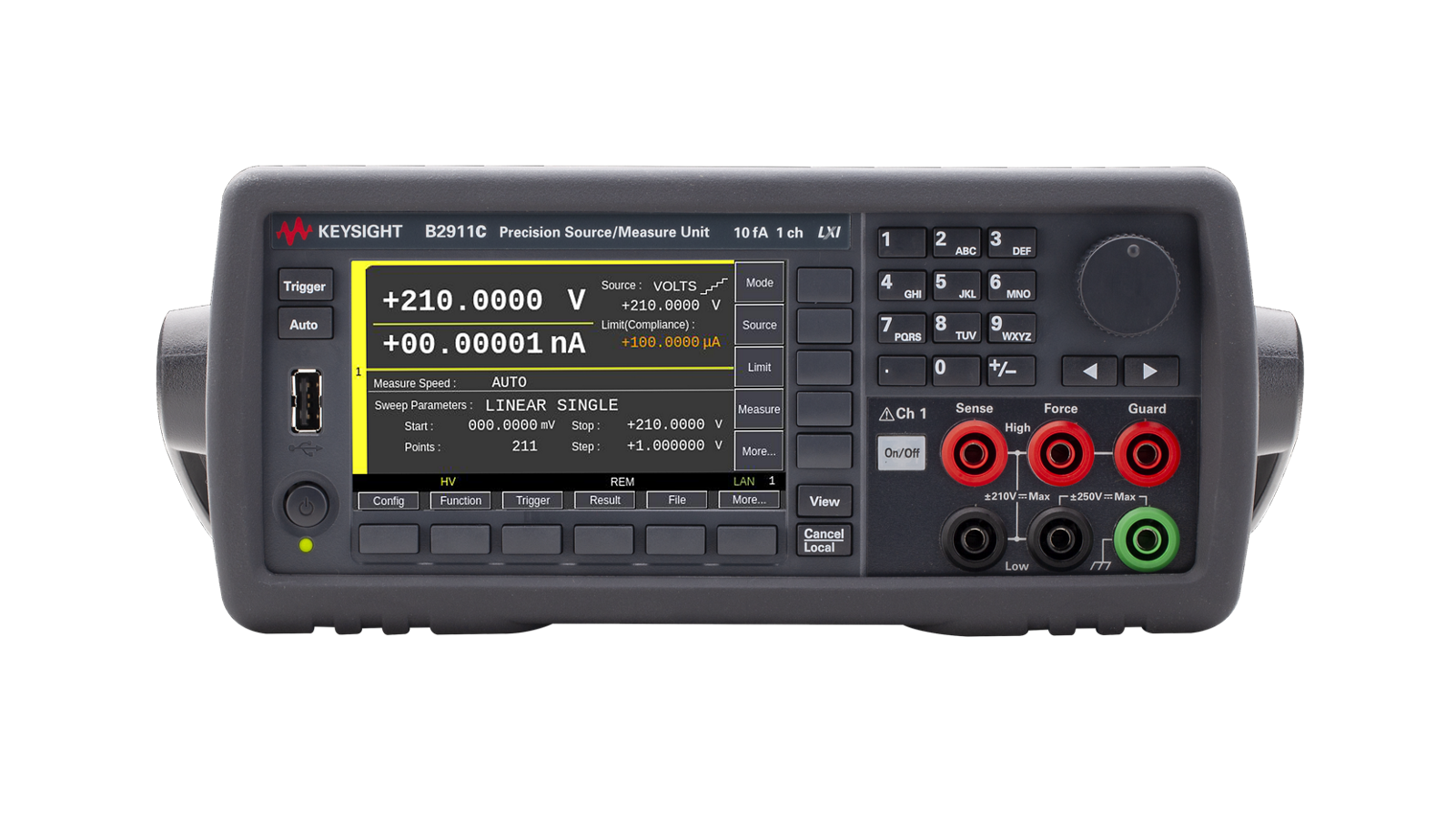
SM3-class Benchtop Source Measure Unit, single-channel, 10 fA resolution
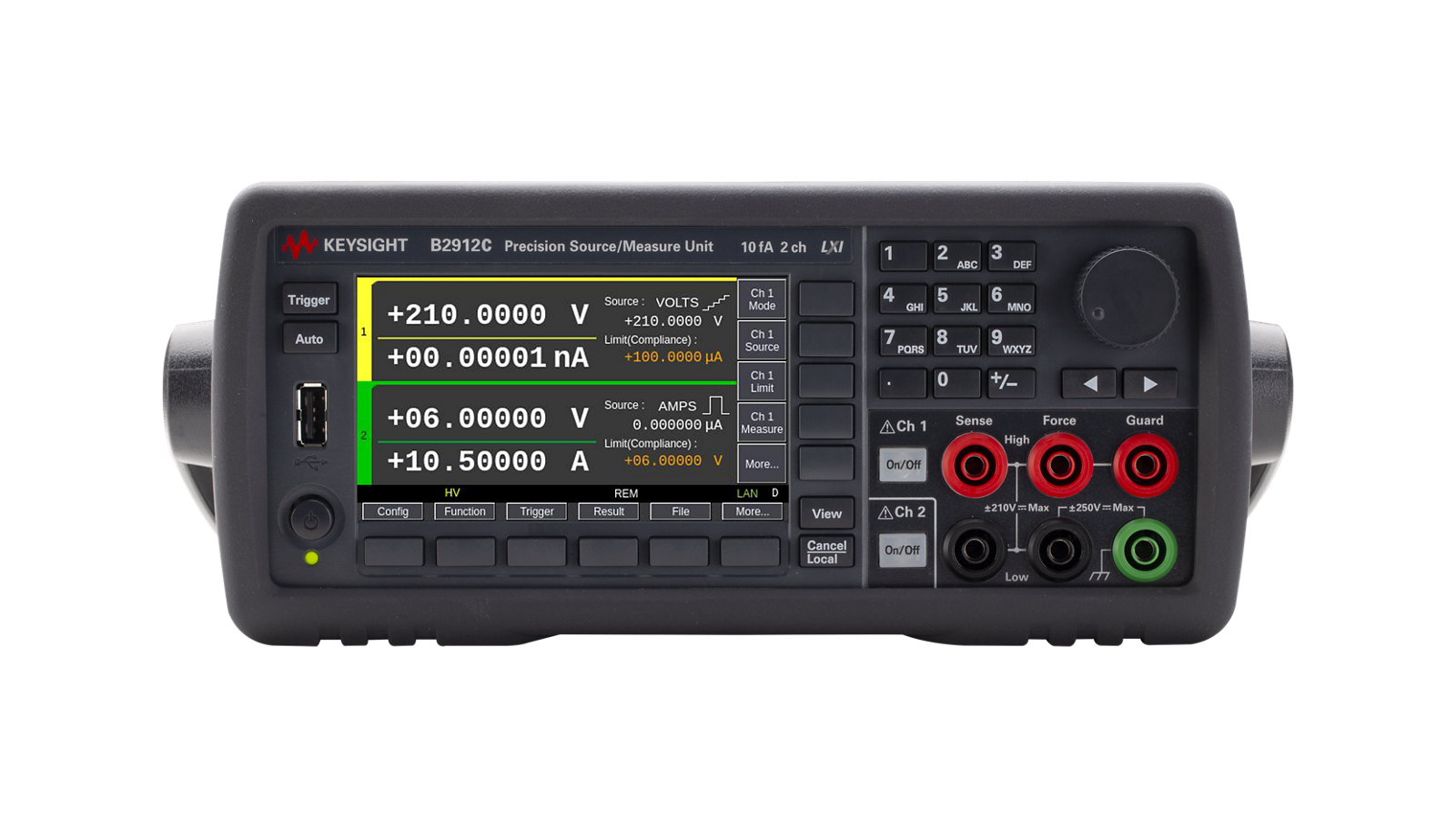
SM3-class Benchtop Source Measure Unit, dual-channel, 10 fA resolution
Services and support
Innovate at speed with curated support plans and prioritized response and turn-around times.
Get predictable, lease-based subscriptions and full lifecycle management solutions—so you reach your business goals faster.
Experience elevated service as a KeysightCare subscriber to get committed technical response and more.
Ensure your test system performs to specification and meets local and global standards.
Make measurements quickly with in-house, instructor-led training, and eLearning.
Download Keysight software or update your software to the newest version.
Frequently asked questions
Source measure units handle high-power applications by offering precise voltage and current sourcing, high-power output capabilities, and advanced protection mechanisms. These features ensure accurate and safe testing of power electronics, batteries, and high-power semiconductor devices.
- Many high-power SMUs support wide voltage and current ranges, often reaching hundreds of volts and tens of amperes. This allows them to test power transistors (IGBTs, MOSFETs, SiC, GaN), DC-DC converters, solar cells, and battery packs.
- They also incorporate 4-quadrant operation, enabling them to both source and sink power. This capability is critical for simulating real-world operating conditions, such as charging and discharging batteries or testing bidirectional power devices.
- To prevent excessive power dissipation and DUT damage, high-power SMUs include compliance limits, ensuring that voltage and current do not exceed predefined safety thresholds.
- Additionally, many SMUs feature pulse measurement capabilities, allowing them to deliver high-power pulses for short durations. This reduces self-heating effects in sensitive devices while still achieving accurate high-power characterization.
- High-power SMUs also integrate active cooling, thermal protection, and programmable power sequencing, which ensure stable operation even under demanding conditions.
These capabilities make SMUs indispensable for high-power semiconductor testing, automotive and aerospace electronics, energy storage systems, and renewable energy research, where precise control and measurement of high-power devices are essential.
Source measure units (SMU) ensure precise low-current measurements by incorporating high-resolution measurement capabilities, low-noise design, and advanced sensitivity enhancements. This enables accurate detection of currents down to the femtoampere (fA) range.
Low-current measurements are critical in applications such as semiconductor leakage testing, nanotechnology research, photodiode characterization, and material science.
To achieve this precision, SMUs:
- Utilize low-noise, high-gain electrometers, which minimize interference and thermal drift that can affect readings at extremely small currents.
- Feature high-resolution analog-to-digital converters (ADCs) with multiple measurement ranges, automatically switching to the most sensitive range for optimal accuracy
- Incorporate advanced filtering techniques, such as low-pass and moving average filters, to reduce external noise from environmental sources, including electromagnetic interference (EMI) and power line fluctuations.
- Include guarding and triaxial connections, which help eliminate leakage currents and improve isolation when measuring ultra-low currents.
- Maintain the integrity of sensitive measurements by applying low-burden voltage (virtual ground) technology to ensure minimal voltage drop across the test leads.
- Employ zero-check and offset compensation to correct for drift and background currents, to further improve accuracy
These features make SMUs an indispensable tool for researchers and engineers working with low-power electronics, biomedical sensors, and ultra-sensitive electronic components. They ensure precise, repeatable, and reliable low-current measurements.
Source measure units (SMUs) and electrometers are both used for ultra-low current measurements, but they differ in functionality, accuracy, and application scope.
Electrometers are highly specialized instruments designed specifically for measuring extremely low currents, often down to the attoampere (aA) range, with minimal noise and extremely high input impedance (typically >10⁴⁴ ohms). This makes them ideal for applications such as picoampere-level leakage current testing, ion beam experiments, and ultra-sensitive photodiode characterization. However, electrometers generally do not have sourcing capabilities, meaning they can only measure electrical signals rather than actively control them.
In contrast, SMUs combine both sourcing and measurement functions, enabling precise current-voltage (IV) characterization with excellent low-current sensitivity, often in the femtoampere (fA) range. This makes them highly versatile for applications such as semiconductor testing, low-power sensor development, and materials research.
Modern SMUs incorporate low-noise design, triaxial guarding, and high-resolution ADCs to achieve high accuracy in low-current measurements. Electrometers still provide superior sensitivity for the lowest current levels due to their ultra-low input bias current and noise-reduction techniques.
Therefore, SMUs are preferred for applications requiring both sourcing and measurement, while electrometers are ideal when extreme precision in current measurement is the primary requirement.
Source measure units (SMU) are essential for the characterization of LED and laser diodes. They provide precise current and voltage control, accurate IV measurements, and protection mechanisms to ensure reliable testing of these optoelectronic components.
LEDs and laser diodes require current-controlled testing, as their optical output and electrical performance are highly dependent on the applied current. SMUs operate in current source mode, applying a precise and stable current while measuring the resulting voltage (forward voltage, Vf) and light output characteristics. This allows engineers to generate IV curves, determine threshold voltage, and evaluate efficiency.
For laser diodes, SMUs help identify key parameters such as laser threshold current, slope efficiency, and power stability. Advanced SMUs also support pulse testing, which prevents excessive self-heating that could alter the diode’s characteristics, making it particularly useful for high-power LEDs and laser diodes.
Furthermore, SMUs include compliance voltage settings to protect delicate semiconductor materials from overvoltage damage. Their low-noise performance, high-speed measurements, and 4-quadrant operation make them ideal for R&D, production testing, and reliability analysis in the development of displays, optical communication devices, and high-efficiency lighting systems.
The significance of high-resolution measurements in a source measure unit (SMU), such as femtoampere (fA) and nanovolt (nV) precision, lies in its ability to accurately characterize ultra-low current and voltage levels. This is crucial for advanced electronics, semiconductor testing, and materials research.
Many modern devices, such as nanomaterials, low-power semiconductors, sensors, and leakage current-sensitive components, require precise electrical characterization at extremely small signal levels.
For example, in semiconductor testing, accurately measuring sub-nanoampere leakage currents in transistors and diodes helps determine their reliability and efficiency. In materials science, high-resolution measurements allow researchers to analyze the electrical properties of graphene, carbon nanotubes, and thin-film materials where small signal variations are critical.
Photodetectors, MEMS, and biomedical sensors also require ultra-low current measurements to ensure functionality and accuracy. Without such high precision, traditional instruments like standard multimeters or power supplies may introduce noise or measurement errors, leading to incorrect analysis.