Getting Started with Fault Injection Security Testing: Principles, Techniques, and Live Hardware Demonstration
Webinars
Every security feature in a connected product, from secure boot and authentication to encryption and licensing, depends on the hardware beneath it. Fault injection is a physical attack technique that targets that foundation. Attackers use it to push a device briefly outside its normal operating conditions and cause it to misbehave in ways that expose data, bypass protections, or reveal secrets. If your devices are deployed where an attacker can reach the hardware, this is a threat to understand and test for.
This introductory webinar explains what fault injection is, why it matters for product security, and how engineering and security teams use it to test their own countermeasures before an attacker finds the weaknesses. No prior experience is required.
Why this matters
Physical attacks are not limited to one industry. Automotive electronics, IoT devices, crypto wallets, gaming consoles, and embedded systems in critical infrastructure are all within reach of an attacker with hardware access. A glitch lasting only nanoseconds, delivered through the power line, the clock, an electromagnetic pulse, or a laser, can cause a chip to skip a security check or return a faulty cryptographic result. The webinar opens with a short video of EM fault injection used against a slot machine, which shows how effective these attacks can be even with low-cost equipment.
What you will learn
- How fault injection works, and how voltage, clock, electromagnetic, and laser methods compare
- What attackers gain from it: bypassing PIN and password verification, unlocking licensed features, extracting firmware for reverse engineering, and recovering cryptographic keys through differential fault analysis
- What a complete fault injection test environment requires, including the device under test, test bench, glitch sources, and control and analysis software
- How an automated test campaign runs, with millions of precisely timed glitch attempts, and how the results reveal the narrow parameter combinations that expose a vulnerability
- How to turn those findings into design mitigations and verify that they work through retesting
Live demo
The second half of the webinar walks through a hardware demonstration of a power-based fault injection campaign, in three parts.
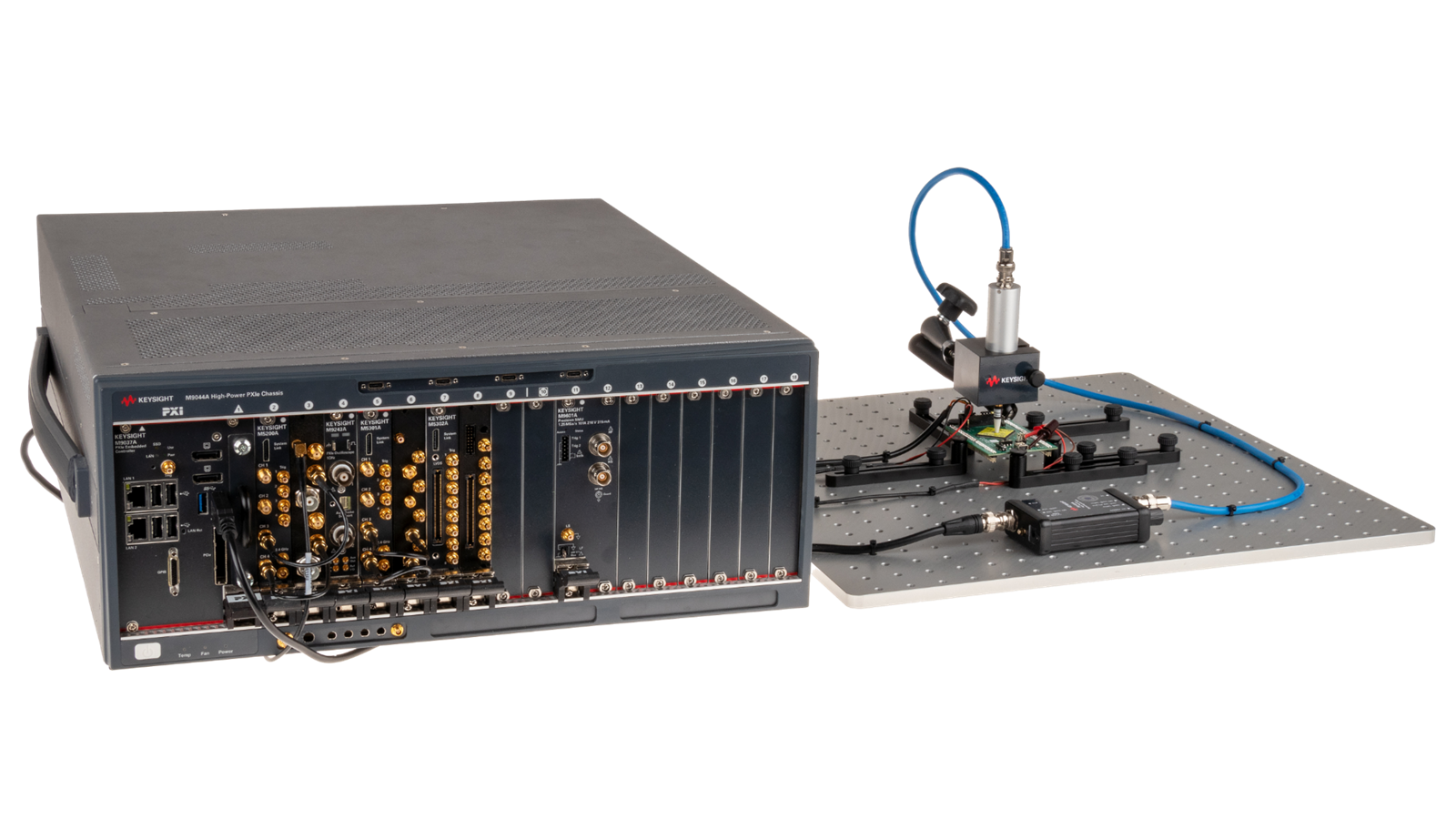
The test setup. You'll see the complete bench: a PXI-based embedded security test bench with the modules that control the test, a glitch amplifier, and a development board as the target. The target's power line is routed through the glitch amplifier, so the device receives its normal supply voltage until the moment a glitch is injected. The presenter shows how the test software is configured, including the glitch voltage and glitch length ranges. For each attempt, the bench picks values within those ranges.
Watching the device under test. A measurement circuit and amplifier monitor the target's current consumption while the campaign runs, and a PXI card digitizes the signal. You'll see how the bench knows what the device is doing, and how the output of each attempt is compared against the expected, normal result to decide whether a glitch had any effect.
The results. As the campaign starts, the target powers up and glitches are injected automatically. Results appear in a live table: green for normal behavior, yellow for an unresponsive device, and red for exploitable faults. Because the target has no countermeasures, a cryptographic operation is compromised within seconds. That is enough faulty output to begin differential fault analysis and recover the device's secret key. You'll also see how the full results plot reveals the small window of glitch parameters that produces a vulnerability, and how that information goes back to design teams to guide mitigations.
The session also includes a short Q&A on practical topics such as success criteria, certification requirements, and regulations like the EU Cyber Resilience Act.
Who should watch
No prior fault injection experience is needed. If you work on products that run on silicon, such as a semiconductor device, an automotive control unit, an aerospace or defense system, a data center platform, or an IoT product, this webinar gives you the foundation to understand physical attacks and what they mean for your designs.
If you come from a hardware or embedded design background, you'll see how the choices you make about power, clocks, and secure code paths can be tested against real attack techniques. If you work in product security or security evaluation, you'll learn how a fault injection test environment is built and how its results are interpreted, which helps you assess whether your countermeasures hold up. If you work in test and validation, you'll see how automated campaigns can be added to existing workflows. If you lead engineering or product teams, you'll get a clear picture of the risk, the effort involved, and how testing supports certification and regulatory requirements.
You'll leave with a shared vocabulary and a practical understanding of the method. That lets your team make informed decisions about protection levels, testing depth, and where hardware security belongs in your development process.
Take the next step
Device security testing is not a one-time checkpoint. Attack techniques evolve, devices stay in the field for years, and a design that resists today's methods may be exposed to tomorrow's. Testing needs to be a continuous process, repeated as designs change, as new attack research appears, and as regulations and market expectations evolve. This webinar is a first step in that process. Press play to see how these attacks work, and how to start building fault injection testing into your approach to device security.