Digital Down Conversion and Real-Time Spectrum Analysis
Lessons
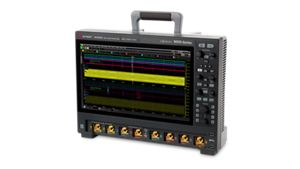
“Digital Down Conversion and Real-Time Spectrum Analysis” explores the advanced capabilities and benefits of digital down-conversion (DDC) and real-time spectral analysis (RTSA), features available on the next-generation Infiniium MXR- and UXR-series oscilloscopes. These features significantly enhance testing and analysis, ensuring superior signal integrity and performance in various applications.
While fast Fourier transforms provide a quick and easy way to display spectral data on screen, DDC and RTSA take testing to the next level by leveraging the hardware power of the Application-Specific Integrated Circuit (ASIC) at the core of the oscilloscope.
DDC is introduced first, enabled under the Setup menu by switching from the time domain view to the DDC view. This transition brings some changes to the interface, but users can continue their work as usual, utilizing all standard trigger modes and other tools like color grading. DDC processes signals in the frequency domain instead of the time domain, with the ASIC handling this processing in hardware to display tens of thousands of plots per second. This feature can be used across every oscilloscope channel, offering over two gigahertz of analysis bandwidth. The data can be saved or exported to the PathWave Vector Signal Analysis (VSA) software directly on the oscilloscope, providing a seamless workflow for detailed signal analysis.
RTSA mode is enabled via an icon on the top left of the interface. Unlike DDC, RTSA is purely a visualization mode designed to help identify even the most infrequent transients. In this mode, the ASIC skips storing data in memory and streams it directly to the display in real time. Although data cannot be saved or exported in RTSA mode, it offers a 100% probability of intercept for most signals and displays hundreds of thousands of plots per second. Advanced masks allow users to plot only when signals enter or avoid certain power levels of the spectrum, and easy-to-use markers help quickly determine the frequencies and power levels of signals on screen. RTSA can operate with up to 320 megahertz of analysis bandwidth, though users are advised to check the data sheets for specific details due to the complexities of real-time operation.
The lesson emphasizes that these features are new and many are exclusive to Keysight, highlighting the innovative advancements in the Infiniium MXR and UXR series oscilloscopes. By leveraging DDC and RTSA, engineers can achieve more precise and efficient signal analysis, ensuring optimal signal integrity and performance in their electronic designs.