












- Overview
- All Models
- Support
High-sensitivity peak and average power measurements
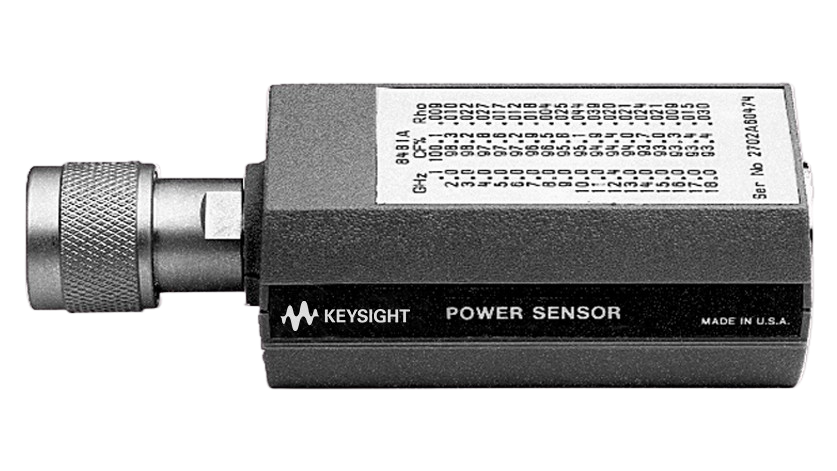
Keysight diode power sensors offer exceptional precision and high sensitivity, ideal for low-level RF and microwave power measurements. Diode technology ensures precise detection of weak signals that other sensor types may miss. With optimized standing wave ratio (SWR) performance, these sensors minimize signal reflections and improve impedance matching, enhancing measurement accuracy. Their excellent temperature stability ensures consistent performance in varying environmental conditions, making them perfect for long-term testing.
High sensitivity
Provides high sensitivity, leveraging diode sensor technology to capture low-level signals that other sensor types may fail to detect.
SWR performance
Minimizes mismatch uncertainty with optimized standing wave ratio (SWR) performance, reducing signal reflections, and ensuring better impedance matching.
Temperature stability
Offers minimized drift across operating temperatures to maintain measurement accuracy for long-term monitoring and testing under varying conditions.
Fast measurement response
Delivers rapid settling times and high measurement speed for time-efficient power readings, enabling quick averaging and faster throughput.
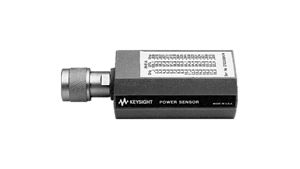

-
Frequency range
50 MHz to 50 GHz, 10 MHz to 18 GHz
-
Power range
-70 to -20 dBm
-
Connector type
2.4 mm (m), Type-N
-
Measurement type
Average/CW only
-
Maximum power
20 dBm (10 uW)
Most popular configurations
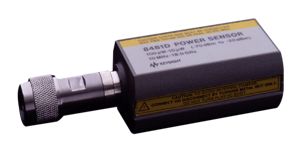

Diode Power Sensor
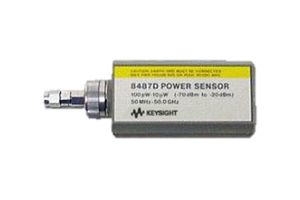

Diode Power Sensor
- Explore Our Extensive Power Meter and Power Sensor Catalog
- Buying Guide for Power Meters and Power Sensors
- 7 Practices to Prevent Damaging Power Sensors
Services and support
Innovate at speed with curated support plans and prioritized response and turn-around times.
Get predictable, lease-based subscriptions and full lifecycle management solutions—so you reach your business goals faster.
Experience elevated service as a KeysightCare subscriber to get committed technical response and more.
Ensure your test system performs to specification and meets local and global standards.
Make measurements quickly with in-house, instructor-led training, and eLearning.
Download Keysight software or update your software to the newest version.
Frequently asked questions
A diode power sensor is a type of RF sensor that uses Schottky diodes to detect and measure the power of an RF signal. It is widely used in both average and peak and average power measurement applications due to its wide dynamic range, fast response time, and compact size.
Diode sensors are commonly found in production test systems, field instruments, and automated test setups where accurate, real-time RF power measurements are required across a broad frequency and power range.
Diode power sensors operate by converting RF energy into a DC voltage using high-speed Schottky diodes, enabling accurate and fast power measurements across a wide dynamic range.
1. RF-to-DC Conversion
The RF signal is coupled into a matched load and passed to one or more Schottky diode detectors.
The diode rectifies the RF signal, converting it to a DC voltage proportional to the instantaneous RF envelope.
2. Square-Law and Linear Regions
In the low-power range, typically less than –20 dBm, the diode operates in its square-law region, where output voltage is proportional to the true power, which is the square of the input voltage.
At higher input powers, the diode moves into the linear region, where output voltage is more linearly related to input voltage, requiring correction algorithms to maintain accuracy.
3. Dual-Path Architecture
Many Keysight sensors use a two-path architecture, combining:
- A high-sensitivity path for low-level signals
- A wide-range path for higher-level signals
The sensor automatically selects the optimal path to maintain accuracy across a dynamic range as wide as –60 dBm to +20 dBm.
4. Signal Processing
The DC signal is then:
- Low-pass filtered for average power measurements
- Or digitized at high speed for peak and time-domain analysis
Internal temperature compensation and frequency response correction are applied to ensure consistent accuracy.
You should use a diode power sensor instead of a thermocouple sensor when you need:
- wider dynamic range, making it suitable for both low-power and high-power measurements without changing sensors
- faster measurement speed, required for production test, automated systems, and applications with real-time feedback
- time-gated or modulated signal support, including average measurements on bursty or complex waveforms
- cost-effective, high-throughput testing, especially in manufacturing environments where speed and versatility matter more than absolute precision
In contrast, use a thermocouple sensor when waveform independence and accuracy are critical, such as in calibration labs or when measuring signals with very high crest factors or unknown modulation.