











- Overview
- All Models
- Support
Enhanced capabilities in an entry-level SMU
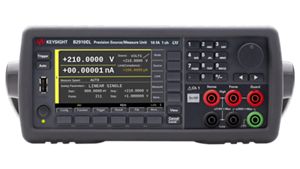
Keysight Essential source measure units (SMUs) are designed to deliver reliable, high-performance electronic testing in a compact and affordable benchtop unit. Our Essential SMUs combine 6-instruments-in-1 and 5.5-digit source resolution, making them ideal for a wide range of applications, including device characterization, circuit testing, and educational use. Additional features include support for 4-quadrant operation, an intuitive graphical user interface, and flexible connectivity options such as USB, LAN, and GPIB. Choose one of our popular configurations or configure one specific to your application.
6-instruments-in-1
Combines a digital multimeter (DMM), power supply, current source, electronic load, arbitrary waveform generator (AWG), and digitizer in one instrument, eliminating the need to sync or configure multiple devices.
4-quadrant operation
Provides full control over both voltage and current, enabling comprehensive testing of active and passive devices in real-world operating conditions.
Built-in math and limits
Performs basic calculations on measured data to extract parameters like resistance and power without exporting raw data and sets pass / fail limits for automated testing.
Multiple connectivity options
USB, LAN (Ethernet), and GPIB connectivity provide flexibility, compatibility, reliability, and scalability in different testing environments.
-
Source resolution
5.5 digits
-
Minimum current measurement resolution
10 fA to 1 pA
-
Number of channels
1
-
Pulse output
No
-
Maximum voltage per output
21 V to 210 V
-
Maximum current per output
1.5 A
-
Maximum sample rate
5 kSa/s to 20 kSa/s
-
Minimum sampling interval
50 µs to 200 µs
Most popular configurations
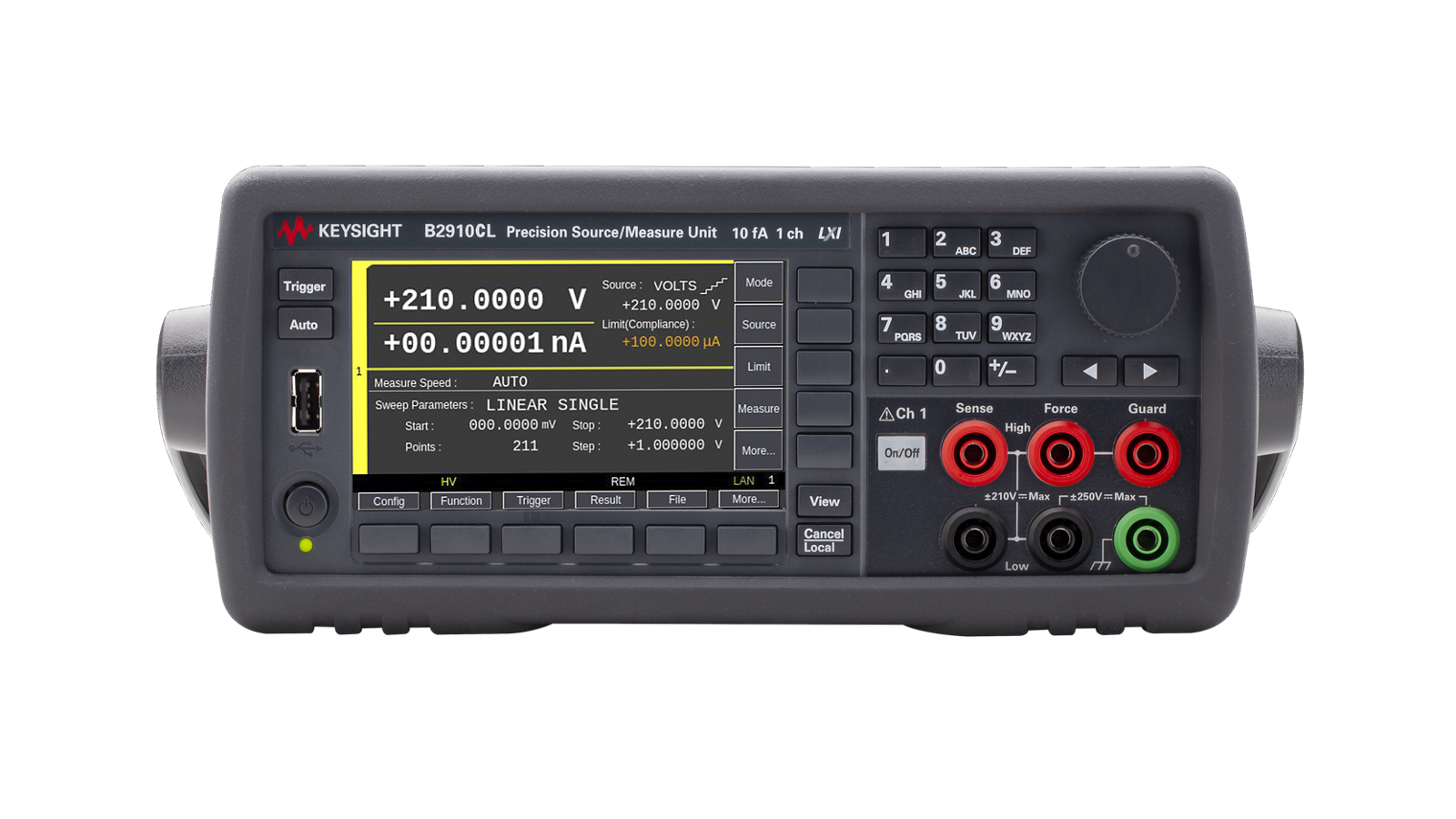
SM1-class Benchtop Source Measure Unit, single-channel, 10 fA resolution
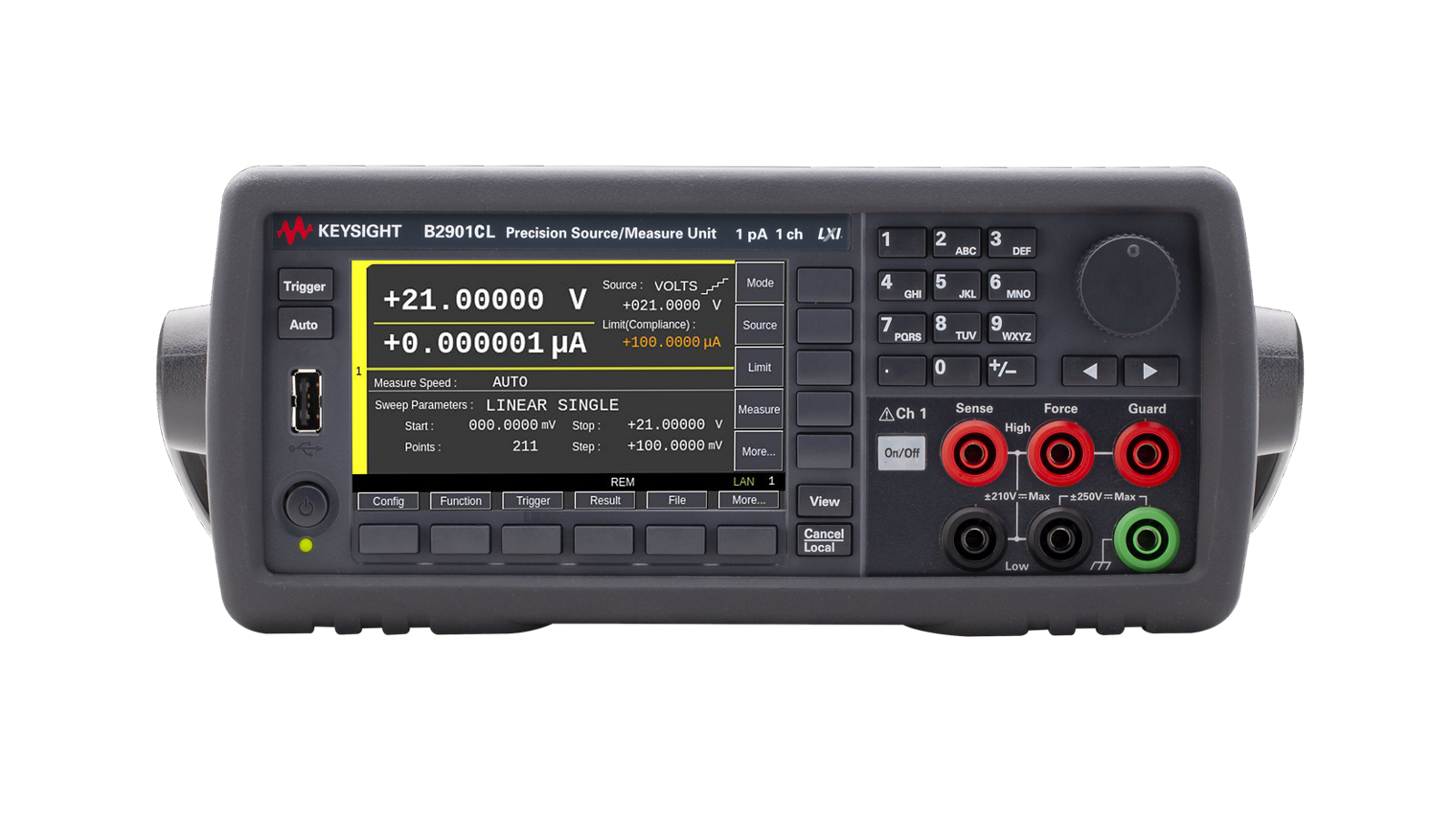
SM1-class Benchtop Source Measure Unit, single-channel, 1 pA resolution
Services and support
Innovate at speed with curated support plans and prioritized response and turn-around times.
Get predictable, lease-based subscriptions and full lifecycle management solutions—so you reach your business goals faster.
Experience elevated service as a KeysightCare subscriber to get committed technical response and more.
Ensure your test system performs to specification and meets local and global standards.
Make measurements quickly with in-house, instructor-led training, and eLearning.
Download Keysight software or update your software to the newest version.
Frequently asked questions
Although source meters and source measure units (SMU) are often used interchangeably, there are subtle differences between them depending on the manufacturer and context.
Generally, a source meter is a type of SMU that integrates a highly accurate power source with a precise measurement unit, allowing it to source and measure voltage and current simultaneously in a single instrument. A source meter is designed to measure direct current (DC) or voltage while simultaneously sourcing (supplying) or sinking (receiving) them.
Some distinctions may arise in terms of capabilities and performance. Advanced SMUs offer multi-quadrant operation (4-quadrant sourcing and sinking), high-resolution measurements (down to fA and nV levels), programmable sweeps, and automation features. These capabilities make them suitable for complex applications such as semiconductor testing, battery simulation, and power electronics characterization.
On the other hand, some simplified source meters may lack full 4-quadrant operation or ultra-low current measurement capabilities. This makes them less suitable for applications requiring extreme precision but still useful for general-purpose testing and characterization
A source measure unit (SMU) differs from a power supply, power analyzer, and multimeter in terms of functionality, precision, and application scope.
Unlike a power supply, which only provides voltage or current without precision measurement capabilities, a source meter can both source and measure voltage and current simultaneously with high accuracy, often in the femtoampere (fA) and nanovolt (nV) range.
Compared to a power analyzer, which is designed to measure power consumption, efficiency, harmonics, and transient behavior of electrical systems over time, a source meter focuses more on precise IV characterization, semiconductor testing, and material analysis at both low and high-power levels.
Meanwhile, a digital multimeter (DMM) is a passive instrument that only measures voltage, current, or resistance but cannot actively source power. In contrast, a source meter combines both sourcing and measurement in a single instrument, making it ideal for IV curve tracing, leakage current testing, and characterizing electronic components.
Additionally, source meters operate in all four quadrants, meaning they can source and sink power, unlike traditional power supplies or multimeters, which only handle unidirectional current flow. This versatility makes source meters essential for advanced electronics testing, battery simulation, and precision component characterization, bridging the gap between traditional measurement instruments.
Compliance voltage in source meters refers to the maximum voltage limit that a source measure unit (SMU) or source meter applies when operating in current source mode to protect the device under test (DUT) from excessive voltage exposure.
When an SMU is set to source a specific current, it automatically adjusts the voltage across the DUT to maintain the desired current level. However, if the DUT has a high resistance or an open circuit, the voltage required to maintain the set current could exceed safe limits, potentially damaging the device.
To prevent this, the compliance voltage acts as a safety threshold, ensuring that the SMU will not exceed the preset voltage value while attempting to force the specified current. Once the compliance voltage limit is reached, the SMU stops increasing the voltage and may indicate a compliance condition, signaling that the desired current level could not be achieved without exceeding the voltage limit.
This feature is crucial in semiconductor testing, diode characterization, and battery simulations, where precise control of voltage and current is essential to prevent damage and ensure accurate measurements. By setting an appropriate compliance voltage, engineers can protect sensitive components, maintain test integrity, and ensure safe operation during electrical characterization.
Yes, an entry-level source measure unit (SMU) can be used for semiconductor and diode testing; however, its suitability depends on the specific device under test, including the required voltage, current, accuracy, and sensitivity.
Entry-level SMUs typically offer basic IV (current-voltage) characterization capabilities, allowing users to apply a precise voltage while measuring current (or vice versa). This makes them ideal for testing diodes, LEDs, and low-power semiconductor devices. They can measure key parameters such as forward voltage (Vf), reverse leakage current (Ir), breakdown voltage (Vbr), and resistance characteristics, which are critical in evaluating the performance and efficiency of semiconductor components.
However, entry-level SMUs may have limited current and voltage ranges, lower resolution in low-current measurements, and fewer advanced features such as pulse testing or ultra-low noise performance. These limitations can be particularly significant for applications that require high-power transistor testing, advanced semiconductor research, or nanotechnology experiments.
Despite these limitations, entry-level SMUs still provide accurate and repeatable measurements for basic device testing, educational labs, and small-scale R&D applications. They offer a cost-effective solution for engineers and researchers working with standard semiconductor components while maintaining essential precision and control