














- Overview
- All Models
- Support
Fundamental signal generation for general-purpose applications
Keysight Essential vector signal generators come in two classes. The XG1-class includes the CXG Series and the XG2-class includes the EXG Series. They are used in a variety of applications, including wireless communications for testing 5G devices (sub-6 GHz FR1), Wi-Fi®, and Bluetooth® systems. They are also critical in RF testing for evaluating radar systems, antenna performance, and signal integrity in general electronics. Far from basic, these entry-level vector signal generators also offer enhanced features such as additive white Gaussian noise (AWGN) to simulate real-world conditions and multitone generation capabilities to minimize distortion. Choose one of our most popular configurations or build the one you need for your application. Need help selecting? Check out the resources below.
Pre-configured waveforms
Test your devices with multiple, verified, standards-compliant vector signals, including 5G NR FR1, WLAN 802.11, and ZigBee®, using high-fidelity signal generation.
Generate multitone signals
Generate interference in transmissions or neighboring channels. Characterize nonlinear devices like amplifiers and mixers by simulating the intermodulation distortion.
Simulate real-world conditions
Add AWGN to a carrier in real-time with an available calibrated noise generator to evaluate receiver sensitivity and simulate real-world conditions.
Self-maintenance capabilities
Quickly identify and address instrument issues, ensuring minimal disruption to testing. Internal self-diagnostics ensure your signal generator remains in optimal working condition.
-
Maximum frequency
6 GHz
-
Maximum modulation bandwidth
120 MHz to 160 MHz
-
Number of outputs
1
-
Phase noise @1 GHz (20 kHz offset)
-122 dBc/Hz to -119 dBc/Hz
-
Output power @1 GHz
18 dBm to 21 dBm
-
Harmonics @ 1 GHz
-35 dBc
-
Frequency switching speed
800 µs to 5000 µs
Most popular configuration
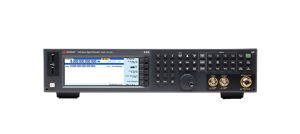
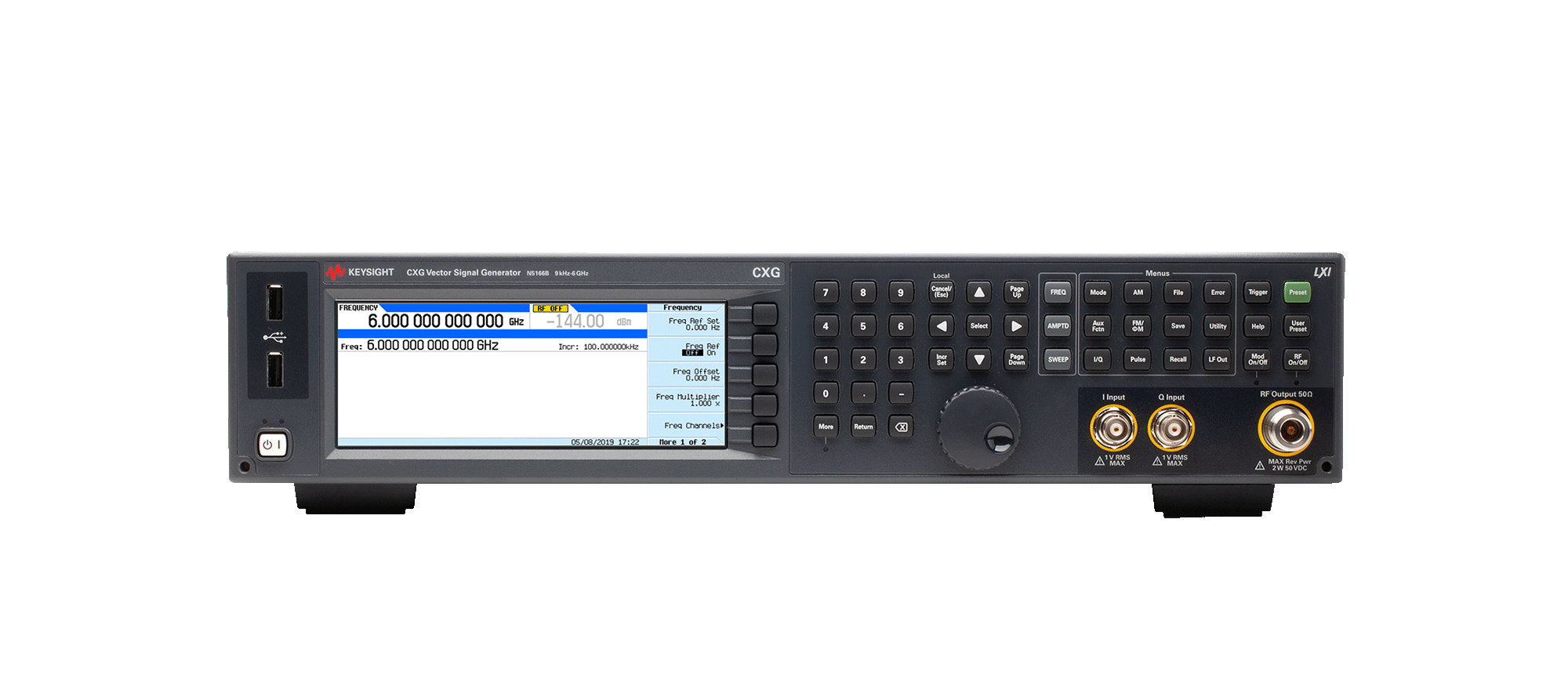
XG1-class Vector Signal Generator
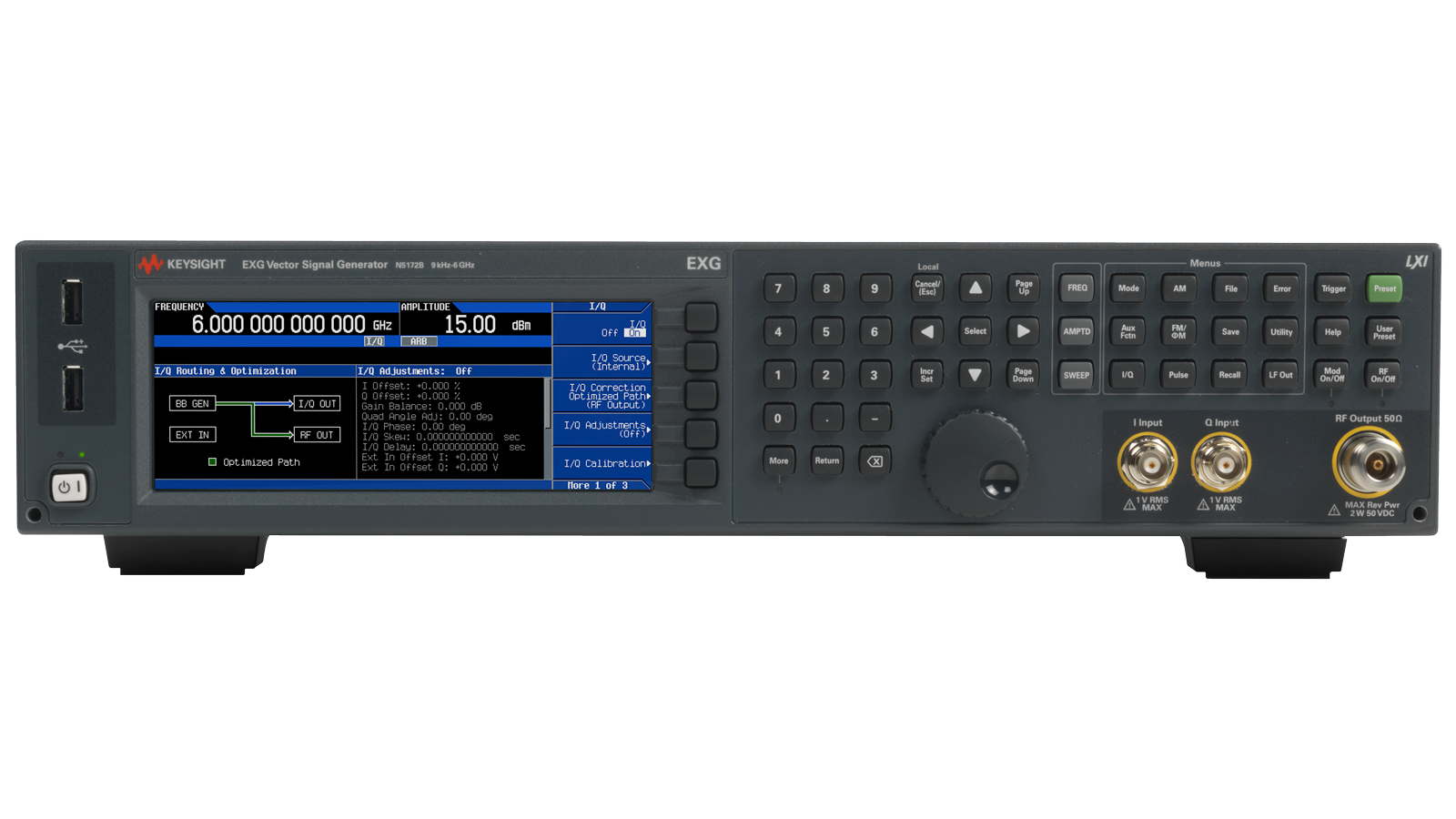
XG2-class Vector Signal Generator

XG2-class Vector Signal Generator
Services and support
Innovate at speed with curated support plans and prioritized response and turn-around times.
Get predictable, lease-based subscriptions and full lifecycle management solutions—so you reach your business goals faster.
Experience elevated service as a KeysightCare subscriber to get committed technical response and more.
Ensure your test system performs to specification and meets local and global standards.
Make measurements quickly with in-house, instructor-led training, and eLearning.
Download Keysight software or update your software to the newest version.
Frequently asked questions
A vector signal generator is an advanced type of electronic test equipment used to generate precise, complex radio frequency (RF) signals with specific modulation schemes. Unlike simpler signal generators that produce basic waveforms such as sine, square, or triangle waves, a vector signal generator can create signals with intricate digital modulation, including QAM (Quadrature Amplitude Modulation), PSK (Phase Shift Keying), or OFDM (Orthogonal Frequency-Division Multiplexing). These signals emulate real-world communication signals used in technologies like wireless networks, cellular systems (e.g., 4G/5G), radar, and satellite communications.
The term "vector" refers to its ability to control both the amplitude (magnitude) and phase of the signal, which are represented as vectors in a complex plane (I/Q plane, where I is in-phase and Q is quadrature). This enables the vector signal generators to generate highly customizable and realistic signals for testing receivers, amplifiers, and other RF components.
Multitone RF signal generation is the process of creating multiple sinusoidal tones simultaneously within a single RF signal. Rather than producing a single-frequency signal, a multitone signal comprises two or more distinct frequencies, typically spaced at defined intervals within a specified bandwidth. These tones can be equally spaced or customized, for example, in frequency or amplitude, depending on the test application.
This technique is especially valuable for testing and characterizing RF and microwave components, subsystems, and systems such as amplifiers, filters, and receivers. For instance, when assessing the linearity of power amplifiers, multitone signals can help uncover intermodulation distortion (IMD) products that arise when multiple tones interact nonlinearly in the device being tested. These intermodulation products serve as key indicators of how effectively a device performs under real-world signal conditions.
AWGN is a widely used model in signal processing and communications for representing random noise that interferes with signals in electronic systems. It is called "additive" because the noise is superimposed onto the original signal, resulting in a noisy output, much like static distorting a radio broadcast.
The term "white" signifies that the noise has a uniform power spectral density across all frequencies within a given bandwidth, similar to how white light includes all visible wavelengths. This indicates that the noise is broadband and that its values at different times are uncorrelated. "Gaussian" describes the noise amplitude as following a normal distribution, creating a bell curve centered around a mean (typically zero), with its spread determined by its variance, which reflects the random nature of the noise’s strength.
AWGN is a realistic approximation of real-world noise sources, such as thermal noise in circuits or background radiation, and is crucial for testing and analyzing communication systems. Engineers use it to simulate challenging conditions for a 5G network or to calculate the amount of noise a receiver can withstand before losing data.