


Why Use QuantumPro
EM in • Quantum out—automated quantum-parameter extraction.
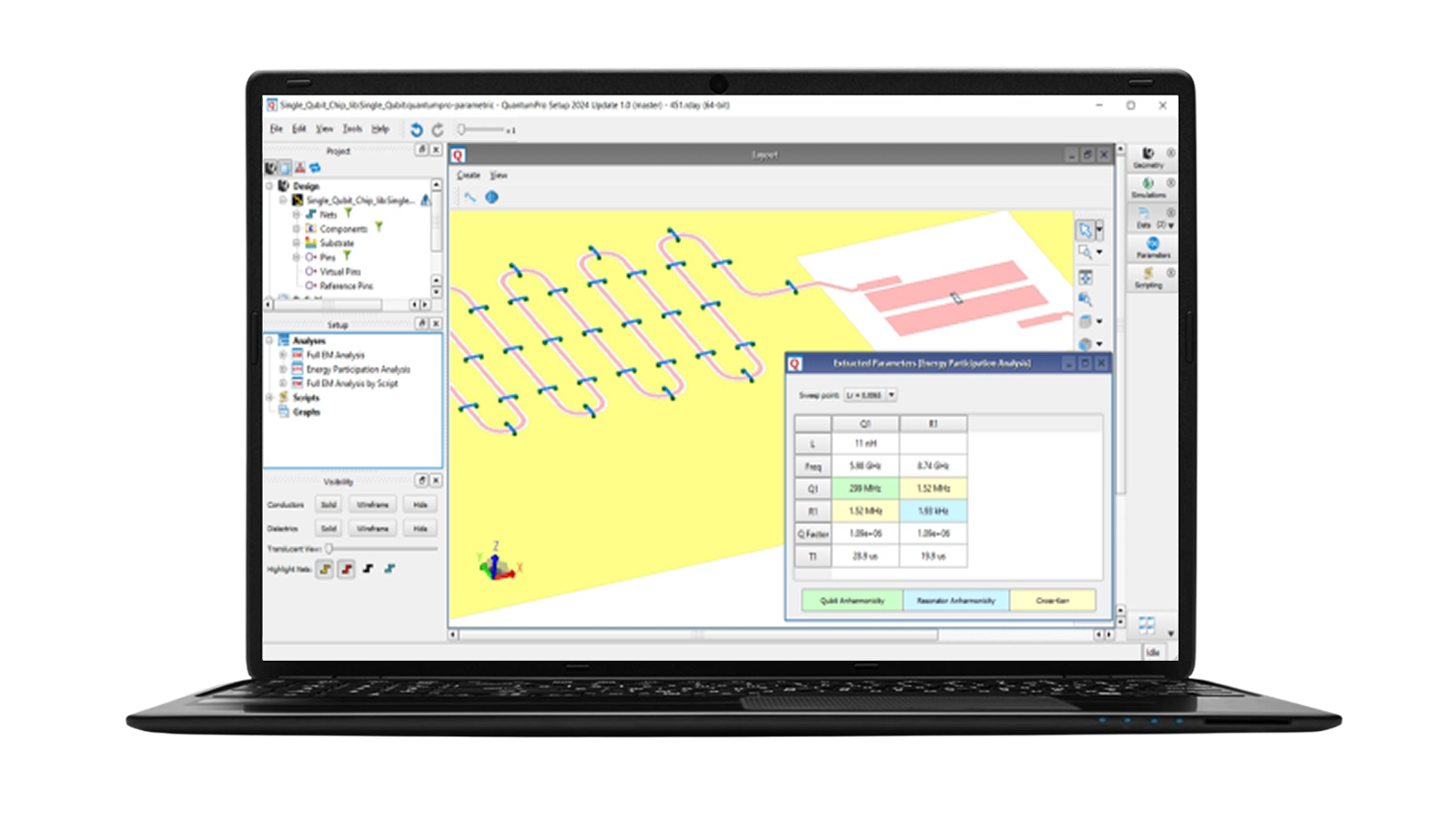
QuantumPro connects layout and circuit design with electromagnetic simulation and quantum-parameter extraction. It supports finite-element frequency-domain and eigenmode analysis, method of moments (MoM) simulation, superconducting material modeling, including kinetic inductance, and Python-based design automation.
Key Capabilities

Electromagnetic (EM) simulation brings you insight before physical prototyping.

Integrated circuit/layout/EM for the design of superconducting qubits.

QuantumPro 3DEM simulators (FEM for frequency domain and eigenmode and Momentum for frequency domain).

Automated quantum parameter extraction from both frequency-domain and eigenmode solutions.

Linear Circuit Simulator for EM-circuit co-simulation.

Modeling of the kinetic inductance in the EM flow.
Resources to Get You Started
Revolutionize your workflow with automated quantum parameter extraction from both frequency-domain and eigenmode solutions. Effortlessly optimize with built-in design automation via ADS/QuantumPro Python scripting. Elevate your EM flow with kinetic inductance modeling. Experience quantum innovation simplified with QuantumPro.


BOOTCAMPS
Superconducting Quantum Design Challenges

Videos
Introducing QuantumPro in Keysight ADS 2024

Vorführung
How to Design Superconducting Qubits Using QuantumPro
Vorführung
Demonstrating Coaxmon Qubit Design in ADS QuantumPro
Vorführung
QuantumPro Modeling and Simulating 3D Qubits
Vorführung
QuantumPro Results Summary Generation
Applikationsberichte
Quantum Parameter Extraction in QuantumPro
Applikationsberichte
Design of Transmon Qubit and CPW Resonator in Flip-Chip Technology with ADS, Quantum Pro
Explore QuantumPro Bundles
ADS software bundles provide designers with pre-configured combinations targeted to a specific design workflow.


ADS Core, EM Design, Layout, QuantumPro
W3704B ADS and EM design environments with linear circuit and QuantumPro — An integrated circuit, layout, EM, and quantum extraction workflow for the seamless design of superconducting qubits.
W3704B ADS and EM design environments with linear circuit and QuantumPro — An integrated circuit, layout, EM, and quantum extraction workflow for the seamless design of superconducting qubits.


ADS Core, EM Design Core, Layout, QuantumPro, HB
W3715B ADS and EM design environments with nonlinear circuit and QuantumPro — An integrated circuit, layout, EM, and quantum extraction workflow for the seamless design of both superconducting qubits and quantum amplifiers.
W3715B ADS and EM design environments with nonlinear circuit and QuantumPro — An integrated circuit, layout, EM, and quantum extraction workflow for the seamless design of both superconducting qubits and quantum amplifiers.
Have Questions? We've Got Answers
Electromagnetic simulation is the process of modeling the electric and magnetic fields within superconducting quantum circuits and their surrounding structures. It enables engineers to predict how qubits, resonators, couplers, control lines, packages, and cavities interact before fabrication. By accurately characterizing electromagnetic behavior, designers can extract critical quantum parameters, identify unwanted modes, and optimize device performance early in the design cycle. QuantumPro from Keysight integrates EM simulation directly into the quantum design workflow to help accelerate superconducting qubit development.
Superconducting qubits are highly sensitive to their electromagnetic environment. Small changes in geometry, material properties, packaging, or interconnects can impact qubit frequencies, coupling strengths, coherence, and crosstalk. EM simulation enables designers to understand these effects before fabrication and optimize designs to minimize loss mechanisms and unwanted resonances. This helps improve qubit performance while reducing costly design iterations.
Modern quantum EM simulation tools can extract many of the parameters needed for quantum hardware design, including qubit frequencies, resonator frequencies, coupling coefficients, energy participation ratios (EPRs), capacitance matrices, inductance values, and mode structures. These parameters can then be passed to quantum circuit simulators and Hamiltonian-based analysis tools to predict device behavior with greater accuracy. QuantumPro provides integrated quantum parameter extraction as part of its EM-driven workflow.
Yes. Advanced quantum EM simulators can model complete 3D environments, including chip packages, cavities, interposers, wirebonds, connectors, and control-line structures. As quantum processors scale, packaging effects increasingly influence device performance through the introduction of unwanted resonances, crosstalk paths, and radiation losses. EM simulation allows engineers to analyze these interactions and optimize both the chip and package simultaneously. Keysight highlights support for full 3D modeling and simulation of qubits, cavities, and packaging within its quantum design environment.
EM simulation reduces the need for repeated fabrication cycles by enabling virtual prototyping of quantum devices. Engineers can evaluate multiple design alternatives, optimize layouts, identify performance bottlenecks, and verify electromagnetic behavior before manufacturing hardware. By combining EM analysis with circuit simulation and system-level quantum modeling, development teams can move more quickly from concept to validated design while improving confidence in device performance. This integrated approach is a key reason why EM simulation has become a foundational technology for scalable quantum computing development.