Core Platform
The Embedded Security Testbench is built on a core platform that brings together system integration, control, and compute into a single, cohesive environment, designed to integrate seamlessly and scale with your needs.
This foundation ensures that every instrument and module operates in sync, enabling precise timing, reliable measurements, and repeatable execution across complex security tests. As testing requirements evolve, additional PXI modules slot into the same system, without disrupting what's already running.
This approach allows teams to start with a focused setup and expand over time, building a flexible test environment that adapts to new use cases, methodologies, and levels of complexity.
At the heart of this platform are two core components:
- M9046A PXIe Chassis
- M9038A PXIe Embedded Controller

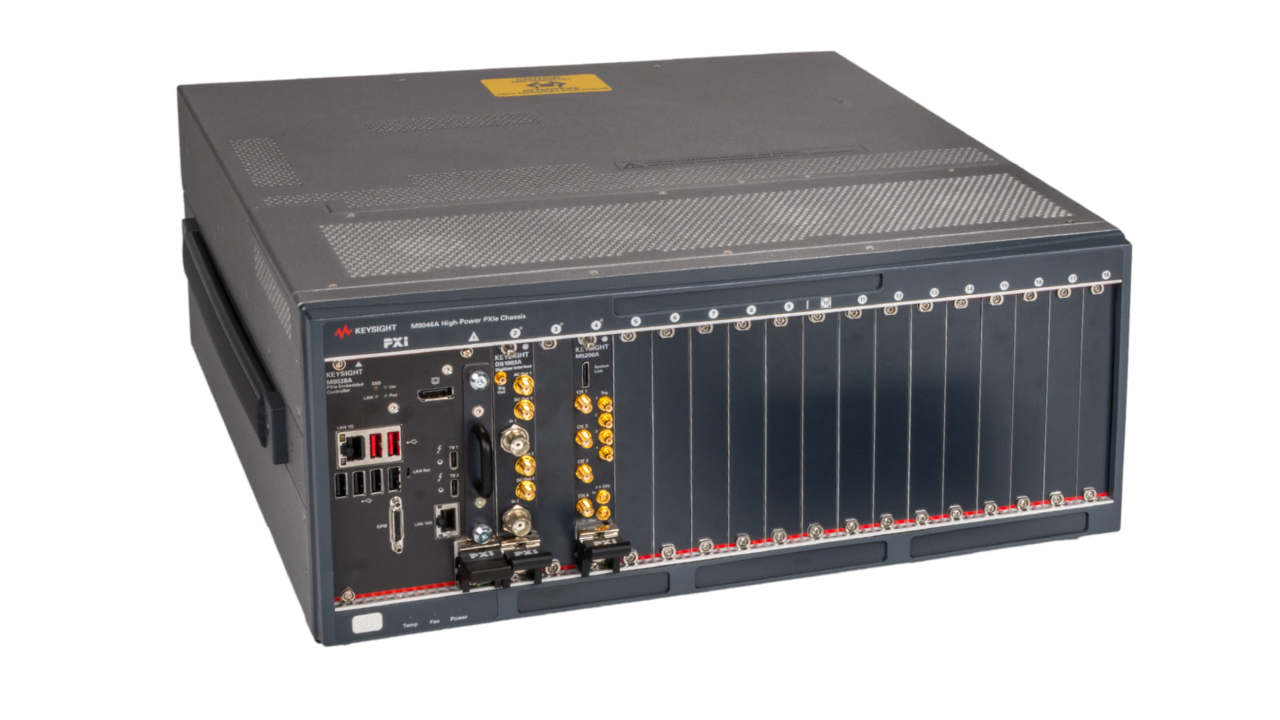

The foundation of the testbench, providing power, cooling, and system integration for all modules. It creates a stable and scalable environment where multiple instruments can operate together in a single, synchronized system.


The control center of the testbench, delivering the compute performance needed to manage test execution and run advanced security analysis. It ensures smooth coordination between instruments and efficient processing of results.
How the Pieces Fit Together
A complete security test setup has four parts: the target device under test, the testbench that powers and synchronizes everything, the hardware specific to your test method, and the software that runs the campaign. At the center of all of it is the DS1050A, the chassis and controller that every other piece connects to and depends on.
What connects to that core changes depending on what you're testing. The tabs below walk through the modular building blocks that plug directly into the DS1050A.
- Testbench Architecture
- Triggering
- Glitching
- Digital I/O
- Upcoming Modules
The PXIe chassis doesn't run one fixed configuration, it accepts multiple modules at once, and which ones you install determines what the testbench is capable of.
- Add a trigger generator and you can fire precisely on signal.
- Add a waveform generator and you can shape glitches with exact timing and amplitude.
- Add a digital I/O module and you can synchronize multiple channels for complex, multi-step campaigns.
This is what makes the platform modular and expandable rather than fixed: the same chassis and controller support Side-Channel Analysis and Fault Injection alike, simply by changing which PXI cards are installed.
A team can start with the minimum needed for a single test type and add modules as new requirements come up, without replacing the core.


DS1060A Pattern‑Based Trigger Generator
Precision Timing for SCA and FI
Precise triggering is essential for side-channel analysis (SCA) and fault injection (FI). The DS1060A provides accurate, repeatable timing to align measurements and injections with the behavior of the device under test.
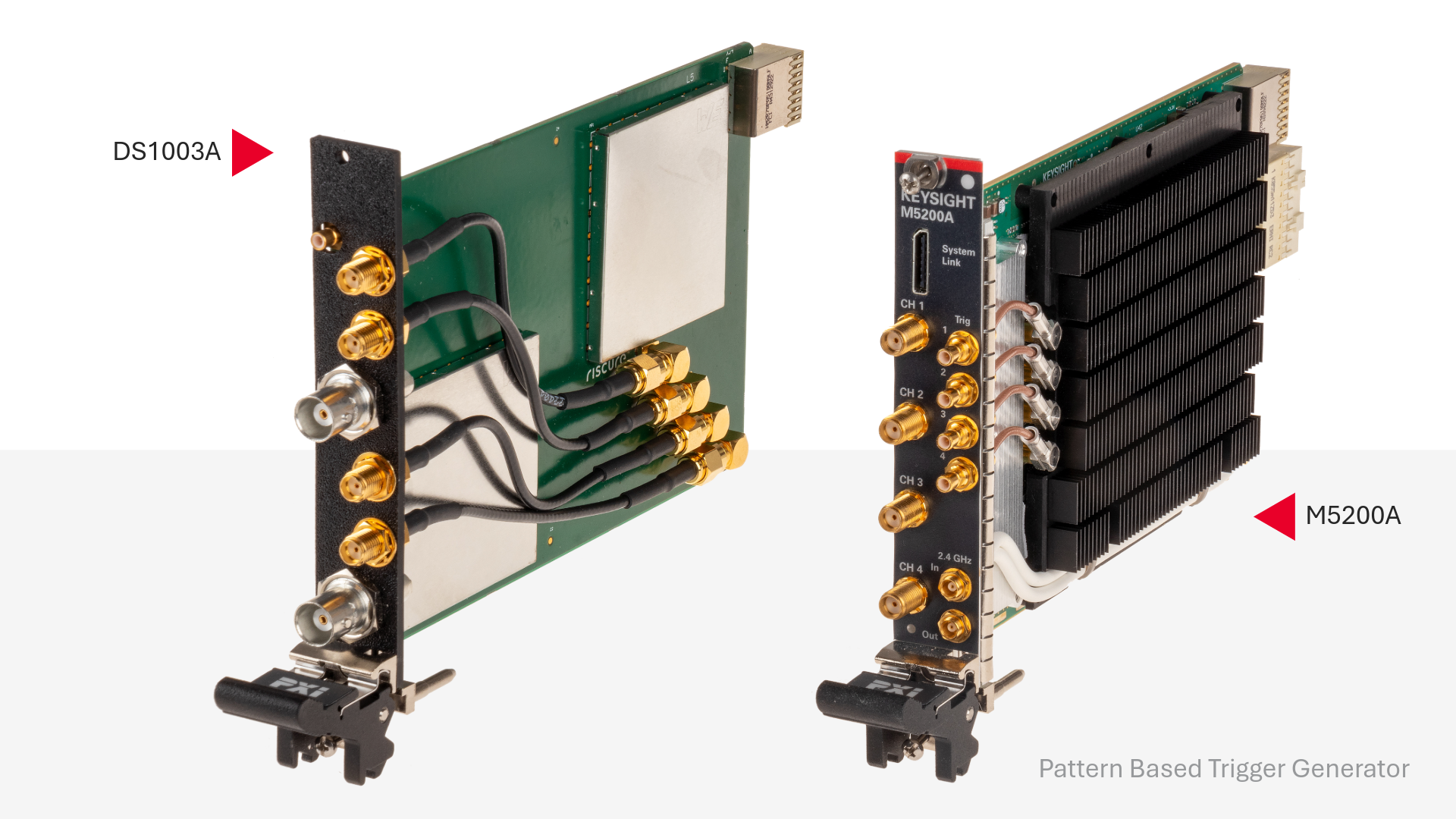
The DS1060A consists of the M5200A Digitizer and the DS1003A Digitizer Interface. The solution can operate as a standalone oscilloscope or run different bitstreams depending on the task. The Pattern-Based Trigger Generator enables pattern-driven triggering, with additional bitstreams for side-channel analysis workflows available.
Key building blocks
M5200A PXIe Digitizer
- High-speed data acquisition with FPGA-based triggering
- Multi-channel capture with deep memory
- Flexible bitstream options: triggering, analysis, or custom
DS1003A Digitizer Interface
- Enables pattern-based triggering and advanced synchronization
- Combines the M5200A's inputs with DC and AC coupling
- Trigger I/O time resolution of 200 ps

What this unlocks
- One module covers both standalone oscilloscope use and dedicated trigger generation, without needing separate hardware for each
- Bitstream flexibility means the same digitizer can be reconfigured for pattern-based triggering today and correlation/TVLA analysis as that capability matures
- Custom bitstream support leaves room to build trigger logic specific to a target that isn't covered by the standard options
DS1070A Baseband AWG
High‑Speed Waveform Control for Fault Injection
Fault injection testing requires speed, accuracy, and flexibility. The DS1070A Baseband AWG delivers all three.
It combines high‑speed analog waveform generation with flexible control, enabling precise glitch injection with exact timing and amplitude, essential for uncovering subtle vulnerabilities in modern embedded devices.
Key building blocks
M5301A Baseband Arbitrary Waveform Generator
- Generates analog waveforms from 0 to 400 MHz
- Multi‑channel operation with sub‑nanosecond resolution
- FPGA programmability for advanced glitch shaping
DS1004A Interface Card
- Converts AWG output to voltage‑level signals suitable for fault injection
- Includes bitstream optimized for glitch generation

What this unlocks
- Precise control over glitch timing and amplitude
- Supports voltage, clock, EM, and laser FI campaigns
- Enables advanced, repeatable fault injection experiments
DS1071A PXIe Digital I/O + Interface Card
Control, Coordination, and Protocol Awareness
The DS1071A Digital I/O solution provides the trigger and communication backbone for complex fault injection campaigns.
It enables tight coordination between the testbench and the device under test, ensuring that digital events, protocols, and triggers remain synchronized during timing‑sensitive attacks.
Key building blocks
M5302A Digital I/O Module
- High‑speed GPIO and LVDS channels
- FPGA‑based control for custom logic
- Support for common debug and communication interfaces
DS1005A Interface Card
- Converts LVDS signals to single‑ended logic levels
- Optimized for glitch control and protocol interaction

What this unlocks
- Precise synchronization across multiple digital signals
- Essential for multi‑glitch and complex timing scenarios
- Flexibility to adapt to different device architectures
- This level of digital control is critical for advanced, coordinated fault injection testing.
Upcoming PXI Modules
New PXI modules are continuously under development to extend the platform’s capabilities. These additions are designed to support evolving testing requirements, new security methodologies, and more advanced use cases across both Side-Channel Analysis and Fault Injection. The platform is built to grow alongside your needs, enabling you to expand and adapt your test setup over time
Build Your Own Device Security Test Lab
Everything on this page starts from the same foundation: the DS1050A serves as the core that every test, module, and campaign builds on. From there, the testbench extends based on your testing needs.
At a high level, building a device security test lab comes down to four elements: the target device under test, the testbench that powers and synchronizes the system, the hardware specific to your test method, clock, power, electromagnetic (EM), or laser, and Inspector, the software that designs and runs your SCA or FI campaigns.
A typical lab grows in stages and complexity. Depending on your needs, there are different tiers and types of labs, each adding components or capabilities as testing requirements expand. Each stage builds on the same chassis, controller, and software, nothing gets replaced as the lab grows.


Device Under
Test
The chip, embedded system, or secure element to be analyzed and validated.

PXI Embedded Security Testbench
A synchronized platform that powers, controls, and connects all instruments in your setup.

Testing Tooling
Specialized hardware, including clock, power, electromagnetic (EM), or laser tools, used to perform specific test methods.


Inspector Software Suite
A unified environment to design, run, and analyze Side-Channel Analysis (SCA) and Fault Injection (FI) campaigns.


Training & Expertise
Continuous training ensures teams can keep up with evolving attack techniques and apply effective SCA and FI methodologies.
Frequently Asked Questions
The DS1050A is the core PXIe-based platform, chassis and controller, that powers and synchronizes Side-Channel Analysis (SCA) and Fault Injection (FI) testing.
Additional modules and test-specific hardware connect to this core depending on what you're testing.
- Side‑Channel Analysis observes a device's physical behavior, like power consumption, electromagnetic emissions, timing and more, to understand what it's going on internally and try to exploit leakages of cryptographic operations.
- Fault Injection deliberately disturbs this normal behavior by glitching the device to fail in a way that exposes a vulnerability.
The DS1050A testbench and Inspector Software support both.
Some modules, like the DS1060A trigger generator, are used across both. Others, like the DS1070A glitch generator and DS1071A digital I/O, are specific to fault injection. The testbench itself stays the same; what changes is which modules are connected.
Yes. The chassis and controller form a fixed foundation, and modules, trigger generation, glitch generation, digital I/O, or test-specific hardware for power, clock, EM, or laser, are added as testing needs grow, without replacing what's already in place.
Inspector Software is the software suite that defines, configures, and executes side channel analysis (SCA) and fault injection (FI) campaigns using the testbench.
While the hardware performs the physical actions, like capturing signals or injecting faults, Inspector Software is what turns those capabilities into a complete, structured test. It allows setting up of target, defining attack parameters, automating measurements, and managing results in a controlled and repeatable way.
In practice, Inspector Software is required whenever you want to move beyond manual interaction and run a real test campaign. It brings together the different hardware components, orchestrates the workflow, and ensures that tests are consistent, scalable, and traceable, whether it's an early evaluation, validation, or certification work.
The DS1050A is designed to be scalable with any testing needs, from focused and single‑technique setups to fully integrated, multi‑technique labs.
You can start with a targeted setup, such as power or electromagnetic (EM) side channel analysis, and expand over time to include additional capabilities like advanced fault injection techniques using laser. Regardless of the scope, the core platform, chassis, controller, and software remain consistent.
This means you don’t need to redesign your setup as your requirements evolve. Instead, you can incrementally extend your lab by adding new instrumentation and capabilities, all within the same unified environment. The result is a flexible testbench that supports everything from early-stage evaluation to complex validation and certification workflows.