What are you looking for?
What Is Bidirectional Scattering Distribution Function (BSDF)?
Definition of Bidirectional Scattering Distribution Function (BSDF)
BSDF stands for Bidirectional Scattering Distribution Function, which is a mathematical function that characterizes how light is scattered from a surface.
It is mathematically defined by the following formula in figure 1, where:
- L is the luminance on the sample surface at the observer direction
- E is the illuminance on the sample surface from the source direction
- Λ is the wavelength


Figure 1. Formula for BSDF.
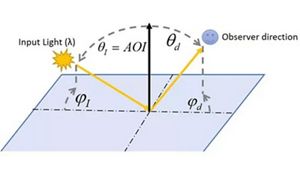

Figure 2. Diagram showing BSDF, input light, and observer direction.
In practice, this phenomenon is usually split into reflected and transmitted components, which are then treated separately as BRDF (Bidirectional Reflectance Distribution Function) and BTDF (Bidirectional Transmittance Distribution Function).


Figure 3. Incident light, specular reflection, reflected scatter distribution BRDF, transmitted scatter distribution, BTDF, specular transmission.
Table of Contents
Why Is BSDF Important to an Optical Design?
During an optical design process, accurate simulation results rely on accurate optical properties. Geometry alone does not determine light distribution; it’s the optical properties that determine how the energy and direction of the rays change. For this reason, it’s important to know as precisely as possible the optical characteristics of the materials you will be using. The best way to obtain precise characteristics is to measure the material directly and export the data to use in an optical software tool.
Requirements:
- Optical designers need accurate optical properties for ray tracing simulations
- Research and development (R&D) engineers need to design the right material with the given optical properties
- The manufacturing process must perfectly control the quality check
Solutions:
- Angular optical scattering with BSDF
- Amount of light propagation TIS (reflectance, transmittance, absorbance ratio)
What Solutions Does Keysight Offer for Measuring BSDF?
You can measure BSDF in two principal ways: goniophotometers and camera-based systems. Keysight provides two solutions for each method.
Goniophotometers
You can measure BSDF with a classical goniophotometer, where a static light source illuminates a sample and a mobile detector turns around the sample to collect the scattered light (or the opposite — with a mobile light source and a static detector).
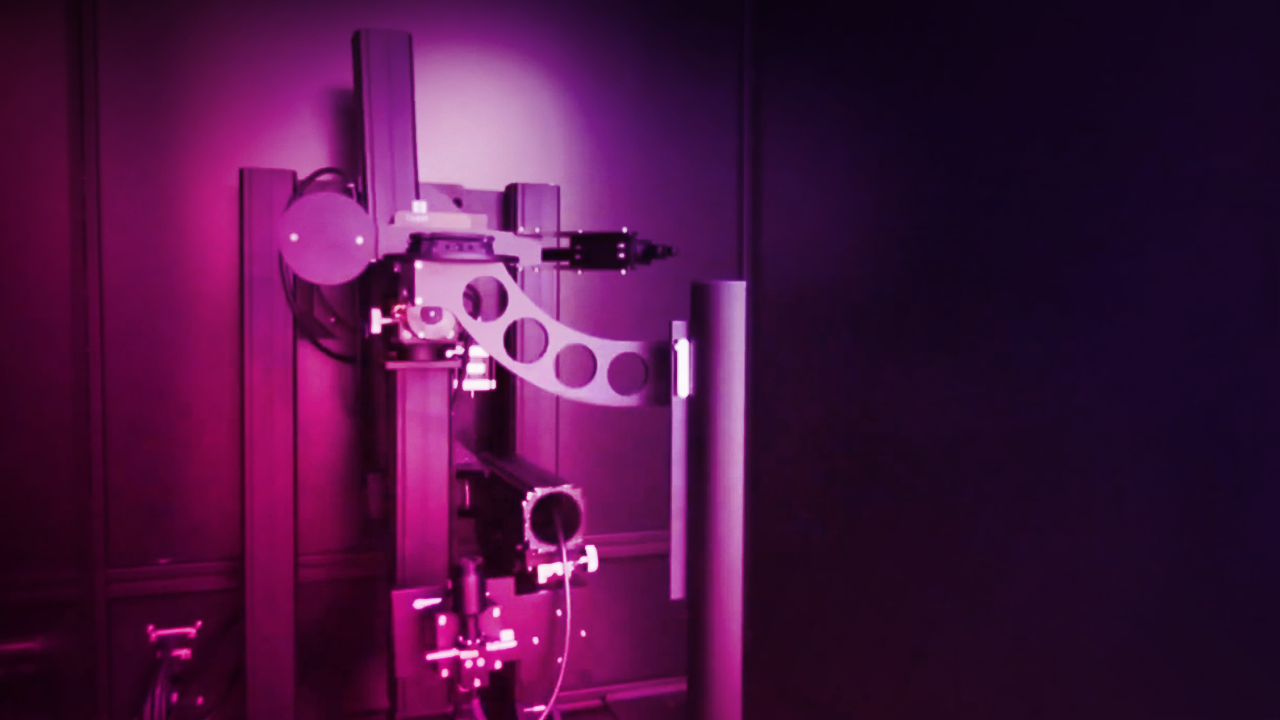
Keysight offers two goniophotometer solutions pictured below: the REFLET 180S (left) and the High Specular Bench (right).


For these high-resolution, high-dynamic motorized scatterometer systems, we provide measurement services in our lab. The Keysight REFLET 180S is also available for purchase.
Solution Specifications
| Feature | Keysight REFLET 180S | Keysight High Specular Bench |
|---|---|---|
| Type | BRDF/BTDF | BRDF/BTDF |
| Dynamic range | 109 | 1013 |
| Wavelength range | 400 nm to 1700 nm | 280 nm to 10.6 µm |
| Incident angles | Tunable: +90° to –90° | Tunable: 90° to 0° |
| Angular range | Full sphere | 1 Plan from –10° to +90° |
| Angular accuracy | < 0.1° | < 0.02° |
| Repeatability | < 1% | < 1% |
| Weight | 80 kg | 200 kg |
| Advantages | • High dynamic range | • Very high dynamic range • Measurement at 0.002° from the specular |
| Shared benefits | • High precision • High repeatability • Customizable wavelength range | |
Camera-based systems
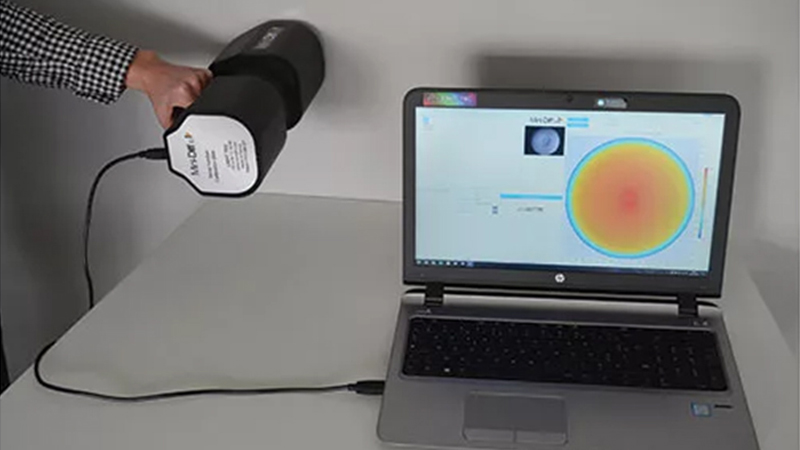
You can also measure BSDF using a camera-based system, where a source illuminates the sample and a system of lenses sends all the scattered light to a camera.
Keysight develops and assembles the camera-based system Mini-Diff V2, which is available for purchase. The Mini-Diff V2 is a portable device that is fast and easy to use.

Mini-Diff V2 Specifications
| Feature | Keysight Mini-Diff V2 |
|---|---|
| Type | BRDF/BTDF |
| Dynamic range | 105 |
| Wavelength range | 630 nm, 525 nm, 465 nm, 940 nm |
| Incident angles | Fixed: 0°, 20°, 40°, 60° |
| Angular range | Sphere [0°; 75°] [0°; 360°] |
| Angular accuracy | 1° |
| Repeatability | < 2% |
| Weight | 2 kg |
| Advantages | • Plug & play • Easy to use & fast • Portable & compact • Attractive cost |
All of these instruments enable you to export measurement data into simulation software to be used for design.
Example of a Vehicle Dashboard Measurement with the Keysight REFLET 180S and Design with LucidShape
R&D teams can use the measurements of a surface for vehicle dashboard material to evaluate the grain size and determine which one reflects the least and scatters the most. The goal is to have the most diffusing surface possible in order to decrease reflection in the windshield for driver safety.
To compare the scattering of two dashboard surfaces with different grain sizes, you would measure the BRDF for four angles of incidence (AOI = 10°/30°/50°/70°) with a white light.


Figure 4. Example of a dashboard measurement with Keysight REFLET 180S.
Both surfaces have a large Gaussian peak with scattering on each side and a Lambertian background.
The level of the background is similar, but Reference 1 is more specular and Reference 2 is more diffusive; this shows that Reference 2 is more suitable for use as a dashboard.
Thanks to the ability to export the measurement data to design software, you can use this data to perform a simulation in LucidShape as shown in Figure 5.


Figure 5. LucidShape simulation for dashboard comparison.
Using the data in LucidShape, you can perform a simulation and draw the same conclusion: Reference 1 is more specular and Reference 2 is more diffusive, which means the driver will experience less glare with Reference 2.
Directly measuring the BSDF enables designers to choose the right material or coating, achieve an accurate rendering, and reduce the cost of prototyping.
Accurately Measure BSDF with Keysight
We offer precision light scatter data solutions for faster, more cost-effective optical product development. Learn more about our optical scattering measurement equipment and SmartStart Measurement Services.

Access Additional Resources



Want help or have questions?