











- Overview
- All Models
- Support
Complex signal analysis in an expert-level oscilloscope
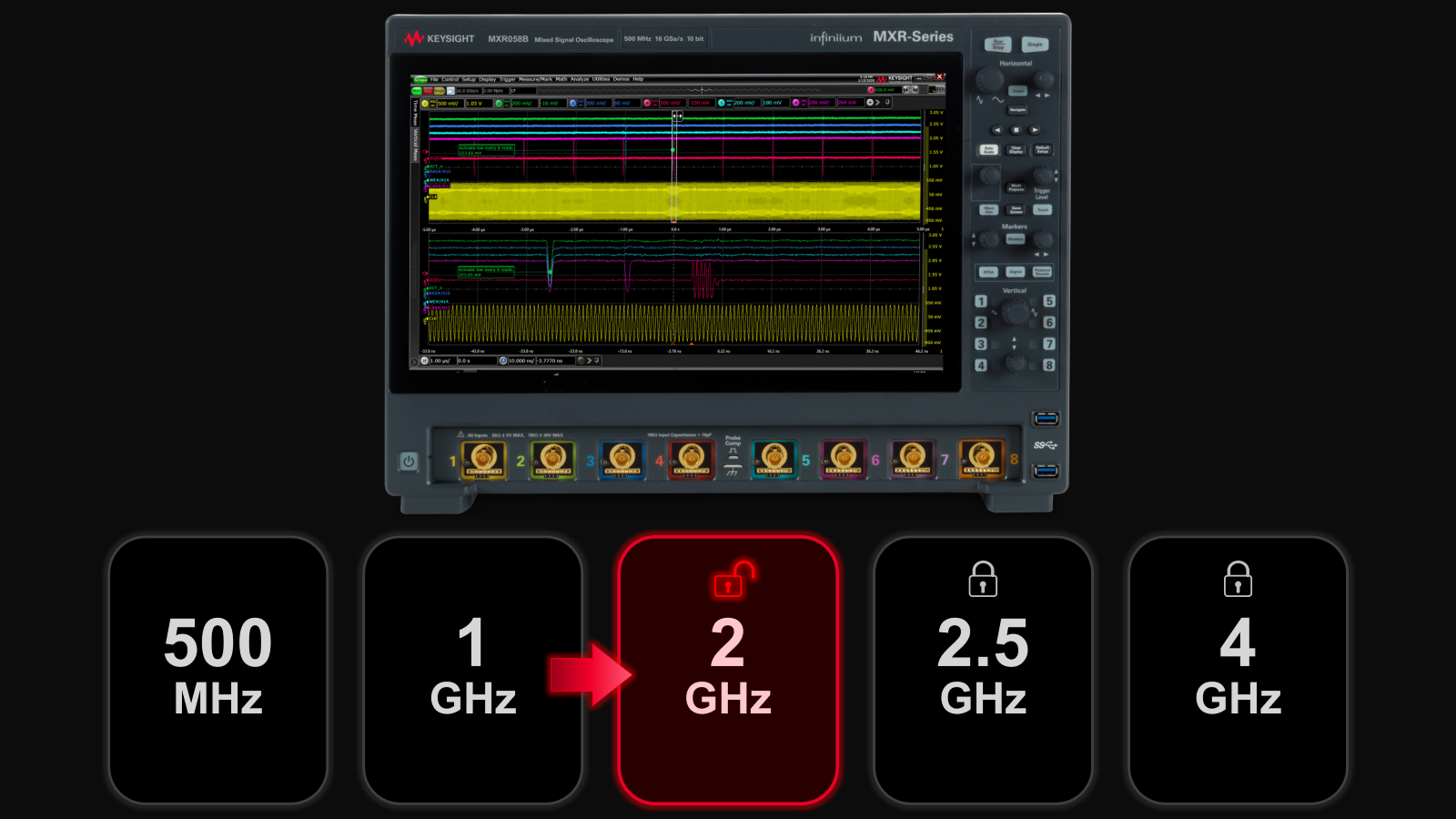
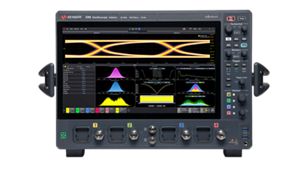
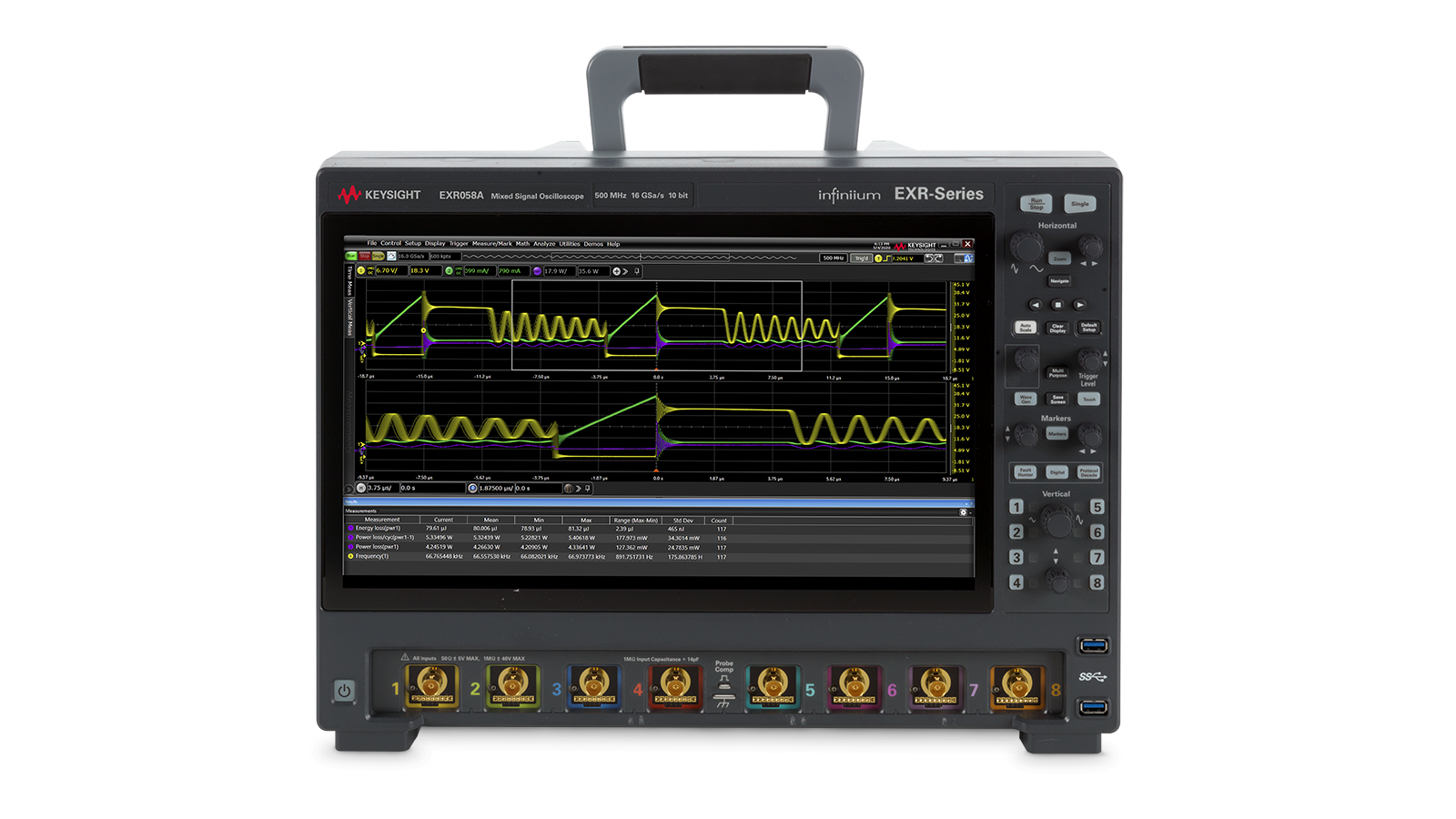
The Keysight XR6-class Expert oscilloscopes deliver up to eight analog channels versus four in our Essential / Advanced oscilloscopes. The MXR oscilloscopes provide eight instruments in one with the addition of a real-time spectrum analyzer, ideal for testing complex applications like 5G multiple-input / multiple-output (MIMO), radar, or satellite communications. As your needs evolve, you can upgrade your Expert oscilloscope remotely with a new license key, avoiding any downtime or the inconvenience of returning it to the factory. Choose one of our popular configurations or configure one specific to your application. Need help selecting? Check out the resources below.
High-channel density
Analyze up to eight analog channels simultaneously, plus up to 16 additional digital channels.
Automated fault detection
Evaluate your signal’s characteristics against user-definable criteria, quickly finding and saving errors for your review.
Powerful test applications
Select from a robust suite of powerful software for signal integrity, power integrity, protocol decode, RF, and compliance testing.
Field upgradeable
Upgrade the bandwidth, memory, and channels you need anytime with a simple license key.
-
Maximum bandwidth
500 MHz to 6 GHz
-
Analog channels
4 to 8
-
Digital channels
16
-
Maximum sample rate
16 GSa/s
-
Maximum memory depth
1.6 Gpts
-
Display size
15.6 inch
-
ADC resolution
10 bits
-
DDC RTSA
Varies
-
Brands included
EXR Series, MXR Series
Most popular configurations
XR6-class Oscilloscope

XR6-class Oscilloscope
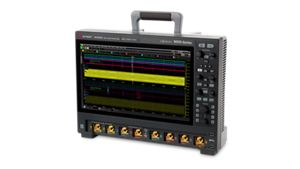

XR6-class Oscilloscope
Services and support
Innovate at speed with curated support plans and prioritized response and turn-around times.
Get predictable, lease-based subscriptions and full lifecycle management solutions—so you reach your business goals faster.
Experience elevated service as a KeysightCare subscriber to get committed technical response and more.
Ensure your test system performs to specification and meets local and global standards.
Make measurements quickly with in-house, instructor-led training, and eLearning.
Download Keysight software or update your software to the newest version.
Frequently asked questions
Oscilloscopes are used in a wide range of industries, such as wireless communications, data center networking, automotive, and aerospace and defense, for analyzing electrical signals. Some of the most common applications of oscilloscopes include:
Signal troubleshooting and debugging
Oscilloscopes are used to diagnose issues in electronic circuits such as signal distortion, noise, and voltage drops. They can also be used to identify power supply issues like ripple and noise, which cause instability in devices.
Protocol decoding
Oscilloscopes can decode and analyze common serial bus protocols like I²C, SPI, UART, CAN, and LIN. The oscilloscope displays digital signals into higher-level information or meaningful data packets such as ASCII characters, hexadecimal values, or communication frames. Protocol decoding is especially useful in the debugging of embedded systems by displaying the decoded data alongside the waveform.
Signal integrity analysis
Signal integrity analysis is a critical step to designing a new product, troubleshooting an existing system, or verifying compliance with standards. An oscilloscope is used to assess signal integrity to detect signal distortion or degradation, leading to errors and failures in data communication systems. An entry-level oscilloscope can perform basic signal integrity checks by measuring rise time, fall time, and voltage levels. However, advanced signal integrity measurements of high-speed signals require a higher-performance oscilloscope like the Expert or Pro grades.
Compliance testing
Oscilloscopes are essential in verifying compliance to industry standards, ensuring the reliability, safety, and performance of products. For full compliance testing, it is recommended to use Expert or Pro oscilloscopes.
For example, in wireless communication systems, an oscilloscope is used to verify that transmitted signals conform to required standards like 5G / 6G, Wi-Fi, and LTE. Similarly, in high-speed data communication, an oscilloscope ensures compliance to standards like USB, PCIe, DDR, Ethernet, and more.
Memory depth is the amount of data an oscilloscope can store and display. The deeper the memory, the more information the scope will show you. This is important because it affects the resolution of the signal you’re viewing. The better the resolution, the more detail you will see in the signal.
A scope with shallow memory might only be able to store a few seconds’ worth of data, which might not be enough to really see what’s going on. But a scope with deep memory can keep hours’ or even days’ worth of data, letting you zoom in for a high-resolution view of whatever portion you’re interested in viewing.
Having a deeper memory can be helpful when you’re trying to track down an intermittent problem that only happens once in a while. Shallow memory might not capture the event at all, but deep memory will let you scroll back and look closely at what happened before and after the event.
A deep memory depth means that more of the waveform will be captured, while a shallow memory depth will only capture a small portion of the waveform. Deeper memory depths are useful for capturing complex waveforms, while shallower depths are sufficient for simple measurements.
Memory depth and sampling rate work hand in hand because the more samples you take per second, the more data you will have to store. As a result, scopes with higher sample rates often have deeper memory.
Using an oscilloscope with high-channel density allows for the simultaneous observation and analysis of multiple signals in complex systems. With multiple input channels, users can view different waveforms side by side, enabling them to capture interrelationships between signals, identify timing issues, and troubleshoot intricate circuits more efficiently. The Pro oscilloscopes offer up to 8 analog channels on a single oscilloscope, providing ample channels for analyzing various components or stages in a circuit at once, which is especially beneficial in systems with multiple interacting elements.
The ability to measure multiple analog signals simultaneously offers precise insights into signal behavior, such as voltage variations over time, phase shifts, and signal amplitude. Engineers can capture real-time data across different points in a system, helping to pinpoint problems like crosstalk, noise, or signal degradation. By having access to a larger number of channels, users can reduce the need for switching between individual inputs or requiring the use of multiple oscilloscopes, streamlining the testing process and enhancing productivity.
Incorporating 8 analog channels also improves the versatility of the oscilloscope in both design and diagnostic applications. For instance, engineers can analyze the operation of multiple components in parallel or compare signals in different parts of a circuit, making it easier to verify designs or detect faults across complex systems. This multi-channel setup is invaluable for applications like embedded systems, automotive diagnostics, and communication systems, where observing several signals concurrently is crucial for accurate analysis and decision-making.
If more than 8 analog channels are needed, MultiScope software can be found in certain advanced oscilloscopes. MultiScope provides even higher channel density by allowing users to connect multiple oscilloscopes to enable simultaneous displays of a high number of signals — sometimes up to 40 channels.