How to Measure Peak-to-Average Power Changes Over Time

Track Peak-to-Average Power Behavior
The relationship between peak and average radio frequency (RF) power can change as a modulated signal moves through different transmission intervals, operating states, or power conditions. A single average power value does not show how short-duration peaks behave relative to the underlying average level, while an isolated peak measurement does not indicate how representative that event is of the overall signal. Tracking both quantities provides engineers with a clearer view of how the signal's power characteristics evolve and whether changes in modulation or transmitter operation produce unexpected variations in peak-to-average behavior.
The measurement setup includes a peak and average power sensor connected to a compatible power meter and the RF signal under test. Engineers configure the measurement frequency, triggering, and timing conditions to observe the desired portion of the signal. Time-gated measurements can isolate selected intervals so that peak and average power can be evaluated under consistent timing conditions. Engineers can compare measurements across successive intervals or operating states to identify changes in peak-to-average ratio and determine whether transmitter power behavior remains consistent as signal conditions change.

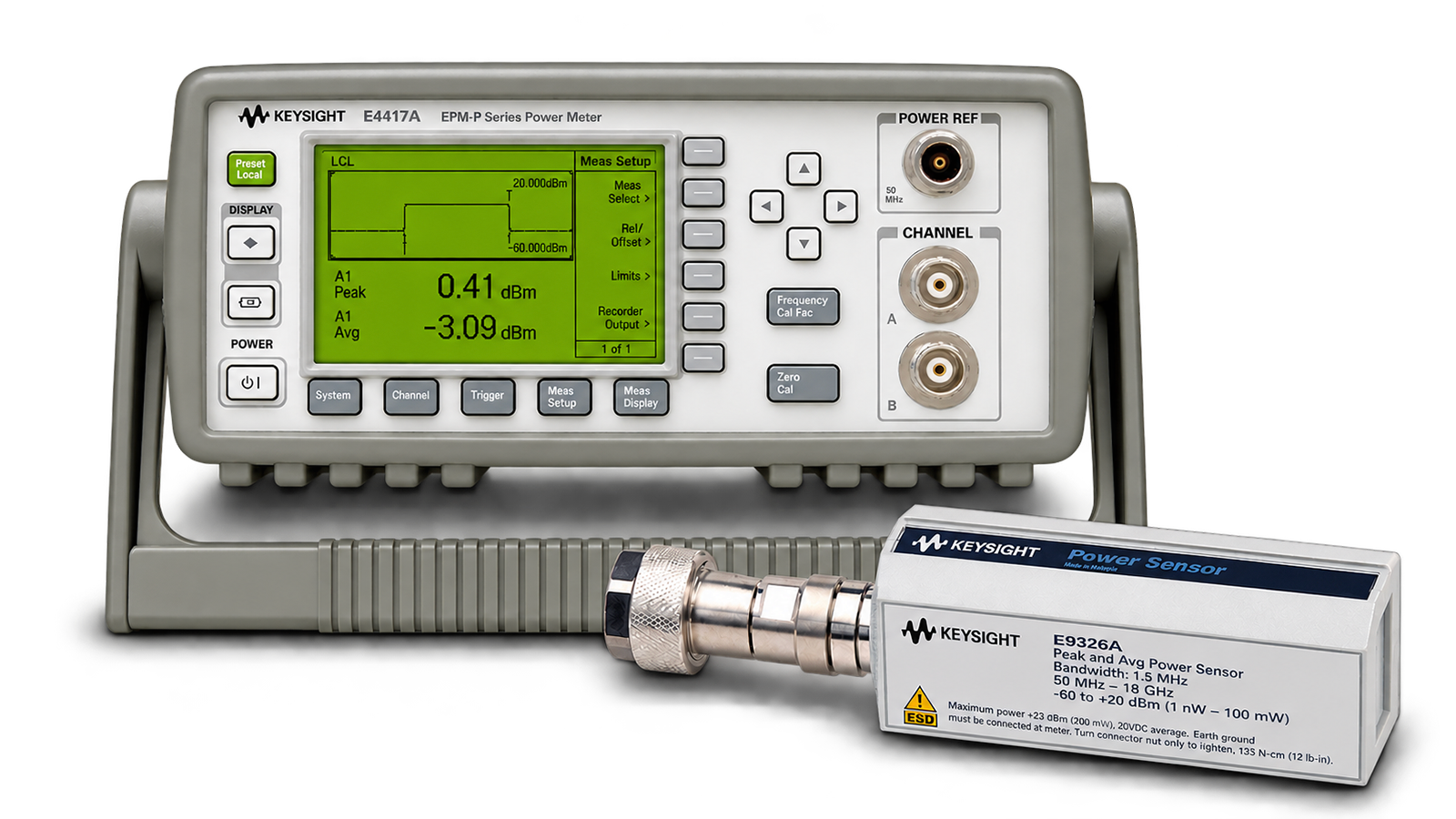
Time-Selective Peak and Average Power Measurement Solution
See Block Diagram of Time-Selective Peak and Average Power Measurement Solution


Explore Products for Our Time-Selective Peak and Average Power Measurement Solution
-


![]()
E4417A EPM-P Series Dual-Channel Power Meter
-
![]()
E9326A Peak and Average Power Sensor, 50 MHz - 18 GHz, 1.5MHz Bandwidth


Discover Resources and Insights
Additional Resources for Peak and Average RF Power Measurements
Related Use Cases


-
![]()
Learn More
How to Measure Millimeter-Wave Power Above 90 GHz
Measure millimeter-wave power above 90 GHz using a waveguide power sensor and compatible power meter for high-frequency component testing.
Learn More

-
![]()
Learn More
How to Perform Burst Power Measurement
Measure burst RF signal power using time-gated averaging with power meters, sensors, and automated control software for TDMA systems.
Learn More
-
![]()
Learn More
How to Measure RF Power During Rapid Amplitude Switching
Measure RF power during rapid amplitude transitions using a power meter, fast-response sensors, continuous acquisition, and automated measurement techniques.
Learn More

Get in Touch with One of Our Experts
Need help finding the right solution for you?