









- Overview
- All Models
- Support
Average power measurements for continuous wave and modulated signals
Keysight average power sensors provide precise, reliable power measurements for continuous wave (CW) and modulated signals, making them ideal for wireless communications, radar, and RF system validation. Unlike peak sensors, which focus on transient signals and high-speed detection, average power sensors ensure stable, repeatable measurements across all modulation types. With a wide dynamic range, fast measurement speeds, and seamless meter integration, these sensors deliver the accuracy needed for average power characterization.
Precision across modulations
Delivers consistent, high-accuracy power measurements across both continuous wave and complex modulated signal types.
Stable performance
Maintains consistent measurements over a broad frequency range without drift or variation for long-duration testing.
Balanced speed and accuracy
Captures up to 400 readings per second via GPIB, balancing speed with precision for efficient average power measurements.
Built-in calibration
Eliminates frequent zeroing and manual calibration with pre-stored reference data, reducing downtime and uncertainty.

-
Frequency range
10 MHz to 6 GHz, 10 MHz to 18 GHz, 9 kHz to 6 GHz
-
Power range
-60 to +20 dBm, -50 to +30 dBm, -30 to +44 dBm, -60 to +20 dBm (1 nW to 100 mW)
-
Connector type
Type-N
-
Measurement type
Average/CW only
-
Maximum power
20 dBm (100 mW) to 44 dBm (25 W)
Most popular configurations
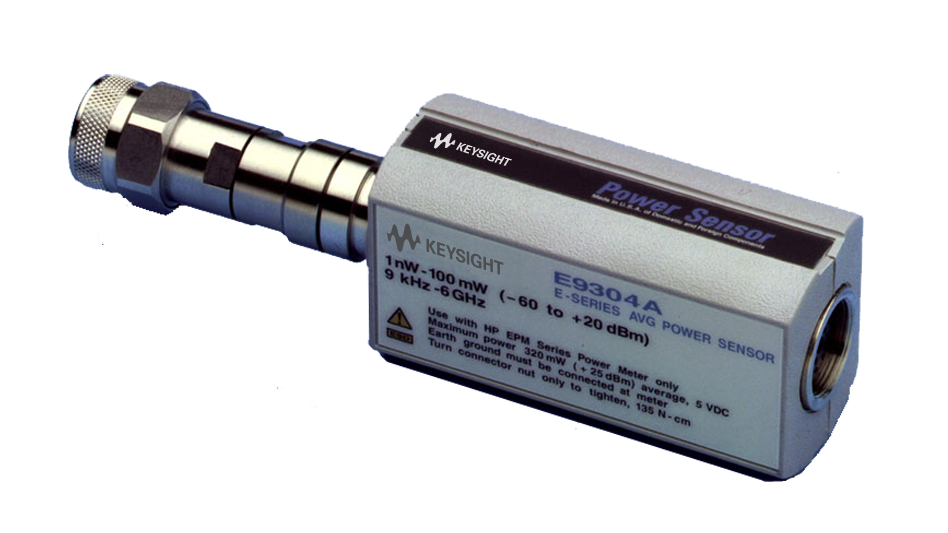
E-Series Average Power Sensor

E-Series Average Power Sensor
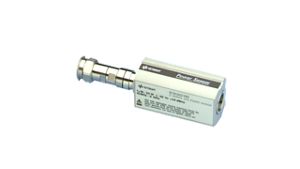

E-Series Average Power Sensor
Services and support
Innovate at speed with curated support plans and prioritized response and turn-around times.
Get predictable, lease-based subscriptions and full lifecycle management solutions—so you reach your business goals faster.
Experience elevated service as a KeysightCare subscriber to get committed technical response and more.
Ensure your test system performs to specification and meets local and global standards.
Make measurements quickly with in-house, instructor-led training, and eLearning.
Download Keysight software or update your software to the newest version.
Frequently asked questions
An average power sensor is an RF measurement device that quantifies the average power of a signal over a defined time interval, regardless of waveform complexity or modulation type. Unlike sensors designed to capture peak or time-varying behavior, an average power sensor delivers a scalar value representing the mean energy content of the signal. These sensors are commonly used in conjunction with power meters for validating transmitters, amplifiers, and RF systems. Because they integrate power over time, average power sensors are ideal for measuring signals with high crest factors or complex modulation schemes, such as those found in modern wireless and radar applications.
Most modern average power sensors from Keysight use a two-path diode detection scheme.
Here’s a breakdown of how the sensor operates:
1. RF Detection:
The incoming RF signal is coupled to a matched load, then directed into two detection paths:
- high-sensitivity path for low-level signals
- wide-range path for higher-level signals
Each path uses Schottky diode detectors to rectify the RF signal into a voltage that is proportional to the square-law region of the signal.
2. Averaging and Signal Conditioning:
The detected voltage is passed through a low-pass filter to average the signal over time.
This filtering process removes high-frequency envelope components, isolating the true average power.
3. Path Selection and Correction:
A microcontroller inside the sensor selects the optimal path based on signal level and applies correction factors for:
- temperature compensation
- frequency response
- detector non-linearity
This enables accurate readings across a wide dynamic range, depending on the sensor model.
Average power sensors are designed for accurate, repeatable RF power measurements across a wide range of industries and signal types.
Common applications include:
General RF Power Measurement
Measure average output power of continuous wave sources across frequencies from a few MHz to several GHz.
Modulated Signal Testing
Accurately capture the average power of complex modulations due to the sensor’s modulation-independent design.
Pulsed Signal Power Measurements
Perform time-gated average power measurements of pulsed signals such as radar bursts or TDMA communication frames, provided the pulse repetition rate fits within the sensor's video bandwidth.
Transmitter and Amplifier Testing
Characterize output power, gain compression, and linearity across different input levels and modulation conditions.
Automated Test Environments
Leverage fast measurement speed, SCPI command support, and external triggering to integrate into automated test systems for manufacturing and validation.
Frequency and Power Sweeps
Synchronize with signal generators or other instruments to perform power measurements over swept frequency or level conditions.