What are you looking for?
RSoft MetaOptic Designer
Inverse metasurface and metalens design tool for accurate, innovative results


Generate Optimal Metalens Designs Quickly and Efficiently
Metalens design traditionally requires extensive physics knowledge and many hours of development. RSoft MetaOptic Designer removes these roadblocks with inverse design capabilities that yield the best metalens designs. With MetaOptic Designer, you can take user-specified criteria and produce metalens and metasurface layouts for next-generation compact imaging, sensing, and display applications.
- Accelerate the creation of novel metalens designs with built-in engineering intelligence that supports designers of all levels.
- Generate accurate results with advanced optimization and simulation algorithms, validated by a rigorous finite-difference time-domain (FDTD) method.
- Significantly reduce design-to-validation cycles in a metaoptic design.
Easily Automate Advanced Metalens Design
Learn how MetaOptic Designer saves time and money by automatically generating metalenses and metasurfaces for optimal design performance. Designers of all expertise levels can create innovative metalens designs quickly and easily.
Key Features of RSoft MetaOptic Designer


Full automation
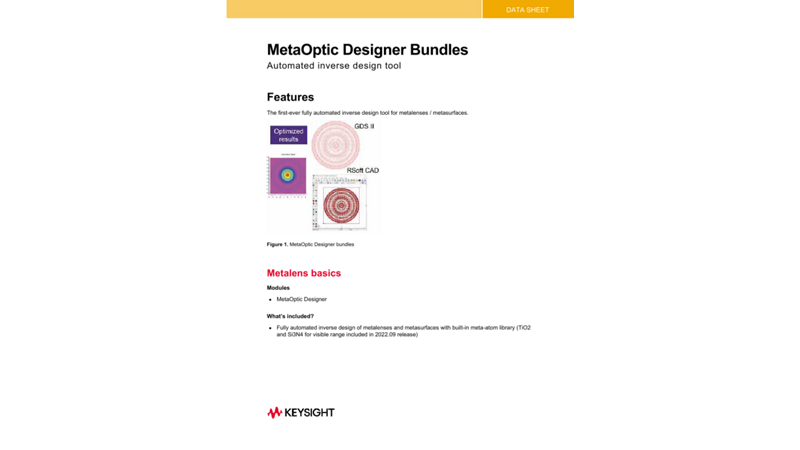
Automatically generate metalens and metasurface layouts, RSoft CAD files for simulation, and graphic database system (GDS) files for fabrication.


Inverse design approach
Find optimal metalens and metasurface geometries using inverse design algorithms to identify structures that meet user-specified targets.


Streamlined process
MetaOptic Designer requires minimal user inputs such as basic lens system configurations, incident conditions, target patterns, and meta-atom library settings.


Full-vector field solution
Advanced and robust simulation algorithms support full-vector field solutions in metalens structures and materials.
Need Support for RSoft MetaOptic Designer?
Explore Blogs






Featured Resources




RSoft MetaOptic Designer – FAQ
RSoft MetaOptic Designer is an inverse design tool that helps designers of all expertise levels optimize metasurface and metalens design. The software automatically produces the best metalens designs as fast as possible.
MetaOptic Designer helps drive innovation across applications such as compact imaging, sensing, and optical displays.
A metalens typically consists of millions of subwavelength unit cells called meta-atoms, which modulate light locally and coherently over the entire metasurface. The shape and size of each meta-atom is determined locally based on the metalens’ overall performance. Designing a metalens with millions of variables is a uniquely challenging task. Traditionally done manually, metaoptic design requires extensive experience and a deep understanding of fundamental physics.