












- Overview
- All Models
- Support
Streamline battery test lab management
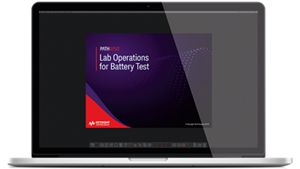
Keysight Lab and Production Operations software transforms the management and efficiency of complex battery testing environments. It optimizes lab throughput by providing an integrated, web-based platform that offers a 360-degree view of all lab resources, including test systems, test objects, software, and personnel. This central management enables efficient coordination of test sequences, minimizing test bench idle time and maximizing asset utilization. Furthermore, the software significantly improves data traceability by digitizing test workflows, centrally registering and tracking every step, result, and document from the initial order to the final report. This is especially impactful for test engineers in battery test environments across the value chain, from cell chemistry to module and full pack testing. Want to learn more about this solution? Explore the resources below.
Optimized scheduling
Enable efficient planning of resources, including test fields, test systems, and devices under test (DUT). This allows for optimized test scheduling, minimized idle time, and increased asset utilization.
Enhanced data traceability
Modernize test workflows by eliminating paper-based processes with a centralized system to register, track, and manage all test objects, results, and documents for full traceability.
Comprehensive lab visibility
An integrated, browser-based platform with a complete, real-time view of the entire lab operation to see the status of assets, software, running test plans, results, and reports from virtually anywhere.
Scalable remote management
The software is automated, networked, and highly scalable to support labs of any size, allowing for remote control and monitoring of the lab and its devices to enable flexible work arrangements.
-
Applications
Lab Management
-
Use cases
Battery test
-
Type
Lab Operations Software
Typical configuration
PathWave Lab Operations for Battery Test
Services and support
Innovate at speed with curated support plans and prioritized response and turn-around times.
Get predictable, lease-based subscriptions and full lifecycle management solutions—so you reach your business goals faster.
Experience elevated service as a KeysightCare subscriber to get committed technical response and more.
Ensure your test system performs to specification and meets local and global standards.
Make measurements quickly with in-house, instructor-led training, and eLearning.
Download Keysight software or update your software to the newest version.
Frequently asked questions
The key features for effectively managing resources in a battery test lab revolve around coordinating three main elements: hardware (assets), test items or devices under test (DUT), and personnel workflows. A dedicated lab operations software platform provides a centralized, web-based system to handle these interconnected resources. Here are the key features for managing resources:
- Test asset and hardware management: This focuses on optimizing the utilization and health of the equipment, including a 360-degree lab view, asset tracking, maintenance and calibration scheduling, and remote monitoring.
- DUT management: This is about tracking the batteries throughout their entire life cycle in the lab, including registration, traceability, and physical location tracking.
- Workflow planning and scheduling: This ensures maximum efficiency and throughput for the available resources, like test capacity optimization, lab orders and task management, and personnel role management.
- Data information management: This ensures the test data is handled efficiently and securely with a centralized data repository for data integrity, traceability, and reporting.
The key challenges in a battery test lab are centered on scaling complexity, managing massive data, and ensuring safety while maintaining high asset utilization. The rapid growth of the electric vehicle and energy storage markets necessitates testing thousands of battery cells, modules, and packs, which quickly overwhelms traditional lab processes. This increased volume creates a resource bottleneck, pressuring lab managers to optimize the scheduling and utilization of expensive test systems and climatic chambers to avoid costly investments in new hardware.
Furthermore, data management presents a massive hurdle, as each test channel generates immense volumes of high-speed, multi-channel data (voltage, current, temperature, etc.) that must be accurately collected, stored, and analyzed in a traceable manner. The absence of standardization across various test systems and software platforms compounds this issue, making it difficult to synchronize workflows and maintain data integrity throughout the testing lifecycle. Finally, given the high energy density and potential for thermal runaway, safety remains paramount; therefore, the test environment must be rigorously designed and remotely monitored to mitigate the risks of fire or explosion, which requires comprehensive safety protocols integrated into the testing infrastructure and software.
The hardware compatible with battery lab test software primarily consists of dedicated battery cyclers, power electronics, and various peripheral instrumentation, with compatibility largely depending on the software vendor and the lab's infrastructure. The central piece of hardware is the battery cycler (also known as a test system or battery analyzer), which performs the charge and discharge routines. Major battery testing software platforms are typically designed to integrate directly with the manufacturer's own cycler product lines.
Beyond the core cyclers, the software must be able to control and communicate with auxiliary lab equipment via standard communication protocols (like Ethernet, GPIB, or Serial):
- Environmental climatic chambers: For testing batteries under extreme temperatures or humidity, the test software must interface with chambers from manufacturers like Thermotron or Test Equity to synchronize the environmental conditions with the electrical test cycles.
- Safety and monitoring hardware: This includes dedicated safety controllers, smoke/fire detection systems, and specialized redundant measurement and control modules that provide an extra layer of safety independent of the main cycler.
- General-purpose instruments: For a complete setup, the software may interface with standard lab instruments, including oscilloscopes, digital multimeters (DMMs), data acquisition (DAQ) units, and source measure units (SMUs), which are used for additional measurements and verification.
- Load emulators: Devices like programmable DC electronic loads are often used with software to perform detailed load simulation and battery emulation.
Battery lab test software is highly scalable, primarily due to its modular and often cloud-based architecture, which is designed to manage the exponential growth in the number of batteries tested and the massive volume of data generated in modern development labs. Initially, a lab may start with a basic system controlling a few channels, but the software is built to scale to manage hundreds or even thousands of test channels simultaneously running different tests across multiple physical test stations. This scalability is achieved through a hierarchical structure: individual test benches use specific automation software to control the cyclers and auxiliary hardware (like climate chambers), and this local data is then fed into a central Lab Management System (LMS), often a web-based platform or a Laboratory Information Management System (LIMS).
This central software layer is the key to scalability, as it focuses on coordinating the entire lab operation, including intelligent scheduling to optimize asset utilization, managing workflows, and ensuring data integrity and traceability from test request to final report. As a lab grows, the software can simply integrate more hardware and use high-performance data architectures to handle the terabytes of high-frequency data collected. This scalable approach allows organizations to increase test throughput without compromising the quality or consistency of their results, which is essential for rapid battery development in the e-mobility and energy storage sectors.