Success Story

3.2T networks for next-generation AI data centers require 448G per-lane signaling, but PAM6 and PAM8 modulation make it hard to scale R&D. Combining Keysight's dual-module AWGs, NTT Innovative Devices' frequency-domain interleaver, and Lumentum's electro-absorption modulated laser, this test setup demonstrated 224 GBaud / 448G signaling at PAM4 for the first time.


448G / lane signaling at PAM4 - Keysight, Lumentum, and NTT Innovative Devices

Validating 224 GBaud PAM4 at 448G Per Lane

NTT and Lumentum Case Study Highlights

Leaders in Optics and Photonics

NTT Innovative Devices and Lumentum are leaders in photonic and optical technologies, which underpin next-generation AI data center interconnects. Together, their high-speed lasers, modulators, and advanced optical components enable the dense, power-efficient, ultra-high-bandwidth links required to move massive volumes of data between GPUs, servers, and switches. These capabilities are critical for scaling AI training and inference as data center networks push past 800G toward 1.6T and 3.2T.

PAM4 Channel and Connector Limitations

PAM4 signaling is widely used for high-speed data transmission because it encodes two bits per symbol using four amplitude levels. As signaling rates move beyond 200 GBaud / 400G per lane, reduced channel margin, connector loss, jitter, timing alignment, and equalization requirements become more difficult to manage. These constraints have driven research into alternative modulation formats such as PAM6 and PAM8, though those approaches introduce additional implementation and measurement complexity.

AWG-Based 448G Test Setup

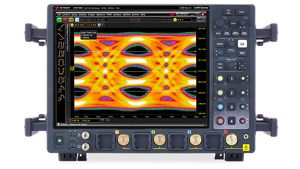
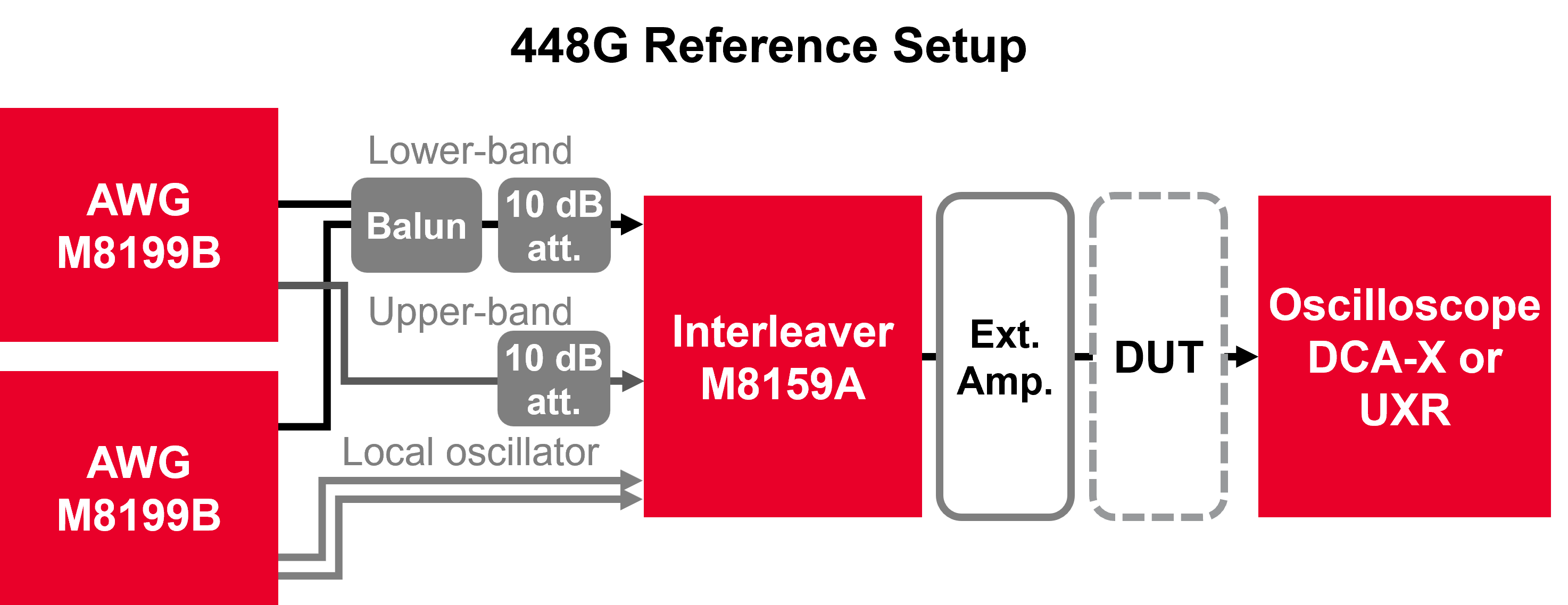
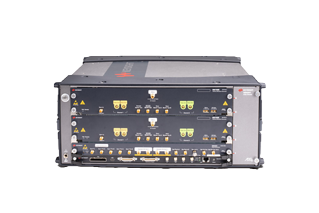
Lumentum and NTT Innovative Devices partnered with Keysight to generate and analyze 224 Gbaud / 448 Gbps signals at PAM4. Keysight provided two dual-module arbitrary waveform generators to generate the signals, which were then run through a frequency-domain interleaver developed by NTT Innovative Devices. The resulting output signal drove an electro-absorption modulated laser from Lumentum. On the measurement side, Keysight’s DCA-X and UXR series oscilloscopes enabled high-fidelity signal capture and analysis at extreme speeds.

Supporting 3.2T R&D for AI Networks

Keysight, NTT Innovative Devices, and Lumentum demonstrated a flexible solution that can implement 448G signaling in several different ways. This allows network equipment and component manufacturers to start building and testing future designs right away. At these speeds, every component needs to be developed and tested individually. With this test setup, R&D teams do not have to wait for custom chips to generate the required signals for testing.
Masahito Tomizawa, SVP and CTO at NTT Innovative Devices

"As AI data centers move to 1.6T, 3.2T and beyond, we’ve proven that PAM4 can remain a leading format, but we’ll continue to explore (...) advanced modulation formats like PAM6 and PAM8.”

Mahasito Tomizawa
SVP and CTO at NTT Innovative Devices

Explore Related Resources

×

Please have a salesperson contact me.

*Indicates required field

Select a preferred method of communication*Required Field
Preferred method of communication? Change email?
Preferred method of communication?

By continuing, you are providing Keysight with your personal data. See the Keysight Privacy Statement for information on how we use this data.

Thank you

A sales representative will contact you soon.