What are you looking for?
Optics for Kids
Concave vs. Convex Lenses
What Are Lenses?
Lenses bend light in useful ways. Most devices that control light have one or more lenses in them. Some use only mirrors, which can do most of the same things that lenses can do.


There Are Two Basic Simple Lens Types
Convex Lens
Convex or positive lenses will converge or focus light and can form an image.


Concave Lens
Concave or negative lenses will diverge (spread out) light rays.


You Can Have Mixed Lens Shapes, Too
Usually, light travels perfectly straight, until something bends it. The straight paths of light are called light rays. When you combine several convex or concave lenses, you can bend the path of the light.


Figure 1. See what happens to the light path when you combine several convex or concave lenses.
Simple or Complex Lenses?
Simple lenses can’t form very sharp images, so lens designers or optical engineers figure out how to combine the simple types to make complex lenses that work better. We use special computer programs to help us do this because it can take billions and billions of calculations.
Different devices use different types of lenses. Click the arrows to view a few examples.
Cell Phone


This device uses...


Camera


This device uses...


Mars Rover


This device uses...
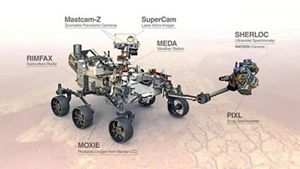

Source: https://www.jpl.nasa.gov/edu/resources/teachable-moment/meet-perseverance-nasas-newest-mars-rover/
Magnifying Glass: A Simple Optical Device


This diagram shows how a magnifying glass bends light rays to make things look bigger than they are. Many optical devices use the same basic idea of bending the light to fool your eye and brain so light looks like it came from a different (usually larger or closer) object.
See a cool demonstration of simple magnification from the Molecular Expressions website (opens a new window and requires a Java plug-in). You can move the magnifying glass up and down to see how the image changes.
Take a Quiz!
Lenses are everywhere and have a purpose. See if you can figure out which lens is used to...
1. Show a big picture on a screen?
2. See things that are far away?
3. See very small things?
4. See in the dark?
5. Capture images of things to see later?
6. Correct poor vision?


A) Telescope


D) Projector


B) Night vision goggles


E) Glasses


C) Camera


F) Microscope
1. D
2. A
3. F
4. B
5. C
6. E
Optics in Astronomy and Space Exploration
Optics has a long history when it comes to astronomy and space exploration. Galileo (1564–1642) was one of the first to use a small telescope to look at the Moon and other objects in the night sky and report his observations.
He discovered...
- That the Moon has mountain-like features
- That Jupiter has its own moons
- Dark areas on the sun, called sunspots
- That planets appear as small disks in telescopes because they are relatively close, while stars always look like points because they are so far away.
Better ground-based telescopes and special optical instruments such as spectrometers enabled people to discover many secrets of the universe. We continue to use and improve upon ground-based telescopes and scientific optical instruments even today.


Since 1957, optics has also been an important part of the Space Age, starting with ground-based telescopes used to track rockets and satellites. Soon after, scientists developed Earth satellites with cameras, telescopes, and other optical instruments, many to look back at Earth, and many more to look at the stars and planets. A little later, the U.S. and what was then the Soviet Union also started to send spacecraft out of Earth orbit to visit the Moon, Venus, Mars, and eventually even Pluto. In 2015, NASA's New Horizons probe was the first spacecraft to fly by Pluto and its moons.
The Hubble Space Telescope is perhaps the most famous space-based optical system, and several engineers at Optical Research Associates (ORA, which is now part of Keysight) actually worked on the design and other aspects of the repair optics. ORA even won a NASA Public Service Group Achievement for this and other space-related work. See this website to learn more about how the Hubble works.
NASA launched another telescope, the James Webb Space Telescope, in 2021. It orbits the Sun and is able to detect and study faint galaxies in the early universe like no instrument before it. In our own galaxy, it can penetrate the visibly opaque dust and gas of stellar nurseries and probe the atmosphere of exoplanets.
If you are interested in learning about other planets, perhaps we'll learn more from the Mars rovers. We take pride in the fact that the Keysight optical engineering team designed the Mastcam-Z zoom lens for the Mars Perseverance rover that landed on Mars in February 2021. The Mastcam-Z instrument functions as the rover’s mast-mounted scientific “eyes.” The “Z” in Mastcam-Z stands for “zoom.” It represents a milestone in the history of space exploration: it’s the first zoom lens system to be included on a deep space instrument.


Next Topic: What Are Lasers?


Continued Learning




Want help or have questions?