What are you looking for?
Defense and Critical Systems Security and Supply Chain Solutions
Validate mission-critical device security at the system level.
In modern defense and aerospace programs, security is no longer a single phase of development — it’s a continuous discipline that spans the entire product lifecycle. Systems must be secure by design and resilient throughout operation, even as adversarial capabilities evolve. At the same time, teams face increasing timeline pressures to design, validate, and field mission-ready systems faster than ever.
From avionics and maritime autonomous systems to secure communications and cryptographic processors, suppliers must demonstrate resilience against sophisticated attacks and meet national security requirements. With rising threats, proactive validation is key to mission success and compliance. Keysight empowers organizations with tools and expertise to verify system behavior under real-world conditions and deploy reliable, high-assurance components while meeting mission and market demands.

Secure Critical Components and Platforms
Keysight provides testing solutions and methods to secure defense and aerospace systems, including:


Avionics and flight control systems
Harden critical navigation and communication components.


Satellites and space systems
Protect electronics against radiation-induced faults and targeted interference.


Secure communications and encryption devices
Verify the robustness of key-handling and cryptographic functions.


Critical infrastructure operational technology (OT)
Safeguard components used in power grids, ports, and transportation.


National supply-chain resilience
Validate and certify components that must maintain trust end-to-end.
Addressing Hidden Risks in Critical Supply Chains
Defense and critical infrastructure systems rely on complex, global supply chains and long development cycles. Each new dependency introduces uncertainty: suppliers can’t always be fully verified, IP and firmware may be exposed, and undiscovered vulnerabilities can delay deployment. At the same time, the risk of hidden backdoors demands stronger, evidence-based assurance.
For teams managing complex supply chains, Keysight solutions enable organizations to:
- Validate suppliers and components through site audits, authenticity checks, design conformance analysis, and second source testing.
- Enhance transparency across tiers by verifying hardware and firmware integrity and illuminating dependencies.
- Adopt evidence-based practices consistent with EO 14028, NIST SP 800-30, 800-37, 8270, and ISN 2023/9 to strengthen supply chain resilience.
Security Advisory and Compliance Services
Keysight provides services that help organizations validate security across the supply chain, accelerate certification, and build in-house expertise — enabling faster, more confident deployment of trusted systems into mission environments.
Vulnerability Analysis
Keysight helps design teams establish a clear risk picture and set priorities.
- Define the relevant threat and risk assessment (TARA) profile.
- Review design documentation and architecture.
- Conduct workshops with product security stakeholders.
- Deliver updated asset inventories, threat and risk analyses, and SBOM/HBOM/CBOM improvements.
- Recommend and prioritize targets for security testing.


Test Planning and Security Testing
We evaluate device resilience against the most relevant attack vectors for mission-critical hardware, using advanced techniques such as side-channel analysis, fault injection, and testing of debug interfaces and cryptographic implementations. Our methods assess resilience against the highest levels of threat sophistication, providing actionable risk insights and faster progress toward supplier assessments and certifications.


Supplier Security Audits
Keysight provides site audit services to evaluate the security and process assurance of all locations involved in a product’s lifecycle. As an accredited site auditor under the Common Criteria (ISO/IEC 15408) scheme, Keysight applies internationally recognized frameworks to help organizations demonstrate compliance and strengthen their security posture.
Deliverables:
- Site Audit Plan
- Site Technical Audit Report (STAR)
- Findings and mitigation roadmap


Build Your Next-Gen Device Security Test Lab
Design a flexible, scalable, and future-ready security lab tailored to your embedded system needs. Whether you’re testing for compliance, evaluating resilience to attacks, or securing devices before deployment, our modular solutions let you run targeted campaigns from pre-silicon to post-silicon.
Your lab evolves with your mission, adapting to new device types, threat models, and skill levels. Choose the right tools and techniques to meet your goals, whether you’re building from the ground up or enhancing an existing environment.

How it works
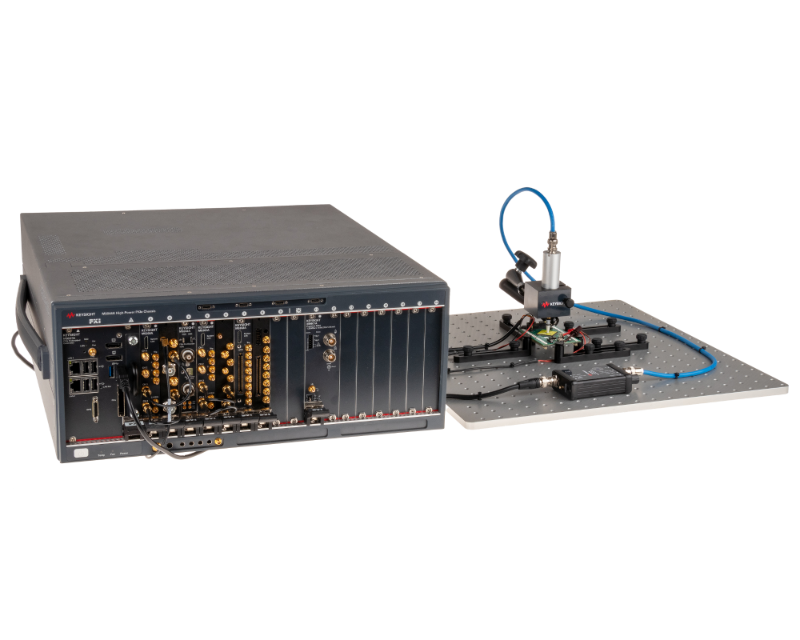
A robust device security test lab typically includes three core components:
- The Target: The embedded system, chip, or smart card under evaluation.
- The Hardware: Tools to capture physical traces while the target operates.
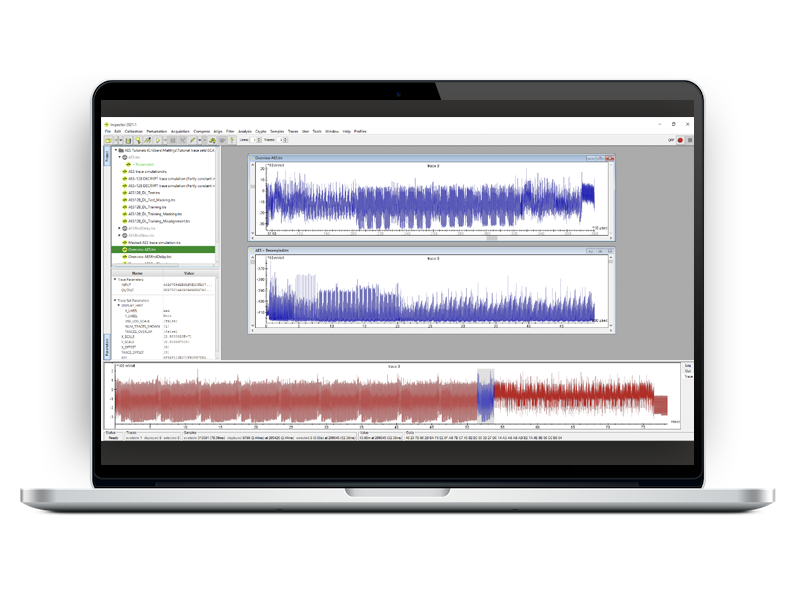
- The Software: Keysight Inspector — an analysis platform that interprets traces using Side Channel Analysis (SCA) and Fault Injection (FI) techniques.
What You’re Testing
Your Device Under Test (DUT), also known as the Target of Evaluation (TOE), can be any embedded system, chip, or secure element. Our solutions support testing across a wide range of form factors and abstraction levels, from pure hardware to low-level software such as firmware and secure boot.
Start testing:
- SoCs (System on Chip)
- FPGAs (Field-Programmable Gate Arrays)
- ASICs (Application-Specific Integrated Circuits)
- Smart cards and secure microcontrollers
- Firmware and secure boot implementations
Capture the Signals That Matter
At the heart of your setup is the Embedded Security Testbench, a PXI-based solution that integrates seamlessly with your lab environment. Depending on your security objectives, you can extend the setup with specialized modules:
- Power/Clock Solution
Enables precise control and monitoring of power and clock signals. Supports both fault injection — by inducing voltage or timing anomalies — and side-channel analysis by capturing power traces, even from noisy targets. - Electromagnetic Solution
Allows non-invasive probing of EM emissions for side-channel analysis and enables EM-based fault injection to assess device resilience. - Optical (Laser) Solution
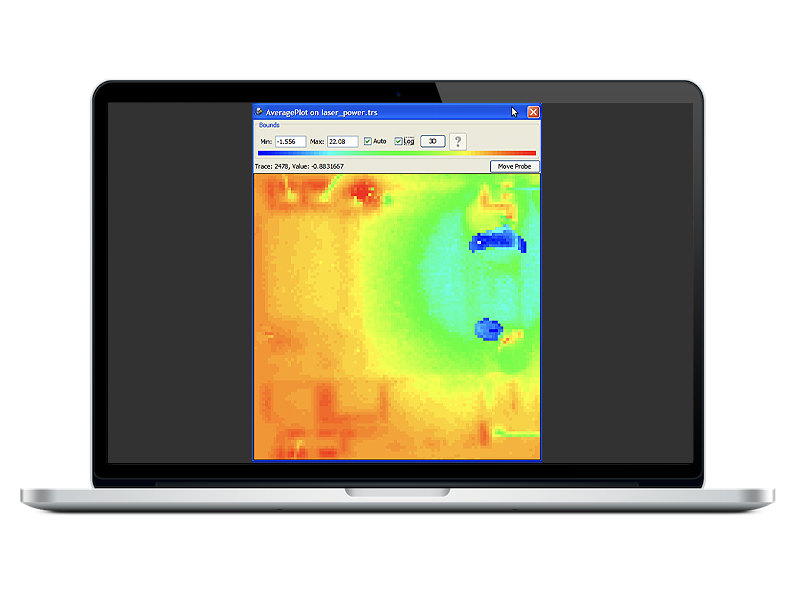
Uses high-precision laser pulses to target specific regions of a chip, inducing localized disruptions or studying physical leakage paths relevant to side-channel vulnerabilities.
Acquire, Analyze, and Secure
Keysight Inspector powers your analysis with advanced cryptographic analysis and fault injection capabilities. Supporting both Java and Python environments, it includes over 100 modules across:
- Acquisition and Signal Processing
- Advanced Cryptographic Analysis and Fault Injection Validation
- Communication and Perturbation Techniques
- Differential Fault analysis and Differential Power analysis
This enables proactive security validation across a wide range of embedded devices.
Training That Evolves With You
Every solution includes training to help your team start testing confidently. Additionally, we offer continuous learning options:
- Essential side-channel analysis and fault injection training for foundational knowledge
- Advanced programs tailored to your team’s experience and goals
All sessions are customized to your lab setup and threat landscape, ensuring your team stays ahead of evolving security challenges.
With You Every Step of the Way
From setup to day-to-day operations, Keysight provides:
- Comprehensive documentation
- Annual software updates
- Expert support and troubleshooting
- Real-world test cases to deepen your team’s expertise
Solutions Across The Hardware Lifecycle
Pre-silicon and FPGA designs
- Analyze RTL, gate-level, and FPGA designs for leakage using simulation and modeling tools.
- Assess third-party IP blocks for potential side-channel vulnerabilities and integration risks.

Prototype and board-level
- Run power and electromagnetic SCA using precision probes.
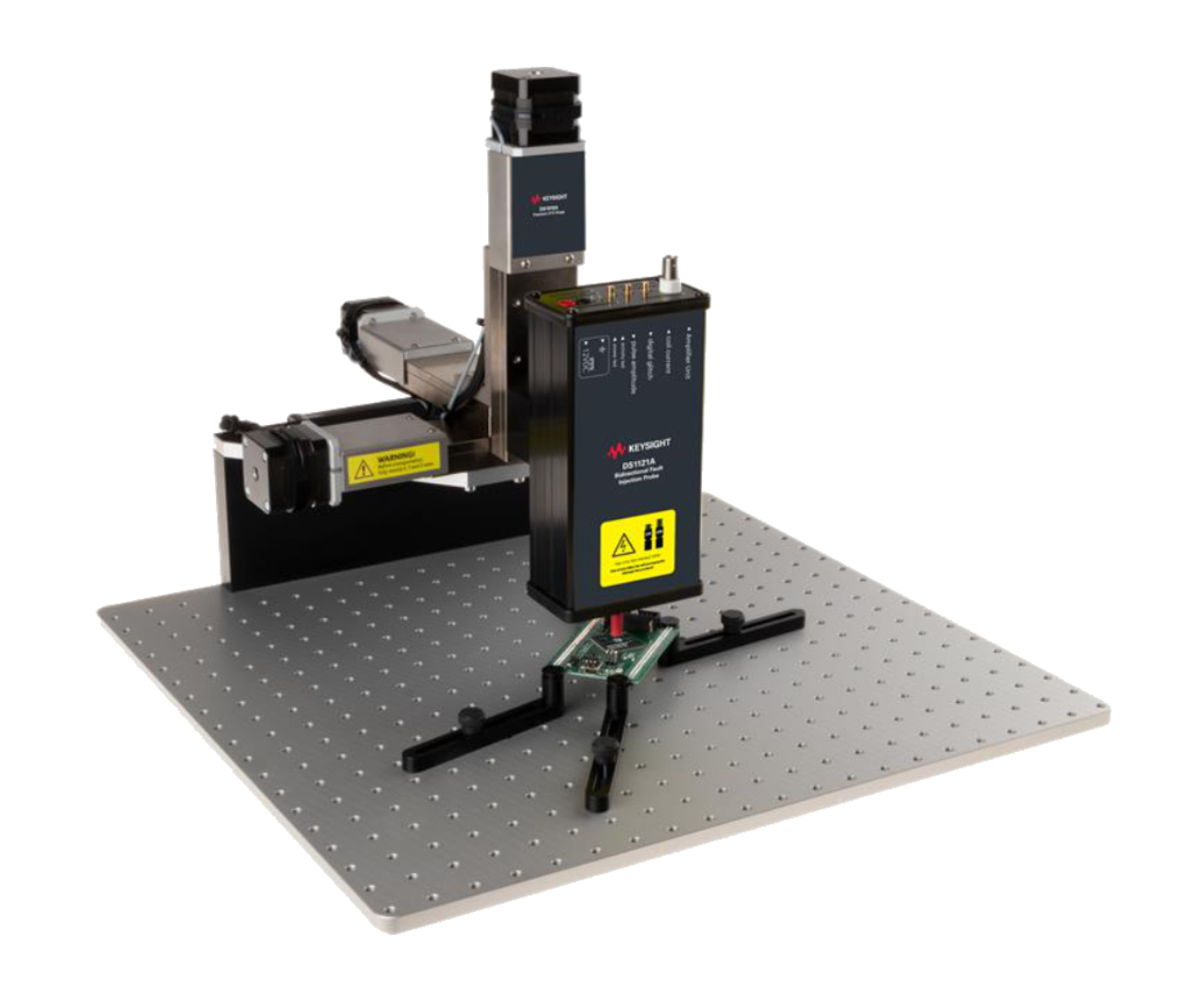
- Apply controlled fault conditions (including clock/voltage transients, EM pulses, laser-based perturbations) to measure fault tolerance.
- Perform fuzzing and negative testing on system interconnect buses to identify unintended or unsafe behavior.
- Target counters, cryptographic state machines, and secure-boot paths to validate resilience before system integration.

System-level testing
- Use Test Vector Leakage Assessment (TVLA) to detect statistically significant side-channel leakage, providing quantifiable evidence of cryptographic robustness.
- Validate resilience to real-world threats and demonstrate compliance.

Failure and forensic analysis
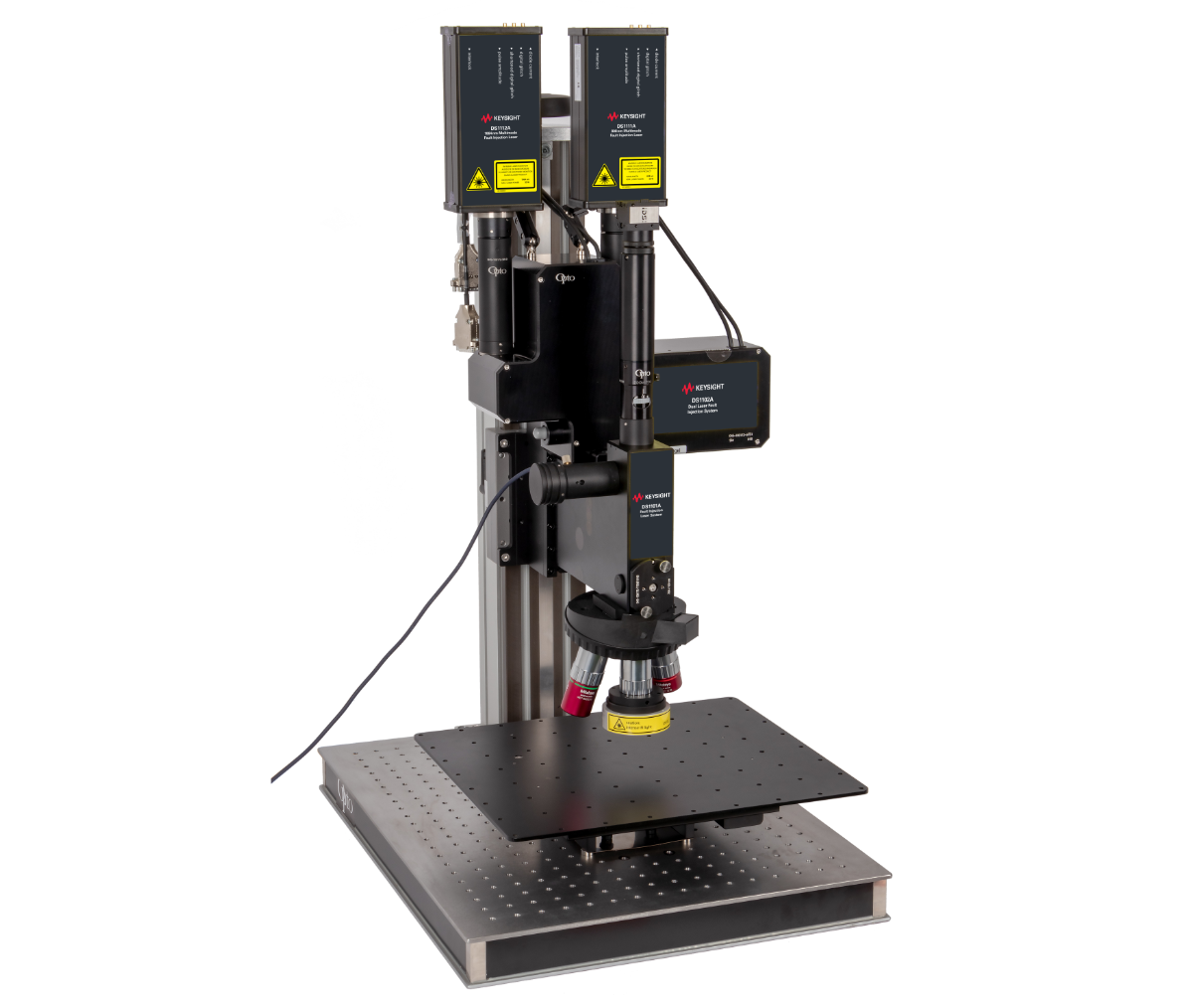
- Perform Laser Fault Injection (LFI) with precision XYZ stages and microscopes to analyze and reproduce hardware behavior at nanosecond resolution.
- Support failure analysis workflows by pinpointing weak points in silicon or packaging and correlating findings with field anomalies and security events.



Post-Quantum Cryptography Implementation Security
Hardware, firmware, and secure elements designed today will likely remain in service well beyond 2030, protecting sensitive communications and sovereign data that must remain secure for decades. While quantum computers capable of breaking current encryption may still be years away, governments and regulators are already setting the standards, timelines, and compliance requirements. For products requiring long-term protection, waiting to act carries its own cost — retrofits and redesigns become exponentially harder once platforms are deployed.
Emerging frameworks like CNSA 2.0 and EUCC and national cybersecurity directives define how systems must demonstrate quantum-resilient protection. Lack of preparation could delay or block market access, especially for high-assurance, regulated devices. Larger keys, new primitives, and resource-constrained endpoints raise complexity and the risk of side-channel and fault-injection vulnerabilities. Keysight helps teams implement PQC securely and efficiently with testing solutions, compliance expertise, and practical integration guidance.
Featured Resources






Want help or have questions?