














- Overview
- All Models
- Support
Optical source for next-gen communications research and conformance
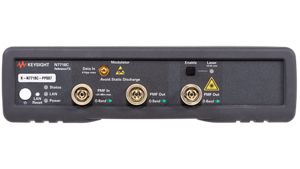
The Keysight XP5-class optical reference transmitter delivers stable, high-quality optical signals for accurate characterization of optical receivers and systems. Our reference transmitter converts high-frequency electrical signals from arbitrary waveform generators (AWGs) or pattern generators into ideal optical signals in a variety of modulation formats, useful for communications research and receiver conformance testing to optical standards. Choose a Keysight optical reference transmitter when you need a golden optical signal source for validating receiver performance. Request a quote for the Keysight reference transmitter today.
Optical receiver test
Simulate ideal and stressed optical transmitter behavior when paired with a high-symbol rate BERT as a key part of an optical receiver test solution.
High-bandwidth research
Generate optical signals at various modulation levels (up to PAM8) at 448 Gb/s for 3.2T pathfinding when paired with a high-bandwidth AWG.
Signal format variety
Suitable for any intensity-modulated signal format at rates above 120 Gbaud with built-in 1310 nm laser. Also compatible with tunable lasers for additional coverage.
Golden optical source
Used by standards bodies and test labs as the ideal signal source reference for receiver compliance testing.
-
Bandwidth
>60 GHz
-
Wavelength range
1260 nm to 1360 nm
-
Input power range
+8 dBm to +20 dBm
-
Output power
6
-
Fiber mode
Single-mode
Typical configuration
XP5-class Optical Reference Transmitter
Services and support
Innovate at speed with curated support plans and prioritized response and turn-around times.
Get predictable, lease-based subscriptions and full lifecycle management solutions—so you reach your business goals faster.
Experience elevated service as a KeysightCare subscriber to get committed technical response and more.
Ensure your test system performs to specification and meets local and global standards.
Make measurements quickly with in-house, instructor-led training, and eLearning.
Download Keysight software or update your software to the newest version.
Frequently asked questions
An optical reference transmitter is a precision optical signal source used to generate clean, standards-compliant optical waveforms for testing and validating optical receivers. Often referred to as a “golden transmitter,” it plays a critical role in ensuring consistent and repeatable test conditions, especially in R&D, compliance validation, and high-speed optical transceiver testing.
Unlike a general-purpose light source, a reference transmitter converts high-speed electrical signals, typically from an arbitrary waveform generator (AWG) or bit error rate tester (BERT), into well-defined optical signals that emulate real-world or ideal transmitter behavior. It enables engineers to assess receiver sensitivity, jitter tolerance, and compliance with standards like IEEE 802.3 or OIF-CEI.
Both an E/O converter and a reference transmitter convert electrical signals into optical signals, but they are built for very different purposes.
An electrical-optical converter is a general-purpose device often used for basic optical signal transmission, data links, or system prototyping. It may lack the bandwidth, signal fidelity, or waveform shaping needed for high-precision testing.
A reference transmitter, by contrast, is engineered for optical receiver testing and standards compliance. It produces clean, calibrated, and reproducible optical waveforms with precise control over parameters like extinction ratio, jitter, optical eye shape, and modulation fidelity. These devices are designed to replicate both ideal and stressed conditions, making them indispensable tools in formal conformance testing and optical receiver characterization.
Selecting the right optical reference transmitter depends on matching its performance characteristics to the requirements of your receiver test setup, modulation format, and compliance standards. Here are the key specifications you should evaluate:
- Bandwidth: The transmitter’s electro-optical bandwidth determines how fast a signal it can accurately convert from electrical to optical. A 60 GHz bandwidth is ideal for supporting high-speed formats like PAM4 at 112 Gb/s per lane or coherent modulation schemes used in 800G and 1.6T systems. High bandwidth ensures the optical output preserves the fidelity of fast rise/fall times, spectral content, and modulation characteristics from your AWG or BERT.
- Wavelength range: This defines the operating spectral region of the optical transmitter. The O-band (1260–1360 nm) is commonly used in short-reach datacom applications, including intra-data center links and low-latency interconnects. Choosing a transmitter within this range ensures compatibility with O-band transceivers, photonic integrated circuits (PICs), and standards like 400GBASE-DR4 or 800GBASE-DR8.
- Input power range: This refers to the required electrical input signal power needed to drive the modulator in the transmitter. Ensure your AWG, BERT, or pattern generator can deliver signal levels within this range to achieve optimal modulation depth, extinction ratio, and eye quality. Driving the transmitter within its specified input range helps avoid under-driving (leading to weak signals) or over-driving (which can cause distortion or damage).
- Output power: This is the optical power level delivered to the receiver under test. A minimum output of +5.5 dBm provides strong, consistent optical signal strength, critical for measuring receiver sensitivity, BER, and jitter tolerance without introducing unnecessary variability. Higher power also gives more headroom for optical attenuation, enabling stress testing and margin validation.
- Fiber mode: The fiber mode indicates the type of optical fiber used for the transmitter’s output. Single-mode fiber (SMF) is required for long-distance, high-speed, and coherent applications where low dispersion and minimal modal noise are essential. Choosing a reference transmitter with SMF output ensures compatibility with telecom-grade receivers, datacenter transceivers, and precision test instruments operating in standardized SMF environments.
By selecting a reference transmitter that meets your bandwidth, wavelength, input/output power, and fiber interface requirements, you ensure accurate, repeatable receiver testing that aligns with industry standards and real-world performance expectations. This enables confident validation of next-generation optical systems across 400G, 800G, 1.6T, and beyond.
An optical reference transmitter is central to structured receiver validation workflows. It is typically used to:
- Generate a known-good optical signal: The reference transmitter converts a clean, high-speed electrical waveform generated by an AWG or BERT into a high-fidelity optical signal. This “golden waveform” represents a reference-quality input with known characteristics.
- Deliver a signal to the receiver under test: The optical output is connected to the DUT’s input. This allows engineers to evaluate how the receiver performs under controlled signal conditions, both ideal and stressed.
- Run performance and compliance tests: Using instruments like a bit error rate tester (BERT), oscilloscope, or receiver compliance software, you can analyze critical receiver parameters such as bit error rate (BER), eye mask compliance, jitter tolerance, and receiver sensitivity.
- Validate to industry standards: Reference transmitters are often used in standards-driven test plans, including those specified by IEEE, OIF, and ITU, to ensure the receiver meets interoperability and conformance benchmarks.
- Inject signal stress if needed: Many setups allow for stressed testing by adding ISI, jitter, amplitude noise, or bandwidth limitations at the electrical input. This helps assess how robust the receiver is in real-world operating conditions, beyond just ideal performance.