












-
Benchtop LCR Meters
Fundamental electrical measurements at your workbench

-
Handheld Capacitance and LCR Meters
Bench-level accuracy in a handheld test meter
-
Impedance Analyzers
High-performance benchtop impedance analyzers

Benchtop LCR Meters
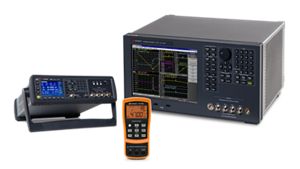
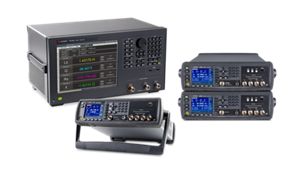
Keysight ZA2-class benchtop LCR meters include the E4980B Series which go far beyond fundamental impedance testing. They deliver highly precise and reliable measurements of passive components, supporting frequency ranges up to 3 GHz. Our benchtop LCR meters accurately measure a broad set of electrical parameters — including resistance, capacitance, inductance, and impedance — under a wide variety of test conditions, such as varying frequencies, signal levels, and bias voltages.

Handheld Capacitance and LCR Meters
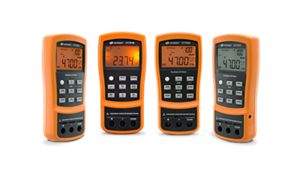
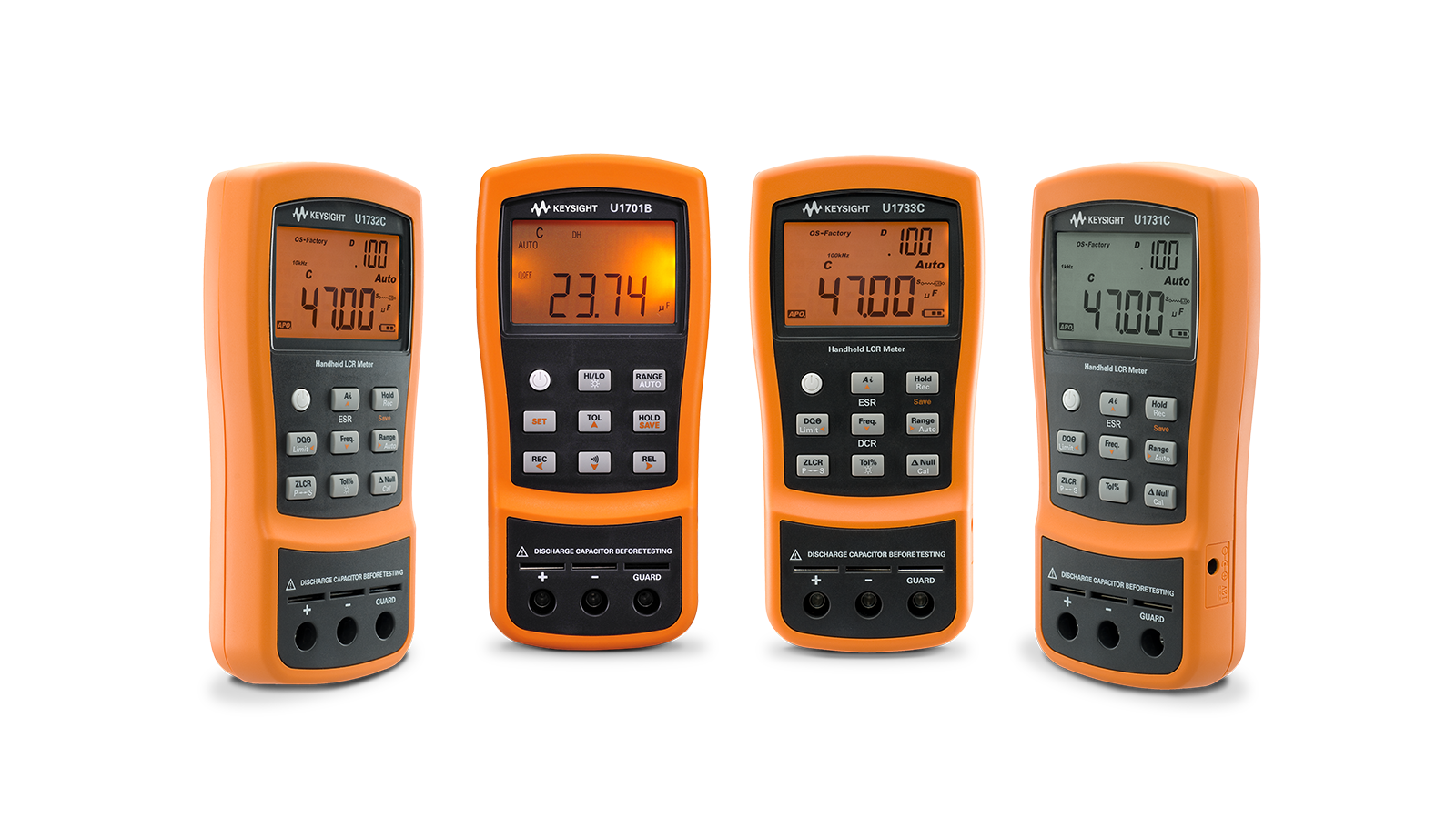
Keysight ZA1-class handheld capacitance and LCR meters include the U1700 Series. They combine portability with precision, offering reliable, easy-to-use measurements for on-the-go testing and troubleshooting. Designed for quick checks in the lab, field, or production floor, these meters provide fast response and accurate measurements of capacitance, inductance, and resistance. Compact yet capable, they support a wide range of component testing needs with dependable performance wherever your work takes you.
Impedance Analyzers
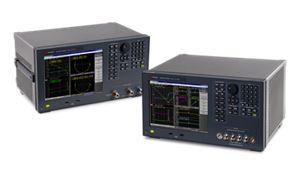
Keysight ZA5-class impedance analyzers include the E4990A Series. They extend beyond general-purpose LCR measurements to provide deeper insights into demanding applications like equivalent circuit modeling, high-frequency characterization, and materials validation. Compared to our benchtop and handheld LCR meters, our impedance analyzers deliver extended analysis functions and flexible biasing, ideal for analyzing complex materials and performing device characterization.

Find the LCR Meter and Impedance Analyzer for Your Application In Minutes
Find Compatible Software and Accessories
Expand the capabilities of your LCR meters and impedance analyzers with software that enables remote control, enhanced data visualization, and precise characterization of material properties or accessories like test fixtures, probes, and calibration kits.
Services and support
Innovate at speed with curated support plans and prioritized response and turn-around times.
Get predictable, lease-based subscriptions and full lifecycle management solutions—so you reach your business goals faster.
Experience elevated service as a KeysightCare subscriber to get committed technical response and more.
Ensure your test system performs to specification and meets local and global standards.
Make measurements quickly with in-house, instructor-led training, and eLearning.
Download Keysight software or update your software to the newest version.
Frequently asked questions
An impedance analyzer measures complex impedance across a range of frequencies to characterize components, circuits, and materials in detail.
It plays a critical role by enabling frequency-dependent analysis and resonance detection, supporting circuit modeling, and helping optimize signal integrity. This deeper level of insight allows engineers to better understand how devices and materials behave under varying conditions.
Impedance analyzers are widely used in research and development, validation, and advanced applications such as materials science and electrochemical analysis, where precision and frequency-dependent behavior are essential.
An LCR meter measures key electrical parameters of components using an applied AC test signal.
Its primary measurements include resistance (R), capacitance (C), and inductance (L), which define the fundamental electrical behavior of components. In addition to these, the instrument can derive parameters such as quality factor (Q), dissipation factor (D), and equivalent series resistance (ESR), providing deeper insight into component performance.
These measurements are essential for verifying component functionality, ensuring compliance with specifications, and maintaining quality in production environments.
The main difference between an LCR meter and an impedance analyzer is how they evaluate a component across frequency. An LCR meter is optimized for fast measurements at one or more selected frequencies, while an impedance analyzer performs continuous frequency sweeps and provides detailed graphical analysis of how impedance changes with frequency.
Both instruments apply an AC test signal and measure impedance-related parameters, including resistance (R), inductance (L), capacitance (C), impedance magnitude, phase, quality factor (Q), and dissipation factor (D). Their capabilities can overlap, but they are generally optimized for different applications.
An LCR meter is typically the better choice for:
- High-speed component testing and production-line inspection
- Pass/fail testing against specified limits
- Measurements at standard or user-selected frequencies
- Automated sorting and high-throughput validation
An impedance analyzer is typically the better choice for:
- Characterizing components, circuits, and materials across frequency
- Identifying resonant and self-resonant frequencies
- Viewing impedance magnitude and phase as graphical traces
- Equivalent-circuit modeling and impedance spectroscopy
- Research, development, and advanced failure analysis
Some modern LCR meters support list sweeps across multiple frequency points, so frequency capability alone does not define the instrument. The key distinction is that LCR meters prioritize measurement speed, simplicity, and production automation, whereas impedance analyzers prioritize continuous sweeps, visualization, and in-depth characterization.
Keysight offers both LCR meters and impedance analyzers, with measurement capabilities ranging from high-speed component validation to advanced frequency-dependent analysis.
Choosing between an LCR meter and an impedance analyzer depends on your application’s frequency requirements, the level of measurement detail needed, and the desired test speed.
For production or high-throughput testing, an LCR meter is typically the best choice due to its speed and simplicity. For research and development or applications requiring frequency-dependent analysis, an impedance analyzer provides the necessary depth and flexibility.
Key considerations include the required frequency range (fixed versus swept), whether graphical analysis or circuit modeling is needed, and the level of throughput and automation required. For applications that demand both speed and accuracy, modern platforms from Keysight integrate automation and ensure measurement consistency across different environments.
An impedance analyzer measures the complex impedance of electronic components, circuits, or materials across a wide range of frequencies. Impedance includes both resistance and reactance, and its behavior changes depending on the frequency of the applied signal. By analyzing the impedance, you can gain insights into a variety of electrical properties such as capacitance, inductance, dissipation factor, and quality factor. These measurements are essential for accurately characterizing passive components like capacitors and inductors, as well as evaluating materials used in advanced technologies.
Impedance analyzers are used in both research and production environments. During development, they can help you ensure proper impedance matching, optimize circuit performance, and troubleshoot signal integrity issues. In manufacturing, they play a key role in quality control by verifying that components meet required specifications. Impedance analysis is also used in fields like materials science, electrochemistry, and biomedical engineering.
Impedance represents the total opposition to alternating current (AC), combining both resistance and reactance, and is commonly expressed as Z = R + jX.
Resistance (R) is the real component that opposes current flow, while capacitance (C) stores energy in an electric field and inductance (L) stores energy in a magnetic field. Together, these parameters define how a component behaves under AC conditions.
Measurements are performed by applying a known AC test signal to the device under test and measuring the resulting voltage and current response. From these values, impedance is calculated and used to derive additional parameters such as resistance, capacitance, inductance, quality factor (Q), and dissipation factor (D). Modern instruments from Keysight automate these calculations with high precision across a wide range of frequencies.
LCR meters and impedance analyzers are used to test a broad range of electronic components and materials across multiple industries.
Common electronic components include capacitors, inductors, resistors, transformers, coils, and printed circuit board (PCB) elements. Beyond these, the instruments are also used in advanced applications involving semiconductor devices, dielectric materials, batteries, electrochemical cells, and sensors, including bio-impedance systems.
These measurements are essential for validating performance, ensuring product quality, and enabling innovation in industries such as automotive, aerospace, and electronics manufacturing.
Test frequency and bias conditions have a direct impact on impedance behavior and overall measurement accuracy, making them critical factors in any test setup.
Component values often vary with frequency due to effects such as parasitics and resonance, and selecting an inappropriate test frequency can lead to misleading results. Bias conditions also play a significant role; for example, applying a DC bias can alter capacitance or inductance in certain components, while the AC signal level can affect nonlinear device behavior.
To ensure accurate results, measurements should be performed at frequencies relevant to the intended application, with appropriate DC bias conditions applied as needed. Following standardized test methods, such as IEC guidelines, further improves consistency and reliability.
Accurate calibration and proper setup are essential for minimizing measurement uncertainty when using an LCR meter or impedance analyzer.
Common sources of error include fixture parasitics such as lead inductance and stray capacitance, cable losses and impedance mismatches, temperature variations, and improper calibration procedures. These factors can introduce significant deviations if not properly managed.
Measurement accuracy can be improved by performing open, short, and load corrections, using high-quality fixtures and cables, and maintaining stable environmental conditions. Following traceable calibration procedures is also critical. Advanced solutions from Keysight incorporate built-in calibration routines and error compensation techniques to enhance measurement confidence and repeatability.